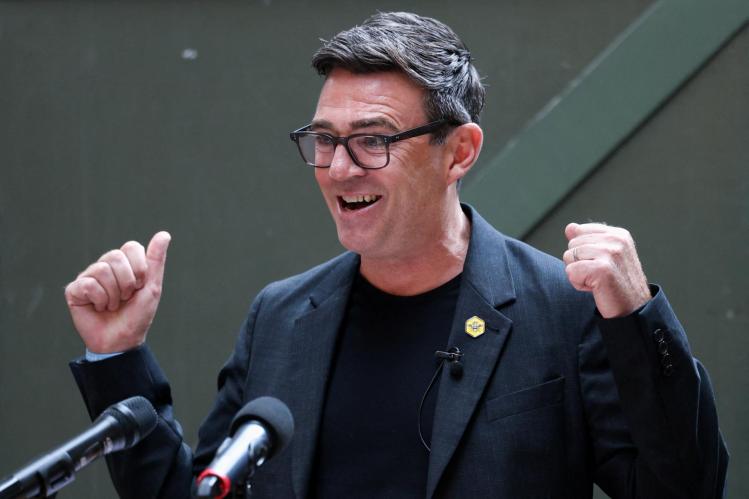
When Andy Burnham travelled from Manchester to London to become the United Kingdom’s sixth prime minister in ten years—the Brits used to laugh at Italy for this kind of thing—many watching his train as it was followed by helicopters couldn’t help but think of Lenin arriving at Finland Station to claim his destiny.
For almost a decade before the June election, Burnham had served as the mayor of the “northern” city Manchester, and that “northernness,” which needs some qualification, is very much part of his charism. Before that, as a member of Parliament for Leigh in Greater Manchester, he served in Gordon Brown’s administration as Secretary of State for Health and as Secretary for Culture, Media and Sport. At that time, he was booed at the twentieth anniversary of the Hillsborough disaster, a fatal crush at a 1989 soccer game in Sheffield at which ninety-seven Liverpool fans were killed and more than seven hundred injured. (The moment spurred Burnham to press for a full independent inquiry twenty years after the original one, which had put some of the blame on Liverpool fans. His urgency was heightened by the fact that he is himself a Liverpudlian, and from the same Catholic background that suffused everything the Beatles did.)
Burnham is a very rare Catholic British prime minister, if not strictly the first. But Boris Johnson’s Catholicism requires an asterisk, at best, and Tony Blair, formerly an Anglican, was only received into the Church months after leaving office. Burnham admits to having lapsed, though it seems he was an enthusiastic altar boy in his youth, and claims that much of his thinking on social justice, poverty, and inclusivity is influenced by Catholic social teaching. He was an admirer of Pope Francis but clashed with the Church on LGBTQ+ issues, which became a major feature of his Manchester administration as the identity wars rumbled. The only epiphanies Burnham has reported relate more to rock music—seeing the Stone Roses and particularly the Smiths at a time when Manchester had usurped London and Liverpool as the source of everything cool about Britannia.
What’s considered to be more important than his religion, which is almost a taboo subject in British public life, is the fact that Burnham is the first Labour Party leader from the Northwest of England since J. R. Clynes (even activists will ask “Who?”) in 1922. And here is the paradox. That train journey to London was seen by many as the apotheosis of “the North,” a powerful but fuzzy concept in Britain, proudly clung to by politicians, comedians, and rock singers, and made the basis of a governmental initiative (“The Northern Powerhouse”) to reposition economic development away from London and the Southeast. The goal was to restore former industrial giants like Manchester, Liverpool, Sheffield, and Leeds. Burnham seeks to take the measure one step further, promising to open a prime ministerial office in Manchester.
The irony is that Manchester is more “middle” than “north” in British Isles terms, and internal devolution has already taken place. Scotland is partly governed by its own parliament and civil culture, Wales boasts a now-turbulent Senedd, Northern Ireland is not to be spoken of, and many major cities are run by powerful mayors, like Burnham was himself. As his rail journey underlined, almost everything in Britain is north or west of London, and that includes mentality as well as geography. Burnham’s tabloid title of “King of the North,” which he does little to resist, has an odd ring.
After arrival and a quick change from the casual wear he favors (think cool English teacher) to a suit, he went to Westminster to meet two hundred Labour colleagues in the first phase of what has been routinely described as a coronation rather than a leadership contest. Extraordinary that a man who wasn’t even in Parliament a little more than a month ago should be party leader-by-acclamation only days later and, ipso facto, the new prime minister.
It has an almost Gerald Fordish quality, except Burnham is nimbler and lighter on his feet. His intellectual hinterland is not easily mappable, however. He admits that his Catholicism is a matter of formation rather than of active belief. He read English at Fitzwilliam College in Cambridge, a good school—famous alumni include Joseph Stiglitz, chief economist at the World Bank, and fellow economist and Nobel laureate Angus Deaton—but a college without the “glittering prizes” aura of some of its neighbors and those in Oxford. Burnham took a decent degree and has the happy turn of phrase that sometimes characterizes belle-lettrists. However, he claims to have felt like a “fraud” at Cambridge, which may be true, or may be a way of keeping his homelier credentials polished up.
What can Westminster expect of Burnham? He has nailed his colors to the mast in favor of what has become known as “Manchesterism,” a term appropriated from the nineteenth-century free-trade movement of John Bright and Richard Cobden. Burnham cowrote a book with another civic mayor called Head North, which set out an agenda for a “more equal Britain.” He will have his work cut out for him not to be accused of joining the London elite, who in the eyes of Northerners sustain almost as if by right the “North/South divide” that is believed to split Britain into haves and have-nots, the all too insistently heard and the unheard.
Burnham’s politics can be defined as business-friendly socialism. He came up at the time of Blair’s New Labour experiment, which was basically Thatcherism with a slightly friendlier face. Burnham counts his vote in favor of the Iraq war as one of his darkest and most shameful moments, and he has in other respects distanced himself from the Blair-Brown legacy. He has no need to distance himself from former Prime Minister Keir Starmer. Burnham’s laddish enthusiasm—he looks younger than his fifty-six years—obviously contrasts Starmer’s gray-man sincerity. One can imagine Burnham leaping up and down at a Stone Roses gig or invading the pitch at an Everton goal. Starmer’s anhedonic demeanor made former prime minister Teresa May’s admission that her naughtiest youthful act was running through a wheat field seem almost salacious.
What can Britain expect of Burnham? He made two previous bids for the Labour Party leadership, in 2005 and 2010, falling in the latter to Jeremy Corbyn, who ushered in a dark and unelectable iteration of modern Labour. So he has long been marked as a coming man, and an ambitious one. He has the reputation of being an inveterate people-pleaser, promising more than he can possibly deliver. Burnham can claim some success as Greater Manchester mayor, notably with the city’s once-chaotic transport system, but insiders are clear that the credit should go to his top staff. Even if one sees running a major city as a microcosm for running a country, Burnham will quickly learn that the same regional incongruences that form the basis of his deliberately unspecific manifesto will be the very ones that trip him up.
There are other factors, too. Interestingly, commentators on the British right, even when predicting a disastrous administration, do so with an element of sympathy, even pity, as when one watches a plucky lad step up, knowing he is going to be brutally knocked down. Burnham’s opponents sardonically predict that grasping the very thing he has pursued for twenty years will make him very unhappy indeed. The facts are that the British economy is in serious trouble. Chancellor of the Exchequer Rachel Reeves, who won’t be carrying on in the job in Burnham’s first Cabinet, has borrowed £140 billion in the last fiscal year. Added to the two previous years’ borrowing, there’s a dollar-equivalent $530 billion tab waiting to be “settled”—this at a time when the National Health Service is groaning under administrative burdens and there is an ever more pressing call to prop up Britain’s increasingly Ruritanian armed forces.
Whether Burnham has the formula to address any of this with conviction remains to be seen. How he will handle another heavyweight issue, relations with Donald Trump, could prove entertaining. He won’t be picking up Trump’s dropped papers or handkerchiefs, that’s for sure. He remains committed to support for Ukraine, but that is now an almost bipartisan position. The consensus remains that when the euphoria dies down and the “money’s all gone” notes are found in drawers, the job might crush even the buoyant Burnham. Which could leave him falling back on his beloved Smiths for solace. One lyric above all stands out: I was looking for a job, and then I found a job / And heaven knows I’m miserable now.
We welcome your comments about this article. Please send your response to [email protected].