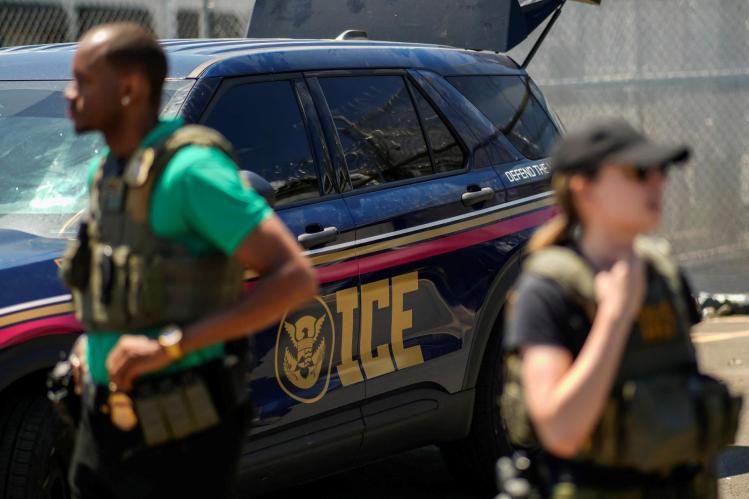
During morning rush hour in Chicago last week, ICE agents crashed into a bystander’s car while trying to detain a Venezuelan migrant. After tackling the screaming, shirtless man to the ground and handcuffing him, agents tased him, according to a local reporter and other witnesses on the scene. Then they used the taser and pepper spray to threaten bystanders who had gathered and started blowing whistles. In the chaos, an agent dropped a loaded magazine in the street.
The scene was reminiscent of last fall’s Operation Midway Blitz, the Trump administration’s massive immigration-enforcement campaign that resulted in the arrest and detention of thousands of migrants in the Chicago area—and which famously prompted a backlash from community residents who used whistles to alert neighbors to ICE activity. During that time, the suburban Broadview processing center also became the focus of protests, including by Catholics demanding pastoral and sacramental access to detainees.
The violent, aggressive tactics employed under U.S. Border Patrol Commander Gregory Bovino, which resulted in the killings of two citizens in Minneapolis, slowed after Trump replaced Bovino with border czar Tom Homan in January. Homan replaced Bovino’s strategy with lower-profile, more targeted arrests, rather than the previous, more visible sweeps. An estimated 580 people were detained in Chicago in the first two and half months of 2026, about the same number detained in just two weeks of Midway Blitz. National numbers have also declined, from an all-time high of about seventy thousand persons detained on any given day in December 2025 to about sixty thousand today. This still exceeds the average of forty thousand during President Biden’s tenure, or the roughly sixteen thousand detainees at the end of Trump’s first term.
The detention slowdown is just one of several victories that should be celebrated, studied, and learned from, say those who work in immigration advocacy. Thanks to the massive pushback, especially in Minnesota, the Trump administration was forced to admit it had overplayed its hand and that militaristic ICE raids are unpopular. Bovino and later Homeland Security Secretary Kristi Noem were sacked, masked agents were pulled back from targeted cities, and the war in Iran took over the headlines. Some groups have also had success challenging the Trump administration in court—for example, the Coalition for Spiritual and Public Leadership recently reached an agreement with ICE to be able to provide spiritual and pastoral care to Broadview detainees.
But these successes don’t change the goal of mass deportations, and Congress’s passage of a $70 million immigration funding package will mean the administration has plenty of money to ramp up arrests and detentions. “We cannot become complacent,” said Dylan Corbett, executive director of the Hope Border Institute, an El Paso–based research, advocacy, and humanitarian-action organization at the U.S.-Mexico border. “But we should not underestimate what happened: there was moral clarity and community engagement, and that changed the calculus of power.”
As the war on immigrants continues, it has expanded to target those legally in the country. Today, arrests are more likely to happen outside a courtroom than in the street, notwithstanding last week’s Chicago incident. Also, with a massive increase in 287(g) agreements, nearly a third of the U.S. population now lives in a county with local law enforcement deputized by ICE—making traffic stops and ordinary interactions potential sites of immigration enforcement. Critics say the program fuels racial profiling, violence, and civil-rights violations, while drawing law enforcement away from their communities and concentrating the Trump administration’s power.
The administration has also shifted to other less public and more subtle tactics to make legal immigration more burdensome. DACA renewals have slowed, and the administration recently announced a plan to force foreign nationals here legally to return to their home countries if they want to apply for a green card. Attention has also turned to the squalor inside detention centers, which many observers are accurately calling concentration camps. Detainees—including children, pregnant and nursing mothers, and the elderly—are held in inhumane conditions. Children have no access to education, facilities are overcrowded, and the sick often lack medical care. Deaths in detention have surged to record highs.
At Delaney Hall in New Jersey, a hunger strike by some three hundred detainees has entered its third week, while protests rage outside the facility. Detainees’ families describe substandard medical care, inedible food, and neglectful and sometimes abusive guards. The strike and work stoppage has also brought attention to the issue of forced labor by detainees, whose “jobs” cooking, cleaning, and doing other maintenance pay as little as $1 a day, saving the for-profit prison company GEO Group that operates the facility millions in overhead costs. The multibillion-dollar company has deep ties to the Trump administration, and its profits have nearly doubled in the first quarter of 2026, thanks primarily to federal contracts. Yet oversight of the facility has been difficult. Democratic New Jersey congresswoman LaMonica McIver is facing criminal charges for trying to conduct an oversight visit to the center last year. She urges officials to “follow the money” at Delaney, which receives $60 million per year from taxpayers.
Outside Delaney Hall, a Catholic sister has been ministering to detainees’ families at a “Radical Hospitality Tent” for the past year, offering coffee and doughnuts, toys for kids, and a listening ear. Susan Francois, a sister of St. Joseph of Peace, calls her work “an act of resistance” and posts a video to social media about her work each Sunday. The Catholic Church more broadly also continues other direct service to immigrants, including legal aid and material support, despite cuts in federal funding.
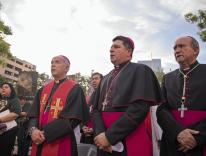
Religious leaders, communities, and activists must continue what they do well, but will need to do even more in response to the administration’s changing tactics. This includes more collaboration with other groups and across religious denominations. Catholic leaders, including Pope Leo XIV and the U.S. bishops, have been successful in challenging U.S. Catholics to see “welcoming the stranger” as an urgent question of conscience today. The bishops’ “special statement” last fall and the appearance of the three cardinals on 60 Minutes in April have broadened the reach of the Church’s witness.
But as the midterm elections approach, the Church must shift to more explicitly political strategies. The Dorothea Project, an online group of women devoted to spreading Catholic social teaching, undertook a letter-writing campaign to bishops urging them to update their voters’ guide to better reflect Church teaching, including on immigration. The bishops discussed “Forming Consciences for Faithful Citizenship” in private sessions at last November’s USCCB meeting; a brief update is on the agenda for the June 10-12 gathering in Orlando. The bishops have also unveiled a prayer service centered on migrants as part of the nation’s 250th-anniversary celebrations this summer, in what is perhaps a subtle rebuke to Trump’s semiquincentennial plans for a UFC fight on the White House lawn and a commemorative $250 bill bearing his own image.
Church advocacy must go beyond the bishops, however, and several groups have been busy doing grassroots organizing, including at the parish and diocesan levels. The Catholic Immigrant Prophetic Action Project, or Catholic IMMpact, has attracted sizable numbers of people to its local and regional trainings in Providence, Phoenix, and Detroit. In San Antonio, some 250 priests, deacons, and auxiliary bishops learned how their pastoral service to immigrants can be a steppingstone to more prophetic work. Collaboration with Catholic IMMpact, which is a partnership of Hope Border Institute and the Center for Migration Studies of New York, often leads to pastoral plans or letters, such as the missive “Be A Merciful Neighbor” from Bishop Steven Biegler of Cheyenne, Wyoming.
Corbett senses a hunger from everyday Catholics to bring the Church’s teaching on human dignity to bear in the public debate on immigration. According to a recent survey from the Pew Research Center, 41 percent of Catholics said clergy at their parish had spoken about immigration, and the message was more likely to be welcoming and supportive of migrants than not. That number is significantly higher than in white mainline Protestant and Evangelical churches. Corbett believes the key is converting pastoral witness and action into civic formation that ties immigration to the common good—and to the defense of democratic norms. “We’ve got to continue to build consensus, because there is going to be a moment when immigration reform is possible,” he said. “We’ve got to get prepared for that moment now.”
We welcome your comments about this article. Please send your response to [email protected].