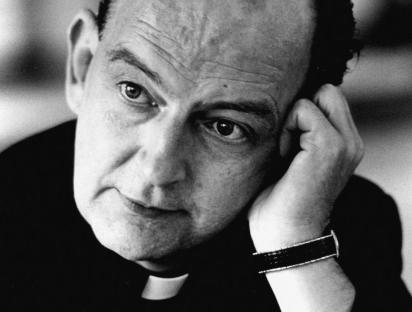
Ash Wednesday follows tradition, from the burning of ashes to the prayers of repentance to the Scripture readings. But Catholics have also adapted the liturgy to address the needs or crises of the particular moment, so as to challenge the faithful to prepare their hearts for the season of Lent. One such event took place in February 1972, at the site of a former cemetery honoring Black Civil War dead in Camden, New Jersey. It was led by Fr. Michael Doyle, part of what was then known as the “Catholic Left” or “Catholic Resistance”—clergy, religious sisters, former missionaries, and other Catholics who, over the course of six years, raided more than fifty draft boards and destroyed millions of files. Before a crowd of tightly bundled adults and children holding candles, he urged the gathered to lick the ashes as an act of penitence for the actions of the United States in the Vietnam War. The ashes he distributed were not from the burnt remains of palm fronds, but from a copy of the Pentagon Papers.
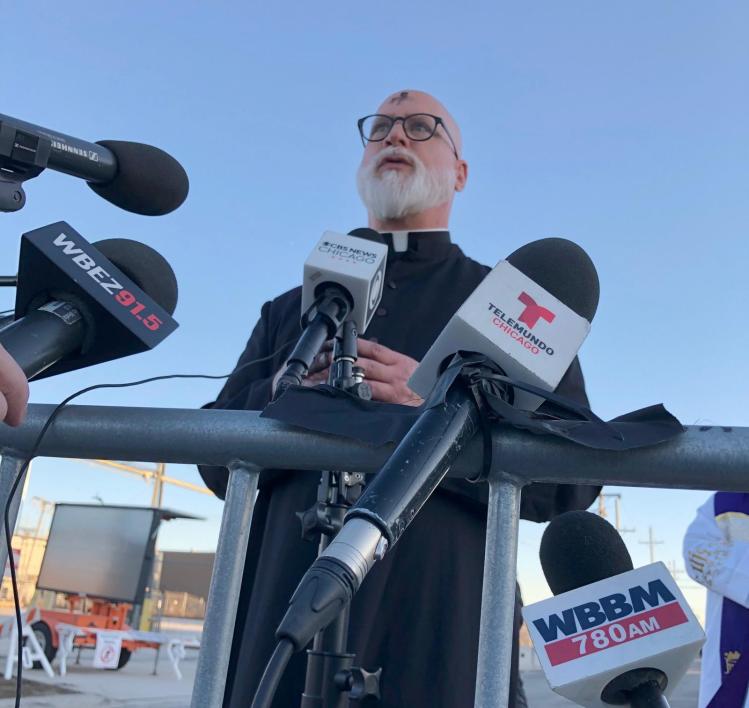
That gathering was on my mind last week when I received ashes at a Mass held outside Our Lady of Mt. Carmel Church in Melrose Park, Illinois, attended by some three thousand people. We were there in communion and solidarity with families facing the detention and deportation of loved ones. Among the more than twenty priests who processed outside the church was Fr. David Inczauskis, a thirty-three-year-old Jesuit and philosophy graduate student currently in residence at Loyola University Chicago. He was there as part of the Coalition for Spiritual and Public Leadership (CSPL), one of the event’s host organizations. Inczauskis was also the master of ceremonies at a Mass several months ago outside the Great Lakes Naval Base north of Chicago, which was being prepared as a base of operations for the Department of Homeland Security’s “Operation Midway Blitz” campaign.
The beginning of Lent arrived as a turning point for CSPL and people of faith who see the cruelty against migrants as a spiritual crisis. The yearly ritual of renewal marks a time of reflection and personal renunciation of comforts, when Christians meditate on Jesus’ forty days of temptation and privation in the desert. It calls us to abstain from luxuries and enter deeper into intimacy with Christ in his suffering. But we are also called to witness his Incarnation here and now in the faces of the most vulnerable.
The Camden Ash Wednesday Mass and similar gatherings of the later decades of the twentieth century offer lessons in how this form of Lenten observation can bring us deeper into the Body of Christ. CSPL’s work fits within a long legacy of communities using the form of liturgy to bolster solidarity and connection. In 1972, Fr. Doyle knew that the Mass would anger his bishop. But he was already awaiting trial, facing up to forty-seven years in prison or deportation back to Ireland, for breaking into the offices of a draft board. He asked the crowd to do more than pray, fast, and abstain; he urged them to “wear the Pentagon Papers” in atonement for the crimes they represented. He emphasized a sacred mandate to welcome the presence of the Holy Spirit through the eyes, nose, fingers, and tongue. “Taste the death they symbolize and take upon ourselves the burden of the guilt and do penance the rest of our lives for the destruction,” he said. This was not merely symbolic. It was an embodied ritual to honor the embodied Incarnation of the Holy Spirit. More than gestures and reenactments, sacramental acts are understood by Catholics as motions that convey God’s grace. They recognized the tasting of ashes and the destruction of draft files, like baptism and communion, as part of God’s presence in the world, on the earth, carried out by humans.
After the U.S. withdrawal in Vietnam and deescalation of violence on the Indochina Peninsula, this form of witness was carried on in the work of the Plowshares movement, which opposed nuclear arms. In 1980, Daniel and Philip Berrigan, along with six other activists, broke into a General Electric nuclear-missile facility in King of Prussia, Pennsylvania, where they damaged missile cones with hammers. In 1997, women and men of the Prince of Peace Plowshares action greeted Ash Wednesday by hammering and pouring blood on the USS Sullivan, a nuclear-capable American destroyer at Bath Iron Works in Maine.
But the liturgies unfolding over the past year are different from those predecessors because they bear witness to atrocities unfolding here on U.S. soil, to the authoritarian violence afflicting American cities, neighborhoods, schools, and businesses. And they are planned and hosted by those who live in the neighborhoods most affected. At Melrose Park, I spoke with Clarissa Aljentera, from the Archer Heights neighborhood of Chicago. She told me that she brought her seven-year-old to receive his ashes that evening because of the ICE raids in their neighborhood. She has been following CSPL’s work on social media, trying to help her son understand what’s going on. She takes hope from his recent declaration that he wants to grow up to be an immigrant lawyer so he can represent the kids at his school.
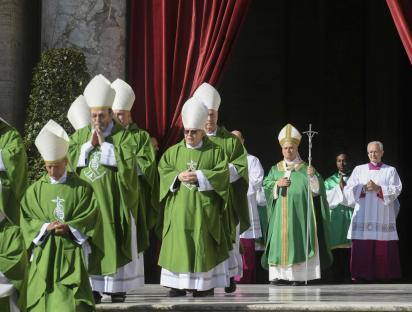
The Melrose Park event was notable as well for the fact that Chicago cardinal Blase Cupich celebrated. Unlike the 1972 Camden Mass, which was condemned by Church officials, last week’s gathering had the official approval of the archdiocese of Chicago, and came only weeks after Cupich and other leaders of the U.S. Conference of Catholic Bishops came out strongly against the Trump administration’s detention and deportation campaign. Cupich recited the Gospel of Matthew, where Jesus said, “Take care not to perform righteous deeds in order that people may see them…. Your Father who sees what is hidden will repay you.” In his homily, he directly addressed those without the protections of native-born status, particularly those confined to their homes out of fear of ICE. “This is for those of you in the shadows,” he declared. Jesus “sees you,” he continued. “He is with you in the secret place.”
The Mass came on the same day that the Department of Homeland Security finally complied with a federal court ruling that that clergy could no longer be denied access to the Broadview detention center in Chicago. CSPL and other faith leaders had been urging the government to grant them the opportunity to minister to the incarcerated for weeks. CSPL had also worked closely with families impacted by the raids to plan the liturgy for the Ash Wednesday Mass, drawing on its network of Chicago pastors to reach out to families and encourage them to take on roles in the ceremonies. Inczauskis felt called especially to that aspect of the preparation to make it, in his words, “a moment of healing and solidarity [by] denouncing the evils of what they faced, and then showing the strength of the Church.” (As the offerings were brought to the altar, migrant family members followed, bringing trays of items that represented their incarcerated or deported children, parents, aunts and uncles. The cardinal blessed them along with the sacraments.) CSPL received significant help from the Missionaries of St. Charles, also known as the Scalabrinians, who have served migrants and refugees around the world since 1887, and who have Melrose Park missions at Mt. Carmel and the parish of St. Charles Borromeo.
The Melrose Park Mass reminded me of how Ash Wednesday allows us to step out of ordinary time and allows celebrants to go off script. Prophetic moments call for words from the prophets. They shake us into an awareness of how comforts and luxuries come to us through larger social and economic forces that inflict hardship and suffering on others. My prayer for this Lenten season is that the momentum I see at these public outdoor Masses sparks a larger revival of spiritual solidarity.