“[T]he way of the cross is traced close to the earth. The mighty withdraw from it; they desire to grasp at heaven. Yet heaven is here below; it hangs low, and we can encounter it even when we fall flat on the ground. Today’s builders of Babel tell us that there is no room for losers, and that those who fall along the way are losers. Theirs is the construction site of Hell. God’s economy, on the other hand, does not kill, discard or crush. It is lowly, faithful to the earth.”—Pope Francis
Jorge Luis Borges, the brilliant Argentine writer, was famously agnostic but prayed the Lord’s Prayer every night to keep a promise he made to his mother. A friend of Jorge Bergoglio, later Pope Francis, Borges seems to have been, if not captivated, then at least intrigued by the enormous mystery of God’s redemptive work.
In one story, “Three Versions of Judas,” Borges introduces us to Nils Runeberg, a fictional theologian hell-bent on demystifying the “enigma of Judas.” Despite protests and ostracization from his colleagues in the academy, Runeberg publishes progressively more daring attempts to vindicate the Gospels’ central villain, Judas Iscariot. He finally concludes something truly unacceptable:
God became a man completely, a man to the point of infamy, a man to the point of being reprehensible—all the way to the abyss. In order to save us, He could have chosen any of the destinies which together weave the uncertain web of history; He could have been Alexander, or Pythagoras, or Rurik, or Jesus; He chose an infamous destiny: He was Judas.
Runeberg falls into disgrace, but he believes that his conclusion is a revelation too terrible to be false. It was the most obvious fulfillment of Isaiah’s prophecy: the Messiah “had no form or majesty that we should look at him, nothing in his appearance that we should desire him. He was despised and rejected by others; a man of suffering and acquainted with infirmity” (53:1-3). Jesus was tortured and scorned at the end of his life, then vindicated and revered for all of history. Judas, however, forever lives in historical memory as a traitor. Runeberg reasons that if God were truly to reach into the depths of human wretchedness when coming to earth, it would have happened not through the glorious triumph of Jesus Christ, but in the inglorious debasement of the Iscariot.
You might like: Commonweal’s interview with Jorge Luis Borges
While preposterous, Runeberg’s error contains a truth: In glorifying Jesus, we can become estranged from the Messiah’s tendency to invite our contempt. Two thousand years ago, the people of God were outraged at the idea that God would send a savior born into poverty and filth. Today, accustomed to the idea of a poor, filthy Savior, we may need a reminder that those we despise might in fact reflect the glory of God.
Isaiah’s prophecy, the one that inspired Runeberg’s error, assured God’s people that the Messiah would be “one from whom others hide their faces.” (53:3) It’s an attribute given both to the fullness of the Old Testament God (Exodus 3:6) and to the same God’s despicable incarnate form among the poor. In his book Radical Sacrifice, Terry Eagleton calls such a rejected person the “Homo sacer”—someone deemed so utterly worthless as to be outside of the law and thus entirely excluded from society. Homo sacer “has died to himself, and so can neither be robbed nor mocked, spurned nor shamed, violated nor humiliated. The body of the beggarman is thus imbued with something of the inviolability of the person of the king.”
Homo sacer is more than a literary trope; there are people who live in that state of exclusion. When I was working at a migrant shelter in a Mexican border city, part of my job was to interview people who’d been caught by Border Patrol and expelled into Mexico. If a Border Patrol agent had abused one of these people, I would record and submit complaints to the Department of Homeland Security. Usually, the victims were reluctant to make any kind of complaint, but most would agree to make the report once I assured them that there would be no retaliation. (I could say such things in good faith back then; now, I couldn’t.) If anything happened with the report, I’d tell them, it would help those who came after them. I’d tell them that an agent might be held accountable and less likely to abuse someone in the future. After hearing this, most people were willing, often eager, to file a complaint.
But there were some people who were unmoved even by this noble purpose. Often these people were the poorest of the poor, the most hopeless among an utterly desperate lot.
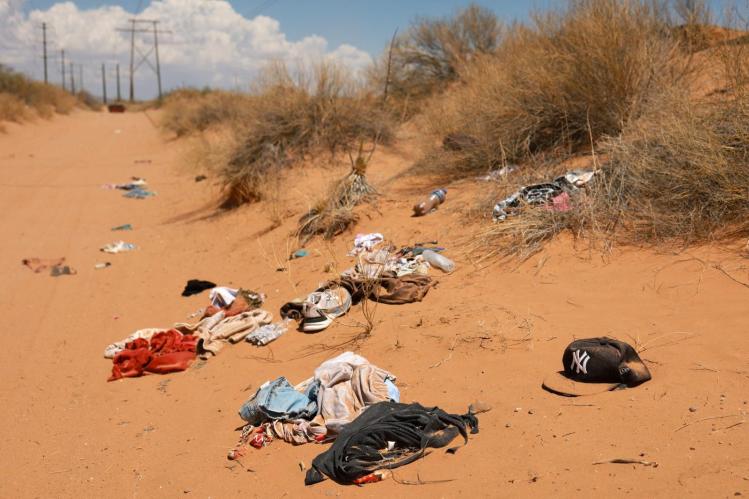
I remember one man who walked in with two companions. He stood about five-foot-four with baggy jeans covered in dirt, shoelaces tangled with bits of desert grass. He spoke in Spanish layered with Mayan vowels. He was severely dehydrated, and the Border Patrol agent who caught him had reportedly emptied out his water bottles onto the ground in front of him. The man told me that the agent kicked him to the dirt, cuffed him, and tied him to the Border Patrol horse, making him walk behind the horse for miles out of the desert. I asked the man if he wanted to file a complaint and explained it could improve things for others in the future.
“No,” he said. “We’ll leave it where it is. God already saw what they did.”
I can’t know the man’s motivations for sure, but I know there were many others like him: men destitute and dusty from the desert who would avert their gaze and isolate themselves even from people looking to help. I’ve come to understand this as a response to the feeling of absolute non-belonging, a mistrust of any kind of power because no amount of power will ever belong to them. Homo sacer, the one who has fallen below the law, can be killed or abused by anyone, even agents of the law, and no human institution can come to the rescue.
We build social hierarchies, whether we admit to them or not, and they define who is legitimate and who is deviant. The deviant class is reprehensible, with no redeeming quality. They don’t get the sympathy even of the sympathetic. Jesus was a persecuted savior; he chose weakness out of his virtue, and eventually history remembered his weakness as the key to understanding his virtue. But Judas’s weakness was never redeemed. If we can see Jesus in the innocent victims of marginality, we would do well to look for him also in the “Judases,” the guilty deviants, the fugitives, the clandestine nobodies who are afraid of harm but used to it. In their acceptance of abuse, they are “imbued with something of the inviolability of the king,” and are thus less afraid of “legitimate” society than we are of them.
We’re sympathetic to the people underserved by our system of laws who still long for full inclusion in it—by longing for it, they affirm its legitimacy. It’s harder to embrace the people who have survived instead by scorning that system, who’ve found some inside-out form of dignity in an embrace of rejection. It’s one reason why among migration advocates, so much effort has been dedicated to asylum seekers and relatively little to those crossing a border illegally with no pretension of a legal right to do so. Or, more recently, why some advocates defend—even applaud—the deportation of a criminal while deploring the deportation of the innocent. Repeatedly, religious leaders defend deportations that “keep our communities safe” (as though the criminal wasn’t being deported to another community equally deserving of safety). But, as the legal scholar César Cuauhtémoc García Hernández concludes in his book, Welcome the Wretched, “insisting that life in the United States is rightly available only to those who steer clear of criminality ignores the basic reality that crime is a feature of life in the United States.” It also ignores the broader reality that criminality is a feature of humanity, and that those who commit crimes, while obligated to make amends for the harm they cause, do not cease to bear the image of God.
One of the things that I find most jarring about borderlands is the moral ambiguity of life within them. The authorities in those areas can be lifesaving or murderous. The mafias are the same. Many of the people who migrate through those lands can legitimately be called victims, but at least some of them have victims of their own.
Even the birds were hard to judge. There were days when I’d work for hours at the shelter, doing seemingly little good. Whatever wasn’t futile was heartbreaking. On those days, I’d come home and sit on my back porch. There was a metal pergola from which hung some invincible vines and a hummingbird feeder. To clear my head, I’d watch the hummingbirds whiz around the feeder, as if dancing. It took me a few weeks to notice that they were not dancing. One bird was pursuing the other, attacking it, scaring it off from the feeder. Even the beautiful birds had a wicked side. All of us do.
Smuggling organizations, like mafias and cartels, are made up of two kinds of people: strong criminals and weak criminals. The strong criminals call the shots, draw the routes, run the staffing, move the money. Then there are weak ones: the drivers, the scouts, and the mules. They take the orders. They’re often addicts, criminal record–holders, hopeless debtors—desperate, exploitable, and expendable, and that’s why the mafia recruits them. If they’re caught, it doesn’t matter to the mafia. They’re already forgotten and already thrown away. And it doesn’t matter to the “legitimate” folks, because they were criminals, smugglers, and lowlifes best kept in prisons, out of sight.
Then one of these desperate drivers driving desperate people crashes, or leaves their truck locked in the heat, and the people inside are killed. As President Biden said of such a scene in 2022, we can blame the “smugglers or human traffickers who have no regard for the lives they endanger and exploit to make a profit.” There’s some truth to that. But we should also notice that the guilty and the innocent in these situations are often both homines sacri, outcast and beneath the law, and the powerful have created a situation where the weak must clash destructively.
It’s indescribably tragic when a truck is left locked in the heat, and in those situations, we can assign blame for a driver’s self-interested negligence, dim-wittedness, desperation, cowardice, and other contemptible qualities common in the Judas Iscariots of the world. But we witness evil, in the biblical sense, when those assured of their belonging and power in a society focus their sights on the dimwit. They convince us all that the dimwit must be caged or shot, and that order won’t be restored until all dimwits are destroyed.
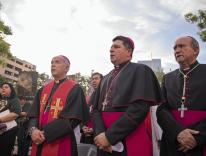
An example from a different migration route shows the hollowness of blaming these low-level criminals. After a ship carrying migrants sank in the Mediterranean, killing dozens, Cardinal Michael Czerny, the Prefect of the Vatican’s Dicastery for Promoting Integral Human Development, corrected an interviewer when they called it a tragedy: The “tragedies,” said Czerny, are “really crimes, facilitated by political actions and inaction.” There were no negligent, self-interested cartel truck drivers to blame here. There were only rocks in the Mediterranean. Those responsible are the ones who control the political actions and inaction that facilitated the crime and “acquiesce or submit to a cruel and inhuman rejection of their neighbor.”
I’ve searched for people who died migrating through the Sonoran desert, and I’ve befriended people who later attempted the desert crossing after exhausting legal migration options. One of those friends told me he’d given up on everything and hoped the desert would swallow him up. Criminal or not, this was a person who was discarded, crushed, and all but killed. He was also lowly, faithful to the earth, and therefore would have understood, in a special way, the urgency of God’s salvation.
The Catholic theologian Cecilia González-Andrieu once wrote that when she was a student in a class taught by the late Gustavo Gutiérrez, he looked out at his class and said, “We don’t love the poor because they are good, we love the poor because God is good.” God loves the poor unconditionally and without judgment while, as González-Andrieu pointed out, our laws have made them “no one.”
Are “good” and “evil” really to be determined more by powerlessness and power than by good or bad action, peace or harm, or innocence or guilt? If we are to accept the truth behind Jesus’ contemptible weakness, then yes. This dynamic—power is evil, weakness and rejection are somehow righteous—permeates the Gospels: in the Canticle of Mary, the story of Lazarus and the rich man, Christ’s third temptation in the desert, the Beatitudes, the Sermon on the Mount, Jesus’ invective against the Pharisees. Unless we’re prepared to abandon the truth contained within the Gospels and call them romanticized works of wisdom literature for another era, we ought to pay more attention to their central moral orientation. There is dignity in the person who sits just outside of whatever acceptable window of mercy we’ve internalized. To deny it is to find righteousness before humans and guilt before God, who has suffered that same denial.
Even the Judases need an advocate. This was the stroke of genius in Nils Runeberg’s ultimately erroneous conclusion, the coherent nonsense that devoured his reputation. Confused by the ineffable character of God’s merciful love, and obsessed with the saving power of weakness, he proclaimed the Messiah Judas Iscariot to the point of his own infamy, to the point of being reprehensible, to the point of total rejection, all the way to the abyss.
We welcome your comments about this article. Please send your response to [email protected].