The Venice Biennale has never been merely an art exhibition. It is a diplomatic instrument dressed up as a cultural event, a map of the world redrawn every two years between the pavilions of the Giardini and the Corderie of the Arsenale. This year, however, the sixty-first International Art Exhibition has made the matter explicit. The jury resigned. The European Commission threatened to revoke two million euros in funding. The Italian government dispatched inspectors. Iran withdrew. And all of this before the doors opened to the public, on May 9.
This year’s Biennale was titled “In Minor Keys” and its theme was conceived by the Cameroonian-Swiss art curator Koyo Kouoh, who died last May at the age of fifty-seven. The phrase, of course, refers to the minor key in music. It was intended as an invitation to lower the volume and attend to artistic practices that withdraw from the spectacle of crisis. Kouoh imagined a Biennale that would offer “islands of resistance” and “oases of care,” that would treat art not as commentary on current events but as a generative field of experience. In short, this year’s edition was designed to be the most intimate and reflective in recent memory. Instead, it has turned into the most politically clamorous.
The fracture point is by now well known. On April 23, the five members of the international jury—Solange Oliveira Farkas, Zoe Butt, Elvira Dyangani Ose, Marta Kuzma, and Giovanna Zapperi—decided to exclude Russia and Israel from the prizes, on the grounds that the heads of state of both countries are under proceedings at the International Criminal Court for crimes against humanity. The Biennale Foundation distanced itself from their decision; the Italian Minister of Culture, Alessandro Giuli, expressed solidarity with the Israeli artist Belu-Simion Fainaru; Israel’s foreign minister, Gideon Sa’ar, suggested the jury’s decision had been motivated by antisemitism. A few days later the jury resigned in a single block. In its place, the president of Biennale, Pietrangelo Buttafuoco established the “Visitors’ Lions”—prizes awarded by the public—and postponed the ceremony to November 22.
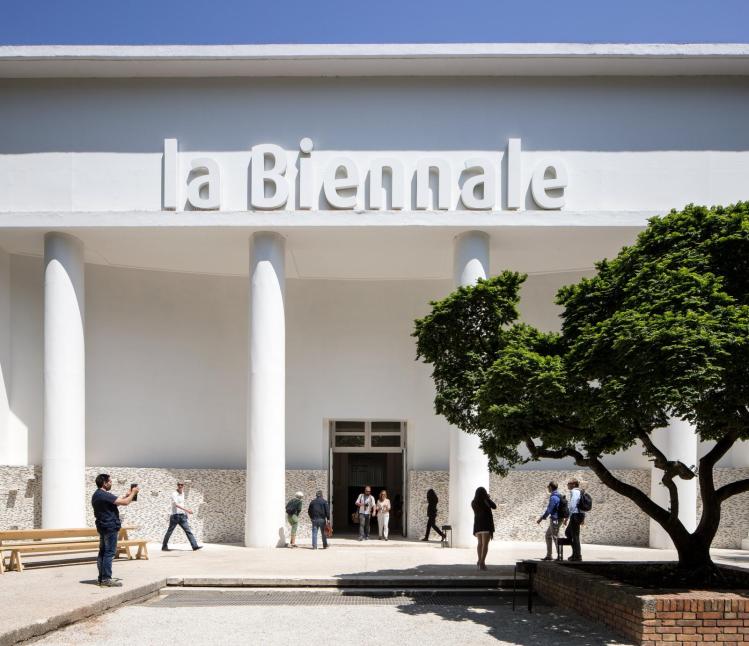
This whole sequence of events might have seemed unthinkable even a few years ago. But it was actually a logical consequence of a structure that the Biennale has carried with it since its founding in 1895. The national pavilions—the first built between 1907 and 1914, all of them, not by accident, belonging to the European empires of that period—are the architectural residue of an era in which art was already an extension of international relations. Each state that enters the Giardini brings with it its own flag, its own conflicts, its own position in the global system. The Biennale is not a museum. It is an assembly. And like all assemblies, it can be paralyzed by vetoes.
The real question is not whether Russia and Israel should take part but what room remains for aesthetic judgment inside a system founded on national representation. When the jury moves to exclude a country, it performs a political act, not an artistic one. When the government overrules the jury, does it perform an act of curatorship, or one of sovereignty? In either case the works themselves become secondary to the frame that contains them.
This is a subject I’ve been thinking about for some time, the way cultural criticism frequently intersects with international relations. Geopolitics is not only about the distribution of power among nations; it is also, and perhaps above all, a repertoire of images, metaphors, and representations. I have proposed two models for thinking about art and geopolitics. The first is the chessboard—a strategic, agonistic vision in which every move is calculated, every position reveals a relation of force, and art functions as an observer of the tensions in play. The second model is the woven fabric—a relational vision in which states and cultures are not separate entities but threads interwoven in a complex design, and art becomes the space in which identities meet and mix with one another.
The 2026 Biennale demonstrates that both models are at work, but in a degraded form. The chessboard is certainly in evidence: the moves of the jury, the government, the European Commission, and various foreign ministries compose a game in which art is just the playing field. But the fabric is there as well: 101 participating countries, seven nations present for the first time, Somalia with an exhibition on its own civil war, Ethiopia with a project on silence. But neither model, on its own, offers an adequate understanding of what is happening, which is a crisis in the legitimacy of judgment.
What the Biennale is demonstrating—unwittingly and for that reason all the more effectively—is the impossibility of separating the critical act from the political act when the very format of the exhibition is built on the logic of national representation. The great international art shows have always been spaces of negotiation between the singularity of the work and the universality of the system. But when the system is at war with itself—when the jury cannot judge without excluding and cannot exclude without setting off a chain reaction—then the format jams.
There is one more layer of complexity. “In Minor Keys” is a posthumous show. Kouoh died a year before the opening. With her trajectory across Douala, Zurich, and Cape Town, she was one of the most authoritative figures in contemporary curatorial practice. Tensions that a living curator might have mediated, or at least contained, instead led to a rupture that took many by surprise. If there’s a lesson here, it’s not that art ought to keep its distance from politics. That would be naïve. The lesson is that art as a space of critical representation and art as an extension of international relations are two different vocations. They can coexist, but not without a permanent and conscious tension. Geopoetics—the term I use for the area where artistic imagination and the geography of power overlap—is not a resolved synthesis. It is a field of forces. And the Venice Biennale, with its nineteenth-century structure and its contemporary ambitions, is the place where this field of forces becomes visible. Kouoh wanted an exhibition that would resemble a Creole garden: a place in which plants of different origins find an improbable but real equilibrium. That metaphor remains a powerful one.
We welcome your comments about this article. Please send your response to [email protected].