NATO secretary general Mark Rutte recently remarked that anyone who seriously thought that Europeans could unwind their security dependence on the United States should “keep on dreaming.” That was on January 26, when the dust was just beginning to settle from Donald Trump’s latest threats to annex Greenland, an autonomous Danish territory.
For a brief period early this year, it looked from Europe as if those threats might be serious this time around. Trump had just pulled off a stunning decapitation of the Venezuelan regime, kidnapping Nicolás Maduro and his wife from Caracas on January 3. Fresh from that brazen, if tactically successful, display of power, America’s ever-cocky president quickly returned to his old fixation with Greenland: “We have to have it.” A few weeks later, and the target has again shifted. Trump has turned his attention to Iran, which is currently being pummeled by U.S. and Israeli militaries in yet another imperial escapade that’s rapidly escalating into a regional war.
Whatever comes, it’s safe to assume there will still be room for Europeans to be shocked by Trump before they rush to forgive and forget. Speaking to European Parliament members on January 26, Rutte wanted to brush over the latest chaotic episode in the alliance he’s headed since October 2024. He warned that without American protection, Europeans would have to commit themselves to unsustainable levels of defense spending, perhaps as high as 10 percent of their GDP. “In that scenario, you will lose the ultimate guarantor of our freedom, which is the U.S. nuclear umbrella. So hey, good luck,” said Rutte. (Already last June, the former Dutch prime minister won a commitment for European NATO members to spend 5 percent of GDP on defense—a major demand from Trump, whom Rutte has referred to as “Daddy.”)
As much as it pains me to say so, the burden of proof still lies with whoever disagrees with Rutte. After what could be called, without exaggeration, a year of humiliation for the peoples and governments of Europe, the region remains wedded to papering over tensions with the United States—and adapting to the U.S. president’s increasingly fickle demands. Moments of crisis come and go, each an occasion for airing pro-forma calls for European independence and sovereignty. And then the pull of geopolitical gravity exerts itself and European leaders fall back in line. With U.S. and Israeli bombs and missiles now dropping on Tehran, Europe is once again cowed into silence because of its addiction to American power.
Already in the last year, European negotiators agreed to a blatantly lopsided tariff deal with Washington designed to avert an open trade war between the erstwhile twin pillars of liberal globalization. The recent Supreme Court decision striking down Trump’s “Liberation Day” tariffs may throw that deal into doubt, but one thing remains clear: Trump’s appeasers on the old continent remain committed to soldiering through the ongoing turbulence. Their ultimate priority is to clinch U.S. security guarantees for Kiev in any eventual diplomatic resolution to the war in Ukraine.
In exchange, Europeans have had to stomach a growing number of insults from Washington. Since returning to the White House, Trump and his allies have thrown their support behind far-right leaders and political movements across the continent. The latest U.S. National Security Strategy, released in November, announces that Europe is facing the threat of “civilizational erasure”—unless, that is, it is willing to take the advice of the Trump administration. This document was a more comprehensive statement of J. D. Vance’s truculent remarks at the February 2025 Munich Security Conference, where he urged Europeans to turn their attention to the “threat from within,” by which he meant “out-of-control migration” and a European elite whose efforts to fend off the continent’s far right were suffocating democracy.
There was an attempt to strike a different note at this year’s Munich conference. Vance was replaced by Secretary of State Marco Rubio, who lavished praise on what he called the “unbreakable link” tying the United States to Europe. The audience reportedly broke into applause after the German defense and foreign ministers, seated in the front row, stood up to clap. Only when the substance of Rubio’s message finally settled in—Europe must end the “climate cult” and defend “the greatest civilization that ever existed” from immigration—did some European officials express ambivalence. By then, Rubio had moved on to Budapest to sing the praises of Hungary’s authoritarian premier Viktor Orbán, who is facing critical elections in April.
Maybe a time will come when Europeans finally say: “Enough is enough.” Lingering somewhere in the European Union’s claim to institutional legitimacy is the idea that the bloc will be able to protect its members against international predation, ensuring that the now-middling nations of the world’s former imperial core don’t fall victim to the appetites of the new superpowers: Russia, China, and, yes, the United States. But the history of the European project is just as much an offshoot of the history of NATO, and therefore of shifting priorities in Washington. Through Trump’s twelve-month diplomatic onslaught, those priorities are shifting again, and Europe is playing the White House’s game.
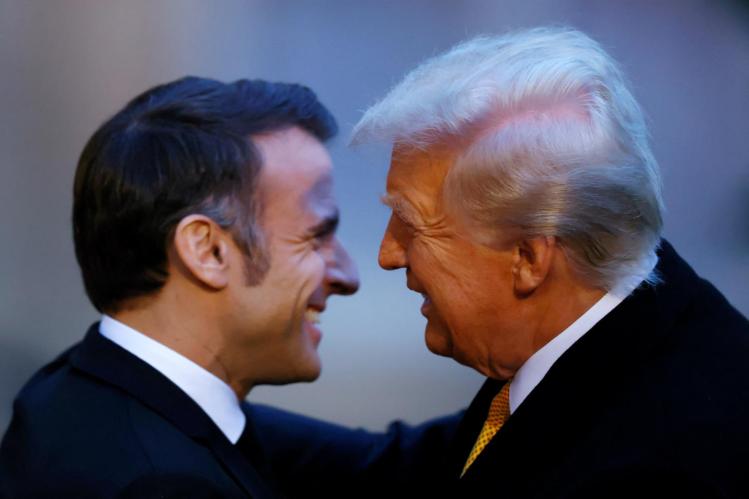
In France, where I’ve lived since September 2016, many observers seem to enjoy a kind of perverse catharsis at the spectacle of the Trump-induced chaos wrought on both the United States and the world. Yes, French president Emmanuel Macron has tried to cultivate a personal and working relationship with Trump, with little to show for it. But shock with the U.S. president also occasions ritualistic genuflections to France’s independence—arguably the origin of the idea that, if they banded together, Europeans could provide a check on U.S. designs.
In short, abuses of American power have a curious tendency to enflame French vanity. Already an old hand at diagnosing American pathologies, the left-wing politician Jean-Luc Mélenchon took his anti-Yankee rhetoric to a new level when he recently decried the United States as a “poor civilization,” one that would not survive beyond this century. Even France’s far right has sought to distance itself from its natural ideological allies in the White House. Jordan Bardella, the official president of Marine Le Pen’s Rassemblement National party, said that if his party took power, it would rigorously adhere to a “nonaligned” international posture.
These all are nods to the idea of “strategic autonomy,” one of the more appealing aspirations to have emerged in European politics in the past decade, as it became increasingly clear that the U.S. stance toward its allies was taking a darker turn. In 2017, the newly elected Macron caught attention across the continent when he devoted a long speech at Paris’s Sorbonne University to arguing that Europeans must wake up to harsh new global realities and develop what he called a “common strategic culture.” In 2019, the French president lambasted NATO as “brain dead.”
Yet for all this very French chest-thumping, genuine breaks from the old transatlantic norms have been rare, and initiatives that would have enabled Europe to act more independently have been watered down, abandoned, or postponed. One exception to this general rule was the establishment in spring 2025 of a €150 billion fund for defense procurements, part of a continent-wide push for rearmament. That deal even included the requirement that one third of the funds be reserved for purchases from European suppliers. Then again, increased European defense spending has been a bipartisan demand from the United States since at least the presidency of Barack Obama. Trump, for his part, hopes to reap the benefits of European rearmament, with last summer’s trade deal including the stipulation that Europeans buy U.S. military hardware. The European Union already finds itself in the position of footing the bill for the continued flow of arms from the United States to Ukraine.
There is also the festering question of the European economy’s dependence on the United States, which has become an obsession in EU policy circles. On the touchy subject of tech regulations, the Brussels-based European Commission—the EU’s executive arm—has slow-walked the implementation of regulations adopted in the early 2020s that many hoped would put an end to the monopoly power of U.S. technology firms. The commission is still preparing to unveil a “tech sovereignty” program, but its efforts thus far have been halfhearted, partly because Europe’s defense sector is afraid of losing access to U.S. technology. Europe has also delayed its plans for a transition to renewable energy. Since 2022, the bloc has traded a reliance on Russian gas imports for one on American fossil fuels. More broadly, the EU’s deregulatory push, notably on environmental regulations, is part of an effort to recover “competitiveness” in the face of American and Chinese capitalism. The most catastrophic figures cited in support of the idea that, compared to the United States, Europe’s economy has seen a huge drop-off since the 2008 financial crisis may be misleading; they don’t take into account the actual cost of living—and are generally a poor measure for real societal health and welfare. But they do say something about the divergence in terms of raw economic power.
Another obstacle to “strategic autonomy” is the lack of coordination in Europe, where twenty-seven capitals struggle to keep their own policies in sync with a slow-moving bureaucracy in Brussels. The problem is summed up in a single statistic: one percent—that’s the projected size of the budget for the European Union as a share of its member states’ overall GDP between 2021 and 2027. That means that almost all government spending, on everything from welfare to defense, is the responsibility of the national governments. The size of the EU economy may be roughly comparable with that of other would-be great powers of the twenty-first century, but nowhere on the continent is there the concentration of decision-making capacity that you find in Washington, Beijing, and Moscow. Berlin may come the closest, but there the default mode is an exceeding caution about any move that might upset Washington. I’m loath to quote Henry Kissinger, but his famous question remains largely unanswered: “Who do I call when I want to call Europe?” If “Europe” has spoken on Trump’s latest Iran offensive, it was in German chancellor Friedrich Merz’s feeble admonishment to fellow EU member states not to “lecture” Washington on its latest military adventure.
The irony is that Trump ought to provide the cement for Europe’s cohesion. Any genuine democrat on the continent should be pointing at Trumpism as a perfect example of the dangers of nationalist ideology and the quotidian violence that nationalists unleash when they come to power. But with far-right parties on the rise throughout the EU and in the United Kingdom, the general tendency is toward a new acquiescence to Washington. Giorgia Meloni, the Italian premier and the most powerful far-right figure on the continent, has been sparing in her criticism of Trump, and even praised the attack on Venezuela as a “defensive intervention.” Macron’s curt response was hardly better: he welcomed an imminent liberation for the Venezuelan people. For Meloni and others on the hard right, vague invocations of a united “West” can serve as a comforting euphemism for accepting the White House’s dictates.
These are but a few of the reasons I remain skeptical of pronouncements about Europe “waking up” to the Trump threat and seriously confronting its own vulnerabilities. It is tempting for Francophiles like me to blame the Germans and their northern European lackeys or the newer member states of Eastern Europe, with their servile dependence on the U.S. nuclear umbrella. On that account, Macron’s March 2 pledge to expand France’s nuclear arsenal and extend its coverage to the rest of Europe is designed to assuage fears of an American withdrawal. Most countries are ultimately unlikely to see it as anything more than a supplement to U.S. warheads.
The grim truth is that in France, as in the rest of Europe, the pretense to autonomy is mostly a matter of domestic political posturing. One can see the behind-the-scenes submissiveness in the private text messages from Macron to Trump, which the U.S. president posted on his Truth Social account on January 19. “We can do great things on Iran,” Macron wrote to his “friend,” before confessing “I do not understand what you are doing on Greenland.” Not daring to express opposition, he settled for a tentative note of incomprehension.
It was not so long ago that European capitals were in an uproar when, during his first term, Trump abandoned the 2015 deal on Iran’s nuclear program. But the passage of time is cruel. In late January, Le Monde published an op-ed by John Bolton that sought to enlist European governments for a regime-change war against Iran. Arguing that a strike on Iran would “end” terrorism in the West, Trump’s estranged former national security advisor went on to conclude that such an operation could have “as a secondary benefit the consolidation of the NATO alliance.” Bolton, as George W. Bush’s ambassador to the United Nations between 2005 and 2009, was once viewed as a pariah in Europe. But a couple decades later, here he was advising Europeans on how they could find common ground with an even more extreme U.S. administration. Now that Trump’s war against Iran is underway, it is notable that Spanish prime minister Pedro Sánchez has been the only leader in the European Union to seriously condemn the U.S. and Israeli attacks. (Trump, in response, has threatened a trade embargo against Madrid.) Other EU leaders have restricted themselves to condemning Tehran’s retaliatory strikes.
Recent history provides a long list of missed opportunities for greater European autonomy. The end of the Cold War could have been the occasion for a reset in Europe’s relations with Russia, but Brussels instead opted to go along with Washington’s project of expanding NATO. Yes, there was the French and German opposition to the 2003 invasion of Iraq, which saw hopes for a new voice in favor of international law from within the West, but memory of that episode has been definitively buried by Europe’s deafening silence throughout the past three years of crisis in the Middle East. The symbolic recognition of Palestinian statehood by several European capitals—including Paris, London, and Madrid—is too little too late after their silence in the face of Washington’s unconditional support for Israel’s criminal war in Gaza. Perhaps the price to pay for any durable rupture with the United States is still considered too steep.
One of the stories that Europeans like to tell themselves about the history of their common project is that it has made its greatest leaps forward only when prodded by crisis. It took a continent-wide civil war between 1914 and 1945 to force the warring nations of Western Europe to adopt a modicum of shared governance. If the last twelve months haven’t been enough, one shudders at the thought of what it would take to wake this sleepwalking continent from its slumber.