In “Euphrasy & Rue,” a poem from his 2020 collection The Math Campers, Dan Chiasson describes how the act of writing might mark the days we live in and moods we pass through:
He was writing an autumn journal, he wrote, as a bridge across time. He wanted a bridge across darkness.
He needed a string to hang his moods upon.
On his daily drives, he used a GPS that could tell him, up ahead, where the broken-down cars were, or where he would meet the police, facts about the traffic as it lurched and settled, lurched and settled, into, into, itself.
His journal, he wrote, was his GPS: it showed him what was up ahead by measuring what was still behind, and figured the difference, and measured, and to some extent determined, the path he needed to travel.
A journal is one way of measuring time and its changes; poetry is another. In Bernie for Burlington: The Rise of the People’s Politician (Knopf, $35, 592 pp.), Chiasson has constructed a different, more expansive kind of temporal bridge. The almost six-hundred-page book attempts, as he writes in a prologue, to track “a change within a change: the evolution of Bernie Sanders as a political phenomenon within the shifting political and cultural landscape of his adopted state of Vermont.” Bernie for Burlington functions as a triple bildungsroman. It considers how Bernie Sanders became one of the most consequential U.S. politicians of the twenty-first century. (You don’t get Mamdani, AOC, or Biden’s domestic-policy successes, such as they were, without Sanders.) It considers how Chiasson, raised by a single mother in the city Sanders came to dominate, became the writer he is. And it considers how Burlington, a place whose lefty credentials are both real and a marketing strategy, became the city it is.
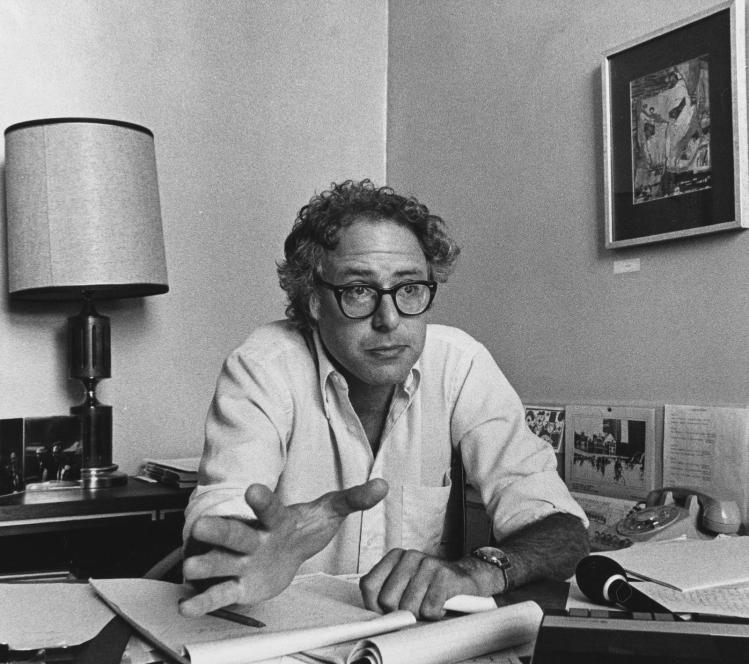
Sanders himself doesn’t much like to look back. His gift is to imagine, to ask and even demand that voters imagine, a different and more equitable future. The grotesquely rich we won’t always have with us, he says, not if we act in concert against them and for us. And yet, as Chiasson argues, to understand Sanders’s political eschatology we must first understand his earlier years: his childhood in working-class Brooklyn (“Bernie’s politics clearly began at his parents’ breakfast table,” he writes, “their scorching arguments show[ing] him the emotional and psychological costs of being underpaid”); his time at the University of Chicago, where he got involved in the Civil Rights movement as well as the fringy psychosexual thought of Wilhelm Reich (Reich, who was also taken seriously by Saul Bellow and Albert Einstein, among others, marketed “Orgone Accumulators” that allowed users to “collect…the energies of the accumulated universe in their bodies” so as to achieve “explosive orgasms and, in aftermath, personal and political liberation”); his move to Vermont in 1968, where he saw how the immiseration of the rural poor rhymed with that of the urban poor; his early years spent in the Green Mountain State, doing odd jobs and writing for The Vermont Freeman; his losing campaigns as the Liberty Union candidate for the U.S. Senate in 1972 and 1974 (he received 2.2 and 4.1 percent of the vote, respectively) and for governor in 1972 and 1976 (1.1 and 6.1 percent); and, finally and improbably, his election as mayor of Burlington as an independent in 1981.
Sanders is widely considered a broad-strokes politician—if Elizabeth Warren’s selling point in the 2016 Democratic race was having a specific plan for every issue, Sanders’s was understanding the system’s endemic corruption—but Chiasson shows how Sanders’s route to, and practicing of, power in Burlington involved tactical pragmatism, too: compromising with real-estate developers, appealing to specific neighborhoods (Burlington’s working-class Italian enclaves) through specific policies (keeping property taxes down), alienating Democrats here and winning over Republicans there. Still, even back in the 1980s, Sanders was most successful when offering a wide-angled vision of how things might be different. Shortly after his stunning victory, he was interviewed by Phil Donahue on the Today show. When asked if he was a capitalist, Sanders said no and then expanded: “Do I believe the profit motive is fundamental to human nature? The answer is, no. I believe in the spirit of cooperation, that you and I can work together better, rather than trying to destroy one another.” Sanders’s political genius often seems less the stuff of poetry than the result of prosaic persistence, hammering home the same familiar points—“The wealthiest one percent now own as much wealth as the bottom 99 percent!”—again and again. But there is a distinctive rhythm, even a poetry, in his rhetoric. Read a transcript of almost anything he says, and you will hear his voice.
The title of Bernie for Burlington can be read as a political slogan: vote for Bernie, your advocate for Burlington. And the book does follow Sanders, with almost forensic care, on the trail and in office as he seeks to municipalize cable services, curb the excesses of the frats at the University of Vermont, and manage increasing homelessness. But the title can also be read metonymically. Bernie is a substitute for Burlington, since to talk of Bernie is really to talk of the city, “its people, its institutions, its landscape, its very existence in time and place.” Chiasson offers a memorable portrait of Sanders: adrift without a purpose until he wasn’t, a political loser until he wasn’t, consistently grouchy and consistently driven. (“I’m not sure Bernie had ever been to a bar in the city,” a friend told Chiasson of Sanders rebuffing an offer to get a drink in 1980. “It was completely foreign to him, the idea that you would just go out for a beer, like friends do. I wasn’t suggesting an orgy.”) But the book’s real protagonist is Burlington, the city’s many shifts—the construction of an expressway; the development of its waterfront; the hollowing out of its local Catholic churches; the growth of its tourist industry—the string upon which Chiasson hangs his mood.
Chiasson has long roots in, and deep affection for, Burlington. His great-grandparents, Wilfred and Laura Delorme, were French Canadians who met while working the mills in Winooski, right across the river from the Queen City. His grandfather, with whom Chiasson and his mother lived during his childhood (he didn’t know his father’s name for years, though he eventually learned that he was a scholar of Teilhard de Chardin and occasionally taught at nearby St. Michael’s College), was a World War II veteran who lamented what he saw as the passing of an older, better, more Catholic Burlington into something weirder and more sinister. He didn’t like Sanders or the people he assumed Sanders appealed to: hippies, transplants, the new Burlingtonians. (Then as now, Sanders actually appeals as much to working-class conservatives as to yuppies.) Chiasson remembers two Sanders volunteers coming to his grandfather’s house in 1980:
The aluminum-sided white colonial at 258 Colchester Avenue was better kept than its neighbors, with a pair of young crab apple trees flanking its front door. Two figures with clipboards approached the home up a short walkway, then disappeared under its porch. Then, the tense exchange that launched my curiosity about Bernie in the first place, and out of which this book flows: from the kitchen, my grandmother’s calling out to my grandfather, “There’s someone at the door”; the creak of his recliner swiveling, and his booming voice: “Don’t open the door—it’s Sanders!”
It may seem an odd choice for a poet to write a political biography. (Not an unprecedented one: Carl Sandburg won the 1940 Pulitzer for Abraham Lincoln: The War Years.) Why this poet would write this political biography seems obvious: Burlington—liberal, white, Catholic in its bones but not really in its present state—is the city that shaped Chiasson’s poetic sensibility. Through Sanders, it has helped shift the country’s political sensibility, too.
A better question might be this: Why might a poet be a good person to write political biography? One answer: because a poet, if he’s good, cares less about sweeping assertions than about precision and exactingness. “No detail too small,” Elizabeth Bishop says in “Sandpiper,” and Bernie for Burlington is filled with enlivening details: Sanders, a talented runner in high school, finished third in New York City in the mile; when Chiasson was young, the stores in Burlington “all closed at three p.m. to mark the hour of Christ’s crucifixion” on Good Friday. Though the book is long, its set pieces display economy. Chiasson describes the city’s ethnically and racially divided neighborhoods, its diners and dives and Italian restaurants, the Old North End and the Burlington Square Mall, 81 Manhattan Drive (“a deteriorating Victorian in a quiet corner of Ward 3” that became the center of a dispute over NIMBYism and city planning) and 242 Main Street (a teen center that, with the Sanders administration’s tacit approval, turned into “a regional magnet for hardcore and skate punk.”) The book introduces dozens of Burlington characters: Dickie Bove, a “short, round man cinched in the middle by his apron string” who operated the Italian restaurant at which, over lasagna in 1980, Sanders and his advisers “plott[ed] their moves in a booth under the room-length mural of Venice’s Grand Canal”; Sadie White, “a freelance political gadfly” who fought against the expansion of the city’s freeway system and who Chiasson, as a boy, saw “towering over all the other old French-Canadian ladies kneeling in their pews” at the Cathedral of the Immaculate Conception. Chiasson looks back at all of this with fondness but without nostalgia.
Bernie Sanders has played pickup basketball his entire life. Chiasson regularly saw him on the courts in Burlington and describes his game thus: “Strong ball handler, solid outside game, and, always, a complete, transforming intensity.” In his 2014 collection Bicentennial, Chiasson imagines an “alternate basketball nobody plays” in which the “players try to tie the score: / That way, at the buzzer, the game isn’t over.” In such a game, play “goes on forever,” with “the score climbing in never-changing change.” The battle of all-against-all giving way to democratic cooperation: this is the alternate political vision Sanders has offered for half a century. It’s a vision that America has seemed to want at various points. And it’s a game that, in 2026, with Trump back in office and our politics somehow even more debased than they were in 2016, nobody seems to be playing.