Last year marked the centennial of the Scopes Monkey Trial, which saw a twenty-four-year-old teacher in Dayton, Tennessee, challenge the state’s ban on instruction contradicting “the story of the Divine Creation of man as taught in the Bible.” The trial—the first to be broadcast live on the radio—riveted Americans nationwide, setting those outraged by students’ exposure to “anti-Christian” material at odds with those alarmed by the threat to educators’ First Amendment rights.
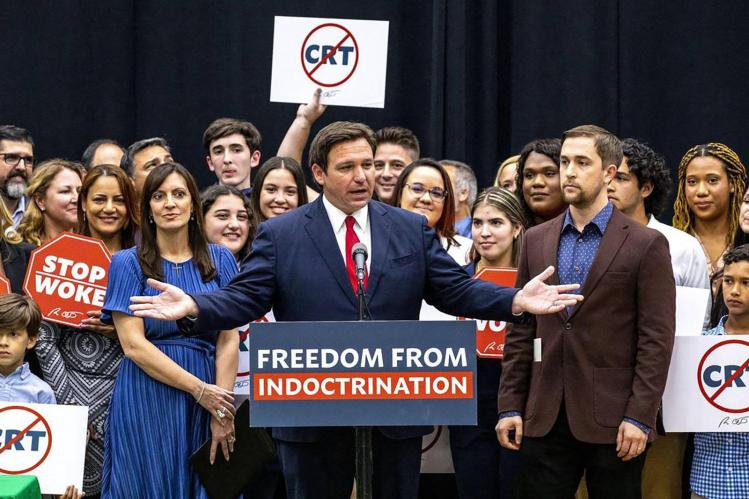
In a 2022 New Yorker essay, Jill Lepore noted the similarities between America’s first “school war” and its contemporary analogue: the continuing conflicts over antiracist education and critical race theory (CRT) in classrooms. “Both conflicts followed a global pandemic and fights over public education that pitted the rights of parents against the power of the state,” Lepore wrote. “What was once contested as a matter of biology—can people change?—has come to be contested as a matter of history.”
Mark Hlavacik’s new book, Willing Warriors: A New History of the Education Culture Wars, begins with a forerunner of the CRT debate: a controversy over an anthropology-based curriculum developed at Harvard in the 1960s. The designers of Man: A Course of Study (MACOS) hoped that an innovative approach to elementary-school social studies—teaching children about non-Western cultures—would make them tolerant observers and skillful navigators of racial and cultural differences. Renowned psychologist Jerome Bruner wrote the program’s essential questions: What is human about human beings? How did they get that way? Ten-year-olds in 1,700 schools across forty-seven states learned about the behaviors of salmon, herring gulls, and baboons, and watched documentaries about the traditional hunting practices of the Netsilik, an Inuit nation in the Canadian Arctic.
Conservatives balked at the content, which included graphic depictions of seal and reindeer hunting, and readings of Netsilik cultural myths, some of which featured polygamy, senicide, and child abandonment. Parents and pastors lambasted MACOS in right-wing magazines and newspapers, portraying the curriculum as an insidious conspiracy among academics to indoctrinate children into anti-American, anti-Christian values. They took these grievances to school boards, and in 1976, the National Science Foundation defunded MACOS.
Hlavacik argues that the MACOS controversy set a right-wing rhetorical template for the next fifty years. It was built on three interlocking assertions: that the curriculum “was the product of a conspiracy, that its content threatened students’ innocence, and that [it] was so outrageous that it warranted a hyperbolic rhetoric that included the demonization of educators and the belittling of children.” Hlavacik notes that, like most of the subsequent culture wars over education, the MACOS controversy became “a contest for control of the social studies curriculum more than a serious effort to improve it.”
Why start the story with MACOS rather than Scopes? In an endnote, Hlavacik claims that while the controversy “followed existing rhetorical patterns for panics over school curricula going all the way back to the Scopes trial, [it] managed to connect those rhetorical patterns with large-scale, federal policy change.” Perhaps. It’s true that the conflicts over education that crystallized in the Scopes trial were taking place within states rather than across them. Compulsory schooling was relatively new in many states in 1925, and a national education system that would promote policies, administer tests, measure student progress, and hold states and districts accountable had not yet emerged. But because the trial got significant media attention nationwide, it established several of the political tools and patterns common to each iteration of education’s culture wars: for example, market-driven competition among textbook and curricula companies. It also introduced a legal novelty that got little traction in 1925 but would emerge later as a powerful rhetorical weapon: parents’ rights.
Looking more deeply at Scopes might have given Hlavacik greater perspective on the long-running corporate and philosophical influences that still color curriculum debates. Instead, Willing Warriors focuses narrowly on two partisan scripts that have dominated discourse on education since the 1970s: that of exposé (generally weaponized by right-wing activists) and innovation (generally evangelized by progressives). Hlavacik argues that the former “attempts to provoke outrage with the imprudent and secretive behavior of an unaccountable elite who are said to control what gets taught in the nation’s schools,” while the latter “reasserts the authority of expertise” and insists that “schools suffer…when promising new ideas are never given a chance by recalcitrant school boards, parents, unions, or bureaucrats.”
Unfortunately, the book reads less like history and more like a series of rhetorical case studies. In five chapters, Hlavacik tracks the rise and fall of MACOS; the media frenzy over Allan Bloom’s 1987 bestseller The Closing of the American Mind; political infighting at the National Endowment for the Humanities and the Department of Education over the ill-fated National History Standards in the early nineties; the marketization of “achievement” that characterized Bush’s No Child Left Behind policies and Obama’s Common Core standards; and the recent resurgent fight over which story of the United States’ past students should learn in K–12 schools, made notable by today’s curricular bogeymen: The New York Times’s 1619 Project and Hillsdale College’s 1776 Curriculum.
The bones of a good historical narrative are here, perhaps one about the decline of trust in expertise and growing skepticism about the value of academics getting their hands in the Play-Doh of K–12 curricula. But Willing Warriors, which purports to be about the ways education culture wars have impacted schooling over the past fifty years, has little to say about, well, schools, and almost nothing about the people who teach and learn there.
Instead, we read more about events that are equal parts medieval intrigue and modern vaudeville, like Allan Bloom’s book promotion on an Oprah episode titled “How Dumb Are We?” (Winfrey assessed her audience before Bloom took the stage and viewers nationwide were treated to “a woman who admitted to thinking that the Magna Carta was a brand of champagne” and another who mistook apartheid for a traditional African dance.) We learn that Lynne V. Cheney, former chair of the National Endowment for the Humanities, sent a research assistant to the annual MLA conference to spy and report back on progressive scholars “politicizing” humanities instruction, and that David Coleman, former president of College Board, schmoozed with billionaires to secure funding for Obama’s Common Core standards. In the introduction, Hlavacik describes a 2022 public meeting held by suburban Texas school district at which a local resident gave his gender pronouns as “top” and “gun” and subjected attendees to “an R-rated spectacle” by reading aloud smut he erroneously believed was in the schools’ libraries.
These are Hlavacik’s “willing warriors”—a motley crew of discontented professors, academic celebrities, talk-show hosts, politicians, and hysterical citizens ready to sound local alarms about the outrages that partisan news, talk radio, and X (formerly Twitter) tell them are happening in U.S. classrooms. It’s a cacophonous narrative—if it’s a narrative at all—one in which teachers, students, and less bored, better adjusted parents are implicitly irrelevant.
Admittedly, studying the culture and politics of schooling is tricky in a country with almost fourteen thousand public-school districts. The vastness and diversity of these systems— simultaneously accountable to local, state, and federal mandates in myriad, ever-changing ways—makes K–12 schools paradoxically both resistant and vulnerable to weaponized rhetoric. Hlavacik notes that most viral stories “about feckless social studies teachers [rely] more on…readers’ biases than…evidence for [their] persuasive appeal. In discussions of America’s schools, it is always easy to score points by telling the public that some school or some teacher somewhere else is hard at work confirming their worst fears.” And in the realm of compulsory schooling, “public” has never been synonymous with “transparent.” “When most parents only see the inside of their child’s classroom a few times a year,” Hlavacik writes, “stories about what happens behind closed schoolhouse doors can be difficult to dismiss.”
The problem is that Hlavacik suggests that what really has happened behind those doors does not matter much. He is less interested in how teachers and school leaders have responded to deepening polarization over the nature, meaning, and content of schooling, and more interested in identifying how the viral rhetorics of exposé and innovation bait “warriors” outside the schoolhouse and shape the terms and outcomes of education’s culture wars.
Of course, these are not insignificant phenomena. Willing Warriors powerfully highlights how the rise of digital media in an era of languishing politics influenced public debates about education. It shows how the malign banalities that first emerged in 1925 have metastasized online. The episodes in these five chapters affirm what Neil Postman observed about digital media’s effects on public discourse in his brilliant 1985 book Amusing Ourselves to Death. Postman argued that truth, “a product of a conversation man has with himself about and through the techniques of communication he has invented,” is endangered in a device-driven world, because our screens subordinate information to entertainment. The rise of “a television-based epistemology has had grave consequences for public life,” Postman wrote, and “we are getting sillier by the minute.”
Hlavacik deftly extends Postman’s observations from the twentieth century into our own. As Americans have replaced their print newspapers and magazines with online platforms, the school wars have found “fertile ground as the content for new and emerging forms of media and similarly fertile ground among everyday Americans who have been only too willing to like, comment, rate, and subscribe and then go to meetings to say rude things to beleaguered public officials.” Postman subtitled his book Public Discourse in the Age of Show Business. Perhaps it was unavoidable, then, that Hlavacik’s “new history” would read more like a tabloid anthology.
What Postman did not predict, and what Hlavacik aptly highlights, is how digital media have, in the name of democratization, amplified voices with the least respect for democratic norms. “Even as more and more willing warriors have found a voice in the culture war politics of education,” he argues, “the voice they find is increasingly not their own but a stereotyped performance that adheres to a tired, rhetorical script. In this way, the culture wars have drawn us in with a false promise of greater political agency and better schools.”
This “us” is vague, however. There are real gains to be made from the attention generated by culture-war rhetoric, just not by students or teachers. Hlavacik notes that groups like Moms for Liberty and influencers like Christopher Rufo have exercised significant agency over school policy and legislation, successfully pushing for book and curricular bans across the country. Still, Hlavacik argues that most “warriors,” at least to the extent that they actually care about improving education, come home empty-handed in the long run. This makes his focus on the loudest voices and the draw of the dramatic all the more frustrating. Rather than better schools, Hlavacik claims, “what we have gotten is a culture of political conflict that makes dummies of the people who take part in it.” But most teachers, students, and parents are neither dummies nor “willing warriors.” Most of us want to drop our kids off at school, trust they will develop some skills for a meaningful life there, and go to our jobs.
Near the end of the book, Hlavacik argues that an effort to control or police school content is “no substitute for articulating a vision for what kind of citizens public schools should be producing and what intellectual skills they need to develop to realize their civic potential.” Partisan warfare over the content of schooling, so often perpetrated to gain power over the story of America’s past, guarantees no particular future. Hlavacik notes that proponents of the 1619 Project and the Hillsdale 1776 Curriculum would do well to keep this in mind. “Insisting that students be reverent of their nation’s history is no guarantee they will grow up to be wise contributors to it,” he writes. “It is also possible that some folks, although confronted with unvarnished truths about the founders, the Civil War, Jim Crow, and so on, might still think that the fundamental story of the United States is about something else.” These are excellent points, and reminders that those of us teaching and learning this century will need to subvert the terms of the school culture wars—the left’s and the right’s—if we hope to do our work well.
But the success of that subversion depends on knowledge of the past—of the choices students, parents, and teachers have made; the conditions that supported their solidarity and exacerbated their conflicts; and how schools have both served and resisted the power of the state and corporate interests. We still lack a “new history” of the school culture wars that attends to the way they have played out in classrooms, faculty meetings, principals’ offices, parent-teacher organizations, district meetings, and teachers’ unions.
Such a history would be especially useful now, as the pandemic’s aftershocks continue to ripple, and as trust in public schools has deteriorated so much that parents are using public dollars to subsidize private educations, and public districts have resorted to hiring marketing teams to recruit enrollees. We need to ask, as did the writers of MACOS: How did we get this way?
Willing Warriors
A New History of the Education Culture Wars
Mark Hlavacik
The University of Chicago Press
$24 | 224 pp.