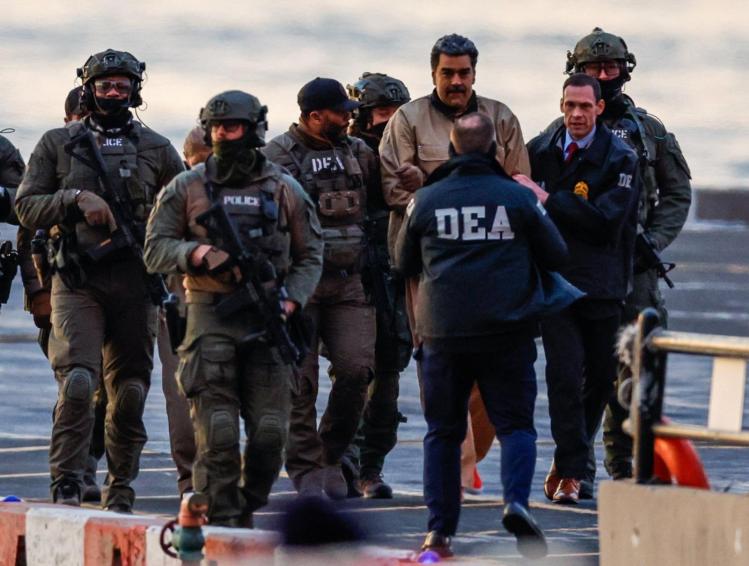
Early on the morning the Department of Justice was supposed to explain controversial redactions to the Epstein files and just days before the fifth anniversary of the January 6 attack on the Capitol, amid falling approval numbers and a flagging economy, Donald Trump took to Truth Social to announce that U.S. forces had invaded Venezuela and seized president Nicolás Maduro and his wife, Cilia Flores. Details were at first hard to come by, but at a news conference later that day additional information about the operation came to light: its timing, scope, and duration; the fact that no Americans were killed; and confirmation that Maduro and his wife were being transported to the United States to face drug and “narco-terrorism” charges. But important questions remained about the justification for the operation, the legal reasoning behind it, and the Trump administration’s plans for a sovereign country whose leader it had summarily deposed and taken into custody.
But then, that may have been by design. The administration seems uninterested in presenting a coherent explanation for why it chose to remove Maduro from office. In spite of charges that he was leading a large-scale effort to funnel drugs into the United States, there is little evidence of this. As has long been reported, Venezuela does not produce or supply the fentanyl that kills so many Americans. It is not a significant source of cocaine, and the little it does produce goes mostly to Europe. If Trump were truly concerned about the scourge of illegal drugs, it’s hard to understand why he recently pardoned Juan Orlando Hernandez, convicted by the United States for running a massive drug operation when he was president of Honduras from 2014 to 2022. As for the contention that Maduro is an illegitimate leader who stole an election and ruled as a strongman, Trump has long emulated and expressed admiration for other strongmen, including Vladimir Putin and Jair Bolsonaro.
Nor does the administration appear inclined to offer a plausible legal rationale for the invasion. Trump did not seek congressional approval for what amounts to an act of war, as required by the Constitution. Only after the fact did the administration brief lawmakers about the operation. Speaking on CNN about what the Trump officials had earlier told Congress, Massachusetts representative Seth Moulton said: “We asked, ‘Are you going to invade the country?’ We were told no. ‘Do you plan to put troops on the ground?’ We were told no. ‘Do you intend regime change in Venezuela?’ We were told no. So in a sense, we have been briefed. We’ve just been completely lied to.” The administration has still less regard for international law: the invasion of Venezuela violates Article 2(4) of the UN Charter, which prohibits the “use of force against the territorial integrity or political independence of any State.” American forces killed at least eighty people during their raid in Venezuela, including many civilians.
The biggest unknown is what the administration now has in mind for Venezuela. The ongoing U.S. blockade threatens economic collapse and civil unrest, which could lead to an exodus of refugees or incursions by guerilla forces gathered just beyond the country’s border with Colombia. Trump himself clearly has no capacity to understand what the implementation of stable, democratic governance would entail, and no one in his administration seems particularly interested in taking up that project. At the January 3 news conference and multiple times since, Trump has said the United States “is going to run” the country. He said he hasn’t ruled out “another wave” of attacks and has spoken glibly of “putting boots on the ground.” Many Americans, especially those who voted for Trump precisely because of his promise not to involve U.S. troops in lengthy foreign wars or nation-building, are understandably dismayed about the likelihood of another quagmire like the ones in Iraq and Afghanistan. Secretary of State Marco Rubio has done little to allay concerns with his fumbling attempts to clarify the president’s words. Rubio said in an interview with Meet the Press that when Trump claimed his administration would be running Venezuela, he meant only that they would be running policy. Then there is the matter of who will actually lead the nation. At the moment, Trump appears to favor Delcy Rodríguez, who was sworn in as interim leader. Rodríguez was Maduro’s vice president, and has reiterated her support for him, demanding his release.
What really seems to be driving Trump is the prospect of seizing Venezuela’s oil reserves, the largest in the world. But if that’s his rationale, the thinking behind it is thoroughly muddled. Trump says he expects American oil companies to “spend billions of dollars” to rebuild Venezuela’s decaying petroleum infrastructure—something industry executives themselves have little interest in, not only because of the difficulty and expense of the work, but also because the administration has no plan for stabilizing a post-Maduro Venezuela.
That other presidents have unilaterally exercised force to topple governments abroad in no way excuses Trump’s attack on Venezuela. All such actions are dark marks on our history. Many have also had catastrophic consequences. (We are still dealing with the disastrous aftereffects of a coup the U.S. government orchestrated in Iran more than seventy years ago.) Is there any reason to believe it will be different this time? What’s worse, the “success” of the operation has only emboldened Trump—a corrupt, know-nothing leader who acts not according to “any reasoned or reasonable understanding of American interests,” as we wrote in our December 2025 editorial, but through the use of extortion and illegal force. In the days since Maduro was snatched from his bedroom, Trump has threatened Mexico, Colombia, and Greenland—a territory of NATO ally Denmark—with similar attacks. Trump has made clear his intention to turn the United States into a reflection of himself: not a leader of the free world or a dependable ally, but a rogue nation with the methods and morals of a mob boss, concerned only for its own narrow interests and ever more greedy for spoils.