The issues that occupied the Catholic Worker movement beginning in the 1930s are, in some obvious ways, still with us: the injustice of laissez-faire capitalism, communism, factory industrialism, and mechanized society. Dorothy Day and Peter Maurin confronted these upheavals, taking Catholic social teaching as the basis of their philosophy and inflecting it with the insights of Marxists, critical theorists, anarchists like Pyotr Kropotkin and Nikolai Berdyaev, the English distributists, and French personalists such as Emmanuel Mounier. But the critiques developed out of these influences might seem hard to apply to a socioeconomic climate that has changed so quickly and so destructively over the past century. Does their work still speak to a world dominated by social media, finance capital, artificial intelligence, and virtual reality?
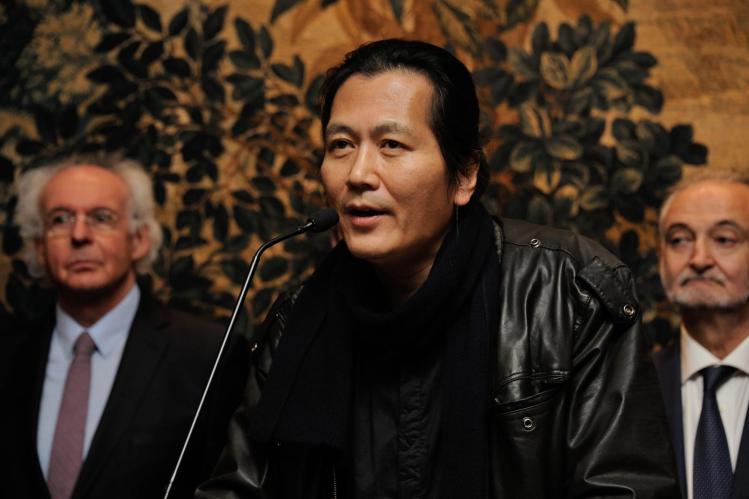
One contemporary philosopher stands out as a bridge connecting the Catholic Worker worldview to the contemporary world. Born in South Korea and educated in Germany, Byung-Chul Han has produced more than twenty short books during the past ten years. This considerable body of work has made him one of the leading European philosophers of his generation, but he is still not as well-known as he should be in the United States. His books bring continental philosophy to bear on late modern culture, especially in its economic and technological aspects. Han, himself a Catholic, brings out the fact that the Catholic Worker’s deepest critique of our present regime operates not on the level of economic theory at all but in its prodigal way of life.
Taking his cue from the Marxist tradition, Han sees contemporary society as dominated by the means of production. The order of the day is incessant work in service of maximal productivity, and this industrial ideal has slowly spread throughout the culture. Even as most workers, in developed countries like the United States at least, have left the physical confines of the factory behind, the factory-like spirit of totalized work has come to dominate us. Efficiency, Han argues, is our ideology, incarnate in the ubiquitous technology that just is the contemporary world, and in whose image we remake and enslave ourselves.
We know this in our bones, if not in our heads. We feel guilty for relaxing; we are constantly harried in the name of productivity; we calumniate those, like the homeless, we suspect of laziness; and we fill our lives and homes with as much “smart” technology as possible to maximize efficiency and convenience. A good “work ethic” and financial prudence are among the top values we want to instill in our children. The very fact that we talk about morality in terms of our “values” reflects the primacy of the economic. All this, for Han, indicates that the industrial ideal has taken up bodily residence in us. We live to work.
This is a familiar line of argument for Catholic Workers. It extends the personalist critiques of Mounier and Arthur Penty—two of Maurin’s biggest influences—who saw technocracy colonizing not only the external world but our affects, habits, and tastes as well. Han’s critique also echoes that great line of Rerum novarum: industrialism had produced conditions “little better than slavery itself.”
Han consistently argues that the move to the digital world is not a move away from the factory drudgery with which Marx and Day contended, but rather its totalization. We no longer spend our time producing only things, but, internalizing the factory ethos, we unendingly produce ourselves. “Accordingly,” he writes in his book Psychopolitics, “industrial capitalism has now mutated into neoliberalism and financial capitalism, which are implementing a post-industrial, immaterial mode of production…. People are now master and slave in one.” Life online demands constant optimization of our image, portfolios, profiles, platforms, credit ratings, histories, etc., to the point that we become our own products. So “now the illusion prevails that every person—as a project free to fashion him- or herself at will—is capable of unlimited self-production.” We spend our lives selling ourselves, and unlike in the factory, we do this work under self-supervision and, if we’re not self-monetizing influencers, for free. Self-oppression, or self-slavery, becomes today’s dominant social form. We are approaching the prospect of the fully capitalized human being.
Here, Han puts his finger on a theme that the social encyclicals, and especially distributists like G. K. Chesterton and Hilaire Belloc, have occasionally broached but never systematically developed. Work, Han points out, is at base concerned with the preservation of bodily life; it is necessary for our survival. In this way, it is intimately connected with the possibility and fear of death. When we are working to acquire the means to life, we are working to push death away, whether we think of it that way or not. The goal of work is the maintenance of what Han, following the Italian philosopher Giorgio Agamben, calls “bare life.”
Han contrasts bare life with other forms of life that have usually been recognized as essential for genuinely human life: art, beauty, literature, philosophy, liturgy, community, the spirit, relationships, and contemplation. These cultural expressions arise not out of a concern for the body or a fear of death but from leisure, celebration, festivity, play, enjoyment, fun, devotion, and love. “As forms of play, festivals…are characterized by an excess, an expression of overflowing life that does not aim at a goal,” Han writes in The Disappearance of Rituals. “This is what lies behind their intensity. They are an intense form of life. In the festival, life relates to itself instead of subordinating itself to exterior purposes.” These forms of life are what the encyclicals call “higher goods,” and Berdyaev and Mounier call “the life of the spirit.” They are not concerned with efficiency, and they are about much more than “mere” biological life and the means necessary to reproduce it.
They are, you might say, prodigal in the face of death and the body’s requirements. For when we engage in these forms of life, we are often wasteful—and sometimes extravagantly so—of time and materials that could be used to prevent death. Think of the building of our churches or the expenditures of a symphony. In these activities, we are not just staying alive; we are living. But when work becomes totalized, the mundane, mere biological existence, bare life, becomes all-important. It colonizes our minds, becoming the unconscious goal of all we do until we can no longer live in the prodigal sense but only work.
In these circumstances, work and the accumulation of capital come to seem like a defense, even an antidote, to death. We are under the illusion that if work holds off bodily death by what we get from it, then the more we do of it—the more we apply it to every facet of our lives—the more resources, and hence the more life, we have. “We produce against the feeling of lack,” Han writes in his book Vita Contemplativa. “Capital is a form of survival. Capitalism is nurtured by the illusion that more capital creates more life, increases the capacity to live. But this life is a bare life, a survival.” This logic of totalized work to fend off a totalized fear of death, Han argues, governs our cultural discourse, occupations, and institutions. They concern themselves with the mere maintenance of bodily life through production and consumption. Deriving their legitimacy from the fear of death, they instill that fear in us all the more deeply.
This account both underwrites key insights of the Catholic Worker philosophy of work and extends it, showing the tradition to be more applicable today than ever. Day and Maurin, in concert with the social encyclicals, always stressed that there was a kind of work that is a created good. They even developed a certain spirituality around it. The Catholic Worker promoted the revitalization of small-craft economies, manual labor, and a return to the land, in service of a “functional society” where economic activity is subordinated to those noneconomic “higher” goods of the local community enumerated above. Like Gandhi, Maurin thought that everyone should do at least some manual labor, and alluding to Marx, he wanted the “workers to be scholars and the scholars to be workers.” This kind of work was to be distinguished sharply from the degraded factory work available under industrialism. Day and Maurin positively encouraged people to get out of those jobs.
Han shows how much more challenging working for higher goods has become today. The transmuted factory of “self-production” usurps ever more of our opportunities to work collectively at a small scale. Without small-scale contributions to a functional economy in service of festivity and worship, we fall short of genuinely human culture and submit ourselves to totalized capitalism.
Han also helps us see the way that Catholic Worker theory and practice are related. The most radical critiques of our social order, he shows, come from those who refuse to submit to the demand that we spend our lives trying to get out of life alive. In this way, Day’s and Maurin’s prodigal lives made them walking rejections of the order of totalized work.
The early Catholic Workers took as their heroes the first Christian communities and set themselves to the literal practice of the Sermon on the Mount. They shared what little they had, embraced and preached voluntary poverty (including recommending it to families), and lived in community with the poor. They had no insurance, no budget, and Day’s financial plan was “another miracle please, St. Joseph.” She lived in close proximity to bodily harm, fights and weapons being commonplace at St. Joseph’s House. And yet, consistent with her pacifism, she placed a strict ban on calling the police. Such laid-back prodigality is a “festive” or “playful” way of life—in stark contrast to the anxious capital accumulation and obsession with health and safety so typical of our age. Han pinpoints exactly what made Day’s life so radical: she refused to try to work her way free of death.
The totalized factory-society aims not only at limitless production but at total control by technical, financial, and, as Han argues in Psychopolitics, psychological means. But Catholic Workers, by their precarious, “irresponsible” existence, lived against this totalized work ethic by living out of control. Here is not tightfisted accumulation, but “taking no thought for tomorrow.” Here are not health and security clung to desperately, but, as Day often said, abandonment to divine providence.
By living outside the frenzy of production and self-production, Day represents a form of what Han calls “the politics of inactivity.” In Vita Contemplativa, he writes:
Capital is the pure form of activity. It is the transcendence that takes hold of the immanence of life and exploits it completely. From life, it separates bare life, life that works. The human being is degraded into an animal laborans. Freedom is exploited, too. According to Marx, free competition is nothing but “the relation of capital to itself as another capital”…. The politics of inactivity [by contrast] liberates the immanence of life from the transcendence that alienates life from itself. Only in inactivity do we become aware of the ground on which we rest.
Inactivity, in this sense, is what distinguishes those noneconomic practices that make life truly human. Catholic Workers’ lives are fundamentally playful and celebratory, heedless of the conventional (factory) wisdom of maximizing control, optimizing efficiency, and living by holding off death.
Of course, Day’s life simply was her practice of Catholicism, living the age-old but radical precepts of the Gospel. It’s important not to construe her faith, as is sometimes done, as an instrument for reforming the social order or the economy. That would be to reinscribe it within totalized capitalism, to place it in the service of an order in constant retreat from death. Rather than flight from death, the Gospel represents an embrace of death.
Together, Day and Han help us remember that this embrace structures Christianity from top to bottom. In her journals and chronicles of her daily life and travels, Day regularly refers to the martyrs, to the need to put ourselves to death, and to the embrace of the cross itself. With Han’s help we can see that Day’s prodigal practices—voluntary poverty and the sharing of possessions—are intelligible only as part of a community constituted by its liberation from the hegemony of death. The radical precepts of the Sermon on the Mount are just the “economic” application of the way of the cross. The radical forms of economic life Day encouraged are the concrete and quotidian way Christians go about believing in the Resurrection.
In other words, by being “irresponsible” with her money and her physical safety, Day was refusing the lie that we must try to ensure our lives turn out right by submitting to the current economic order. Her refusal to abide by the dictates of economic efficiency and to let her life be run by “risk” are training in martyrdom. She reminds us that the early Christians were not simply martyred for a “religious belief” detachable from their daily lives; they went to their deaths prepared by an alternative social life that spurned the fear of death.
Han’s work thus not only demonstrates the continued—and even heightened—relevance of the Catholic Worker’s philosophy of labor for a digital age. He also unearths the intimate connection between radical Christian social practices and the very center of our faith—the Paschal Mystery. If those practices sometimes seem a little too radical for us ordinary Christians, it’s worth recalling that Day herself often pointed out that the way she lived was not for the religious elite, but for everybody. Her own inspiration came from the simple truths Christians share and with which we are marked in our baptism: we have already died, and so we have nothing to lose; we have already risen, and so we can live without fear.