By now, if you have heard of Luca Guadagnino’s After the Hunt, you have probably made up your mind it, and that’s by design. The film’s marketing has leaned heavily on culture-war signifiers—safe spaces, cancel culture, #MeToo. The trailer is heavy on scenes of Yale philosopher Alma (Julia Roberts) dressing her students down for their coddled oversensitivity. “Not everything is supposed to make you comfortable,” she sneers, a quote so brutally on-the-nose they simply had to put it on the poster. Triggered yet, libs? Unfortunately for Amazon MGM, the film’s U.S. distributor, the average moviegoer is probably looking for something other than 139 minutes of irritable mental gestures, After the Hunt’s main ingredient.
Alma and her colleague Hank (Andrew Garfield) are philosophy professors who share an uncomfortably close bond. It is some time around the late 2010s, and both are up for tenure—a process significantly complicated when one of Alma’s protégés, a graduate student named Maggie (Ayo Edebiri), accuses Hank of sexual assault. Hank denies everything. He claims that he is being targeted only because he accused Maggie of plagiarism, and that she is exploiting a “shallow cultural moment” in order not to be punished for her actions.
After the Hunt sets up these basic dynamics, and then (lightly) torques them. Hank was once Alma’s student, and is clearly in love with her. So is Maggie, whose privileged position in the classroom derives partly from her family’s great wealth, and partly from how plainly she adores her mentor, copying Alma’s outfits and mimicking her speaking patterns and hand gestures. This orients the film away from the central conflict—what really happened between professor and student—and toward Alma. With her colleagues and her doting husband Frederik (Michael Stuhlbarg), Alma can be spiky and distant. She is eager to dissect her students’ unquestioned privilege and unreflective assumptions about the world but unwilling to open up about her own inner life. She believes this to be a matter of principle, but her mix of cold resolve and fastidious privacy is better seen as a defense mechanism, built up over a career in academia and a lifetime of having to fend for herself.
Working from a script by actress Nora Garrett, Guadagnino luxuriates in his usual tricks. After the Hunt is, first and foremost, classy. Everything and everyone in it looks good. The clothes are perfectly tailored, the audio systems high-end; and we get to see Frederik putting his Le Creuset cookware to good use. Such pleasures are de rigueur for Guadagnino, a born advertiser. When the residents of his burnished-wood world complain about class privilege and rag on their students for never having known real hardship, perhaps Guadagnino wants the audience to find it ironic, but I doubt it. The film’s visual texture seems mostly unrelated to its main themes, there to soothe the eye while the mind concerns itself with generational conflict, sexual politics, competitive victimhood, etc.
After the Hunt presents itself as a film of ideas, but its references to philosophy—Adorno, Agamben, the panopticon—never advance past Introduction To. Rather than digging into the genuine human complications turned up by any rigorous exploration of perspective, it presents a series of simple inversions. Would you believe that a student can have more power than her professor? That a Black woman can be rich and a white man poor? Take that, wokesters! Hank and Maggie both justify their behavior with references to different ethical theories, but in each case this comes off as mere rationalization. Both people, we are meant to conclude, are self-satisfied and self-seeking. The ideas are just a fig leaf.
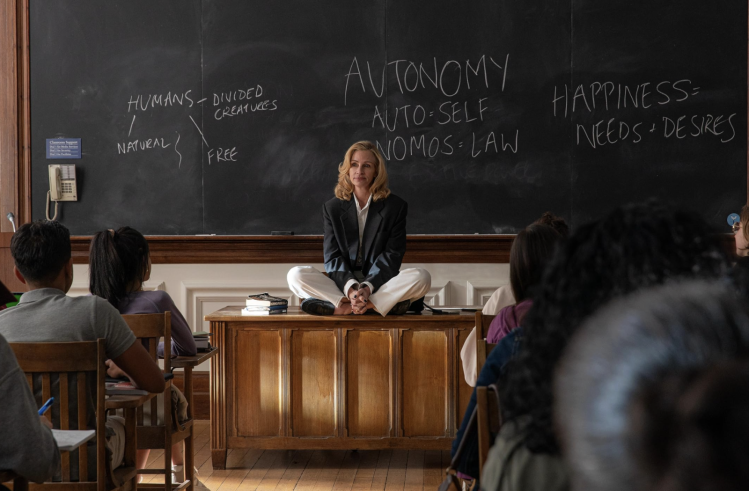
Take the scene in which Alma berates her students for wanting a softened, sanitized world “with all the edges sanded off.” It begins with a discussion of Hannah Arendt and her claim that we see ourselves fully only when we are reflected in another—or more accurately, the Other. When a female student meekly asks the professor what she means by that, Alma unloads: the students belong to a generation that cannot conceive of any subject except in relation to themselves; they are indifferent to the difficult truths that philosophy should seek. And so on.
Does this sound familiar? It’s strikingly similar to a famous scene from Todd Field’s 2022 film Tár, in which the eponymous Lydia Tár, a celebrated conductor, lectures a classroom of young Julliard students on the virtue of the old masters and the ephemerality of passing trends. Lydia is responding to a young “BIPOC pansexual” student who says he wants to expand the canon and let in new music. This scene is hardly balanced: the film gives Lydia much better lines and more time to deliver them. Yet whatever the film or its protagonist feels about the student’s views, he is allowed to express them at length; and when Lydia replies, her arrogance and irritability do not obscure her deep passion for music-making. Whatever else it does, this scene in Tár leaves us with the sense that both Lydia and her student care deeply about their art, and that arguments about music may be worth some hard feelings.
In After the Hunt, the arguments about philosophy don’t seem nearly as urgent. As I watched Alma ranting on and on, I realized that I did not know what kind of philosophy she was supposed to be teaching, or even what she herself believed apart from her low assessment of her students’ seriousness. Her students are even more of a blank; they exist only to lob softballs right down the center of the plate so that Alma can hit them out of the park.
There is a channel of real drama beneath all the hollow references and empty signifiers. It has to do with a wound from Alma’s past, which Maggie accidentally discovers during an early scene. The film doles out more information about this trauma bit by bit and physicalizes it during Alma’s periodic bouts of crippling pain. These scenes situate the film’s various conflicts in Alma’s relationship to her own past and allow her to become something more than a mouthpiece for vague grievances. They also inject some desperately needed moments of humanity and self-reflection. Unfortunately, they are drowned in a torrent of mostly glib dialogue and endless exposition, with ostensibly weighty ideas thrown on like a nice suit jacket, and all of it moving toward a conclusion that could be summed up as “lol, nothing matters.” After the Hunt is a superficial film about profound matters. It confronts our perilous cultural moment and then buckles at the knees.