While traveling through Austria and Germany late spring and early summer, I was thinking of Robert Musil’s unfinished novel The Man Without Qualities, composed almost a hundred years ago, and his description of Viennese high society in 1913—the verge of the Austro-Hungarian empire’s collapse. “Feelings are as important as constitutional law,” he wrote,
and decrees are not the most serious thing in the world. According to the constitution, that was a liberal system, but it had a clerical government. The government was clerical, but the liberal spirit ran the country. Before the law, all citizens were equal, but not everyone was a citizen.
Musil depicted a world on the moral, cultural, and political precipice of World War I. Some wonder if Europe today is on the precipice again.
The continent is at a crossroads, and the soul-searching extends to European Catholicism. The Church is divided over issues like Europe’s rearmament, the war in Ukraine, and the future of Israel and Palestine. The Church of the old continent is currently undergoing a process of globalization, with a growing number of students, teachers, priests, and religious from other parts of the world—including prelates coming from America to re-evangelize Europe. In the Vatican, we have the first U.S.-born pope. Europe is also rethinking its role in relation to America, not only politically, economically, and militarily, but also religiously. In particular, the German-speaking part of European Catholicism, associated with theological and ecclesial progressivism, is visibly nervous about the danger of Trumpism coming to the continent.
This can be seen in some of the current culture-war dynamics in Austria and the role of the liberal-conservative ÖVP party. Former chancellor Sebastian Kurz—a member of ÖVP who resigned in 2021 after a corruption probe and went to work for American billionaire venture capitalist Peter Thiel—has long been believed to be seeking a political comeback. Gudrun Kugler is a Catholic theologian and prominent ÖVP member of Parliament. She embodies the active political engagement of conservative Catholic networks in Austria, which are closer to neoconservative American Catholicism than to the much less visibly Catholic heirs and successors of European Christian-Democratic parties. Kugler graduated from International Theological Institute (ITI) Trumau, where since 2008 she has been a visiting lecturer in the institute for studies on marriage and the family. The ITI is a new kind of theological school, established by the Austrian bishops in the 1990s at the instigation of John Paul II. The founding president was Michael Waldstein, then a recently tenured professor at the University of Notre Dame, and today a professor at the Franciscan University in Steubenville, Ohio. Kugler also embodies a new, entrepreneurial Catholic public presence: in 2005, she and her husband Martin Kugler founded a faith-based dating site active in several European countries.
A shift in the ÖVP’s political stance was evidenced by its adoption of more rigid immigration policies and its collaboration with the right-wing populist and libertarian Freedom Party of Austria (FPÖ), which won the September 2024 parliamentary election with about 29 percent of the vote but failed to form a workable coalition. It has over time softened its anti-Catholic sentiments and has undergone an ideological transformation, embracing “cultural Catholicism” as a component of its national-conservative right-wing platform. A similar, performative use of Catholicism was visible also in the platform of the Swiss People’s Party in the 2023 elections. Mainstream Catholicism in Austria is increasingly concerned about the inroads made by American Catholic traditionalism. These tensions can be sensed at Cistercian abbey of Heiligenkreuz, leading to the June decision by the Vatican to send an apostolic visitation (a rare measure on Rome’s part).
There are similar worries in Germany over the rise of right-wing Catholicism. The urgent political and constitutional issue is whether or not to ban the right-wing radical party Alternative für Deutschland (AfD). In May, Germany’s domestic intelligence agency designated it as a right-wing extremist group, and the German bishops have also warned against it. But AfD is now the country’s most popular political party, according to recent polls. It was the biggest winner in the recent election in North Rhine-Westphalia, Germany’s most populous state, nearly tripling its showing from five years ago. The migration crisis of 2015 prompted the rise of this new right, which is going mainstream. Church leaders have struggled to deal with strong anti-immigrant sentiments fueled by populist politicians who can appeal effectively to Catholic voters.
The nervousness of mainstream and progressive German-speaking Catholicism was heightened by the long European tour of Bishop Robert Barron, who traveled to France, Germany, Ireland, and then Rome for the youth jubilee, describing his journey as “a multifaceted exercise in the evangelization of the culture.” (Barron has plans for Europe, including expansion of Word on Fire to the United Kingdom, and some European Catholics are interested.) The Josef Pieper Foundation in Münster, Germany, gave an award to Barron, who thus joins the ranks of Rémi Brague and Charles Taylor. Numerous lay groups, diocesan committees, and the prestigious Catholic theological faculty of the University of Münster criticized the foundation’s decision. The laudatio for Barron was given by Bishop Stefan Oster of Passau in Bavaria, further revealing the split within the German episcopate over the “German Synod,” whose prospects are now very uncertain. The controversy over Barron spread beyond Catholic circles and landed in German national media, including in outlets that typically don’t cover intra-Catholic debates.
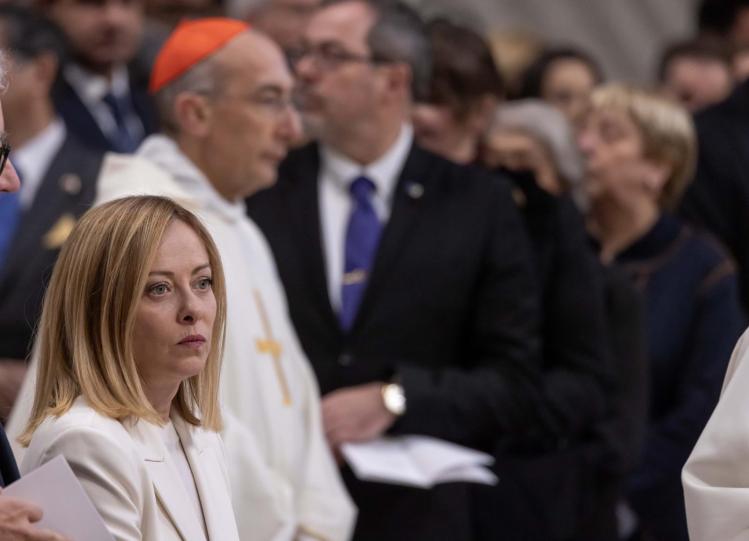
What’s happening in Austria and Germany is not so different from what’s happening elsewhere in Europe. It seems like another step in the ideological remaking of the relationship between Catholicism and politics, and also signals a drift in the Church’s support for a unified Europe. While the episcopates take a publicly antipopulist stance, this doesn’t preclude ideological shifts within the clergy and the laity. This is evident in Italy, where Giorgia Meloni leads a Church-friendly right-wing ideological coalition that has definitively replaced the twentieth-century Christian-Democratic platform. It’s a nonpracticing “cultural Christianity” that has a lot in common with Trump, with whom she is largely aligned (despite some rhetorical differences about the relationship with Israel). How the presence of a U.S.-born pope may affect things isn’t clear yet. But right-wing Italian politicians who never sought or obtained access to Francis seem eager to express their support for the new pope.
Other divisive issues are at play across the continent, including Russia’s war against Ukraine, the possible re-arming of Europe, and Israel and the Palestinians. Dogmatic exhortations from progressive European Catholics, like “never again war” and “never again genocide” seem quaint as new fears of Russian expansionism in Eastern Europe rise, while fading memories of the Holocaust and global criticism of Israel make European Jewish communities more anxious—and weaken the mainstream postwar consensus that brought Western Europe together.
The weakening of the mainstream consensus around Vatican II also has political consequences. Grace Davie argued in a keynote lecture at the annual conference of the European Academy of Religion in Vienna that the nature of European Catholicism is changing. There are signs of a non-inclusive “culturalization” of religion based on identity, political instrumentalization of religious issues (especially by those on the populist right), and a “quiet revival” of individuals seeking contact with religion or a return to the Church (especially young-adult males). Meanwhile, local churches are increasingly being served by ordained ministers and religious from other continents, even as American-style Catholicism is influencing new ideas for addressing secularization. Signs of change are visible in small Catholic churches far from Rome, in Iceland and across Scandinavia, whether it’s the result of internal European migration or new conversions from Protestantism. As one cardinal recently put it, many of these converts “ask for baptism because they have found Christ, but then we must help them discover how to be part of the Church.” Many in Europe still don’t know what to make of the boom in adult baptisms. It seems there may be a new kind of European Catholicism, having more in common with American Christianity (culture wars, multiculturality, adult conversions) than with the old model of dialectics between Christendom and secularization.
French cardinal Jean-Marc Aveline outlined the challenge for European Catholicism at a conference hosted by the Loyola Institute at Trinity College Dublin. He spoke of the need to develop a relationship with the Mediterranean and the Middle East at a time when theology after Gaza means a comprehensive restructuring of much that started at Vatican II—from the “signs of the times” to the beginning of Jewish-Catholic dialogue. The Dublin conference reminded theologians that in the post–Cold War period, the major challenge for European Catholicism and its theological organizations was to connect Western Europe and the Central-Eastern European countries once behind the Iron Curtain. It’s no longer the Eastern Europe we recall from 1989–1991—neither politically nor religiously. There is also a new relationship to imagine with Africa and the wider Middle East.
The second Trump presidency further confirms what former German chancellor Olaf Scholz called the “turn of the times” after the Russian invasion of Ukraine in 2022. J. D. Vance’s speech to the security conference this past February was a shocking moment for European Christians and Catholics—leftists, progressives, moderates, and centrists. The ideological war declared against the European consensus was also an indictment of the support that Catholics gave and still give to that project. The old elites of post-1945 European Christian-Democratic parties were intellectually better suited to decode the religious DNA of Europe and deal with the danger of Catholic integralism for the newborn liberal-constitutional democracies. European Church leaders (clergy and lay) now worry about a new phase in the intra-Catholic “culture wars,” in which European conservatism adopts the playbook of Trumpian Catholicism. European scholars have difficulty seeing the religious crisis that right-wing and populist parties interpret and manipulate. There’s the illusion that progressive politics can survive, or even win elections, talking only to “Pope Francis Catholics.” Progressive party leaders are visibly nostalgic for Francis; they wonder about the Pope Leo effect on Europe, America, and the Church as a whole. Among the enthusiasts for the new pope there are Catholics who ideologically support Trump and Vance and Catholics who are simply proud of this American son in the papacy. While this may prompt a necessary reset after the polarized intra-Catholic relations during Francis’s papacy, it also sends mixed messages to European Catholics about the politics of Leo’s pontificate.
European Catholicism is uniquely indebted to the legacy of Vatican II, and so this moment raises inevitable questions about ideas like ecumenism, interreligious dialogue, religious liberty, and relations between church and state. New forms of re-evangelization that defy the conventions of Christianity in secularized Europe also raise challenges. The institutions of the Tridentine–Vatican II Catholic order (diocese and parishes, seminaries and theological faculties in universities, and Catholic organizations under the control of the hierarchy) now play a much smaller role, while membership in lay-run ecclesial movements has plateaued. As the old ecclesiastical and ecclesial systems wane, new ones are waxing—influenced by what’s happening in the United States.