William F. Buckley Jr. (1925–2008), regarded as the intellectual father of modern American conservatism, had an adversarial but cordial relationship with Commonweal. He wrote three articles for the magazine, including a 1967 lament over the loss of the sonority and “inscrutable majesty” of the Latin Mass and what he regarded as the fatuities of the English translations of the new Roman Rite. “It is absolutely right that the vernacular should displace the Latin if by doing so the rituals of Catholic Christianity bring a greater satisfaction to the laity, and a deeper comprehension of their religion,” he wrote. “I pray the sacrifice will yield a rich harvest of informed Christians. But to suppose that it will is the most difficult act of faith I had ever been called upon to make, because it tears against the perceptions of all my senses.”
In 1960, Buckley engaged in a series of debates at Catholic parishes with William Clancy, a former Commonweal associate editor, on the perennial question of liberal versus conservative Catholicism. In an exchange printed in Commonweal, Clancy remained perplexed by Buckley’s complaint that liberal Catholics were more comfortable intellectually and culturally with secularists and socialists than with their more conservative coreligionists. In emphasizing civil rights for Black people, Buckley suggested, were not liberal Catholics neglecting their first duty, the saving of souls? In urging coexistence rather than confrontation with the Soviet Union, weren’t liberal Catholics ignoring the gravest threat to religious freedom? Buckley also insisted Catholics reject “root and branch, the animating prejudices of our secular scholarship.” Liberal Catholic support for labor unions, which he characterized as “dehumanizing institutions,” undermined the broader common good Catholics were obligated to seek.
Clancy disputed such claims, writing that he had repeatedly heard Buckley “describe [Clancy’s] own ‘liberal’ Catholic position, and [had] failed to recognize it.” Over the decades, many of Buckley’s interlocutors would make the same complaint. It was true, Clancy noted, that liberal Catholics had joined forces with secular and even atheist liberals, but that entailed no betrayal of Catholic principle. Why? Because it had been the “despised liberals” who had “fought the great battles for equality and for freedom” in the modern world. “Was it the Catholics of Europe who stood most strongly against anti-Semitism? In this country, has it been Catholics who have led the battle for Negro rights?…. I fear the answer is obvious. And again it is No.”
As it happens, I once met Buckley, though only briefly. In the 1990s, not long after I joined the magazine’s staff, Commonweal was invited to attend an episode of Firing Line, Buckley’s popular interview-and-debate program on PBS. He hosted the series, which ran to some 1,500 episodes, from 1966 to 1999. His earnings as host, often $500,000 a year, were donated to National Review, the “radical conservative” journal of opinion he founded in 1955. His father, “Will” Buckley, was a Gatsby-like figure—a lawyer, oil speculator, and outspoken Catholic reactionary. Will made his first million dollars in Mexico, and was the principal source of funding for the magazine during its first years.
“Bill” Buckley was famous for grilling his politically liberal guests while slouching in his chair and speaking in a somewhat undefinable patrician accent. His first language, learned from his Mexican nursemaid, had been Spanish, which he spoke fluently all his life. He came from a family of considerable, if precarious wealth, and had made his name first as chairman of the Yale Daily News and then in a book, God and Man at Yale (1952), which denounced his alma mater’s alleged repudiation of religion and capitalist individualism. Buckley’s Firing Line guest the day I met him was the liberal University of Notre Dame theologian Richard McBrien. Before the show’s taping began, Buckley introduced himself to the small audience in a room adjacent to the TV studio. Greeting us, he flashed his famous Cheshire-cat smile and spoke in an outgoing and gregarious manner. Given his reputation as a debater, I was surprised by how easily McBrien fended off his interrogations about liberal Catholic theology and politics. Buckley’s Catholicism was steeped in the certainties of the pre–Vatican II Catechism and shaped by a desire for the approval of his dominating father and pious mother, a daily communicant. Near the end of his life, Buckley insisted that he had never experienced any religious doubts, and his defense of Catholicism on stage and in writing exhibited an imperturbable confidence in the Church’s dogmatic claims and spiritual mission, even when he questioned certain Church teachings, such as Humanae vitae.
As Sam Tanenhaus shows in Buckley: The Life and the Revolution That Changed America, his massive but very readable new biography of this revered conservative figure, Buckley was essentially a performer, “a debater, not a thinker.” He never managed to produce the magisterial philosophical explication of conservatism he had planned to write. “Buckley’s function had never been to give theoretical substance to the movement,” Tanenhaus writes. “He was not its best or most serious thinker. He was its most articulate voice.” Easily bored when it came to intellectual details, he got by on his wits, preternatural self-confidence, and considerable charm. Even in college, where his father provided him with a secretary, Buckley was notorious for speaking authoritatively about books he hadn’t bothered to finish reading. His great skill—attested to by friends and adversaries alike—was as a listener who actually paid close attention to what other people said. Along with his best friend and future brother-in-law Brent Bozell, he was a champion college debater, vanquishing teams from both Harvard and Oxford. Bozell, later a speechwriter for Sen. Joe McCarthy and the ghostwriter of Sen. Barry Goldwater’s influential manifesto The Conscience of a Conservative, was the more systematic thinker. He handled the team’s positive argument while Buckley specialized in rebuttals.
Bozell had converted to Catholicism at Yale, married Buckley’s sister Trish, and was one of the founding editors of the National Review. In the late 1960s, he moved away from Buckley’s more pragmatic politics. Bozell would go on to found the arch-traditionalist Catholic journal Triumph and was an early antiabortion activist. Near the end of his life, he battled mental illness, a fate that brought Buckley to tears. Bozell’s grandson—Buckley’s grandnephew—Leo Brent Bozell IV, joined the January 6 attack on the Capitol. He was convicted in the assault and sentenced to four years in prison, before being pardoned in January by President Donald Trump. Trump’s takeover of the Republican Party with his “America First” rhetoric, an echo of Buckley’s youthful isolationist radicalism, haunts this book and raises troubling questions about the path on which Buckley’s lifework set the Republican Party. Buckley himself understood that Trump was “a narcissist we don’t want in politics.”
One the most appealing aspects of Buckley’s personality was the steadfastness of his religious and moral beliefs, though some of those beliefs were not at all appealing, even at the time. But there were subtle and important changes over time. Tanenhaus’s biography traces Buckley’s journey from the “radical conservatism” of his youth to the Burkean accommodations of his later years. In an earlier book, The Death of Conservatism (2010), Tanenhaus explained Buckley’s evolution succinctly: “In the disorderly 1960s it made no sense for conservatives to attack ‘statism’ when it was institutions of the State that formed the bedrock of civil society.”
Buckley announced his presence on the national stage in the first issue of National Review by famously proclaiming a determination to “[stand] athwart history, yelling Stop.” Thirty years later, he would acknowledge the necessity of Ronald Reagan’s seeming contravention of conservative orthodoxy when it came to actually governing. “Buckley’s approach was to wage the fight as long as he could with all the resources he could muster, giving no hint of irresolution or doubt until things looked hopeless, at which point he made a fresh set of calculations and abruptly pivoted,” Tanenhaus writes. Still, even when he disagreed with them, he continued to make excuses for right-wing provocateurs such as Pat Buchanan and Rush Limbaugh, who relentlessly waged the culture war against “liberal elites” that he had helped launch in the 1950s.
Although Buckley did not shy away from ad hominem attacks in debate or on the page, he was also known for his extraordinary financial generosity and for what the writer Murray Kempton called his “genius at friendships of the kind that passes all understanding.” His many friends included the writers Wilfrid Sheed and Norman Mailer, the economist John Kenneth Galbraith, and politicians such as Allard Lowenstein and George McGovern, the 1972 Democratic presidential candidate—all of them liberals of one kind or another. As an editor, Buckley was equally famous for his keen eye for talent, hiring Garry Wills, Joan Didion, John Leonard, Arlene Croce, Michael Lind, and David Brooks. Many of those protégés eventually abandoned political conservatism, yet all seemed to have remained admirers of Buckley. Tanenhaus, former editor of The New York Times Book Review and author of an excellent biography of ex-Soviet spy and Buckley mentor Whittaker Chambers, shares that admiration, though he, too, is a liberal. But affection for his subject has not inhibited him from writing about Buckley’s personal and professional errors and shortcomings. Tanenhaus had first met Buckley when he interviewed him for his Chambers biography. It was that book that secured for him Buckley’s approval and full cooperation for this biography. Tanenhaus is at pains to show that like many larger-than-life figures, Buckley was a man of contradictions.
Buckley became a national figure and the face of political conservatism when he ran for mayor of New York City in 1965. He was already in great demand as a syndicated newspaper columnist and college speaker. In 1962, his popularity as a campus speaker was second only to that of Barry Goldwater—and exceeded that of Martin Luther King Jr. As for his columns, he bragged about being able to dash off a seven-hundred-word piece in only twenty minutes. The New York City mayoral race pitted the machine Democrat Abe Beame against the favored John Lindsay, a liberal Republican. Buckley and National Review were on a mission to rid the Republican Party of liberals like Lindsay, New York governor Nelson Rockefeller, New York senator Jacob Javits, and earlier, President Dwight D. Eisenhower—the RINOs of their day. Buckley’s larger political goal was to thoroughly discredit liberalism, which he argued was a gateway drug to the evils of statism and socialism, the enemies of individual freedom. Buckley, whose initial National Review staff was stocked with disillusioned Marxists who brought the extremism of their former convictions to their new political faith, considered liberals “far more dangerous” than Communists.
Buckley chose to run for mayor as the candidate of New York’s small Conservative Party. In his public appearances and TV debates, he dazzled audiences with his erudition, sly jokes, and devastating rejoinders. He knew he had no chance of winning but thought that exposing the ineffectiveness of Lindsay’s program was worth the effort; it would help revive the radical conservative rebellion within the Republican Party shaken by Goldwater’s stunning 1964 defeat. Asked what he would do if he won, Buckley famously quipped, “Demand a recount.” His caustic attacks on Lindsay and severe law-and-order policy program provoked outrage from the liberal establishment. “As the fury mounted,” Tanenhaus writes, “Buckley remained as genial and relaxed as ever as he modulated effortlessly between his two personas: the ideological firebrand who made direct appeals to the outer-borough mob and the comic patrician who charmed Manhattan audiences.”
Buckley proved to be enormously popular with economically insecure middle- and working-class “white ethnic” voters outside Manhattan. Urban crime and disorder were pressing issues, and the city’s white majority resented the attention given to the poor Black population, especially by the welfare system. Buckley’s appeal to these voters anticipated Richard Nixon’s Southern Strategy and his appeals to the so-called Silent Majority in 1968. Ronald Reagan’s rhetorical assault on big government, which definitively ended the era of New Deal Democratic Party dominance, perfected such backlash politics. Buckley understood early on that the political war against liberalism was “ideological, but the battlefield was cultural.” That is a political reality that Trump understands and many Democrats still don’t.
As a teenager in the 1930s, Buckley was an admirer of the isolationist and race theorist Charles Lindbergh and his America First movement. It had long been Buckley’s ambition to lead an insurgency that would roll back, rather than compromise with, the dramatic expansion of the federal government under President Franklin Roosevelt. Here, the anti–New Deal and often antisemitic and racist attitudes of Buckley’s father and his associates were formative. When Bill was young, the libertarian Social Darwinist Albert Jay Nock, author of Our Enemy, the State, was a frequent guest at Great Elm, the grand Buckley estate in Sharon, Connecticut. Bill, who adored his father and prized his every word, considered himself the heir, and his father the actual founder, of the radical conservatism that National Review would make respectable. In 1921, Will Buckley was expelled from Mexico by a newly elected pro-democracy government that confiscated his oil holdings. Will had helped fund an unsuccessful counterrevolutionary movement there. The friendly attitude of the Woodrow Wilson administration—and especially its assistant secretary of the Navy, Franklin Roosevelt—toward Mexico’s democratizing forces further embittered Buckley Sr. toward the Democratic Party. He passed those grievances on to his son.
Bill Buckley cited Nock’s book in the first article he wrote for Commonweal, where he expressed his hopes for the 1952 Republican presidential candidate. The twenty-seven-year-old argued that “ideally, the Republican Platform should acknowledge a domestic enemy, the State.” He complained about collectivism, taxes, and the “horrors of welfarism” imposed by the New Deal, insisting on the “irreconcilability between individual freedom and State-sponsored security.” Yet he conceded that the existential threat posed by the Soviet Union required “Big Government for the duration.” That obvious contradiction in his thinking—like the tension between his libertarianism and cultural conservatism or his uncompromising individualism and the communitarian dimension of Catholicism—was never fully resolved.
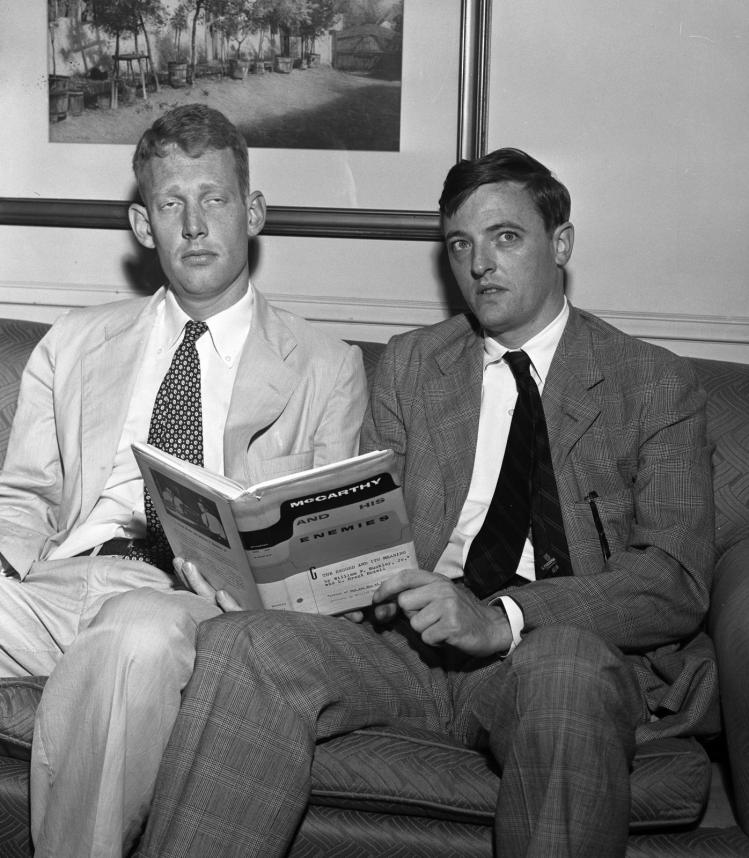
Tanenhaus writes sympathetically but critically about the more controversial episodes in Buckley’s long career, which included his unrepentant defense of Sen. Joe McCarthy’s red-baiting and conspiracy-mongering. With Bozell, he coauthored McCarthy and His Enemies, which defended McCarthyism while remaining largely silent about the man himself. Buckley’s anticommunism was militant and unwavering. He argued that a hundred million deaths would be an acceptable toll to defeat the Soviet Union in a nuclear war. In National Review, he explained “Why the South Must Prevail” in oapposing civil-rights laws and desegregation efforts. The young Buckley evidently agreed with Barry Goldwater’s assertion that “extremism in defense of liberty is no vice.” In that spirit, he railed against those protesting the Vietnam War and advocated for further military escalation.
Tanenhaus duly examines the infamous televised encounter between Buckley and Gore Vidal during the violent antiwar demonstrations at the 1968 Democratic Convention. Vidal called Buckley a “crypto-Nazi”; Buckley responded by calling Vidal a “queer” and threatening to “sock” him in the “goddamn face.” Tanenhaus also scrutinizes the nature of Buckley’s close but long-undisclosed relationship with convicted Watergate conspirator E. Howard Hunt. Buckley joined the CIA briefly in the early 1950s. He was sent to Mexico City, where Hunt, a veteran CIA operative, was his supervisor and became a good friend. Buckley would become godfather to Hunt’s three children. These compromising facts were not revealed to readers when Buckley wrote about the 1972 break-in at Democratic Headquarters in Washington D.C. “Garry Wills accused him of being Hunt’s ‘apologist, protector, and propagandist,’” Tanenhaus notes.
In his financial affairs, Buckley, like his wildcatting father, was more gambler than prudent investor. He nearly went bankrupt during the stagflation of the 1970s. In 1979, he was fined six hundred thousand dollars by the Securities and Exchange Commission for violating antifraud law. “I am no good with figures,” he tried to explain. “I don’t understand them.” At the height of his fame, he was earning two to three million dollars a year from his column, speaking fees, and book royalties. “As much as he earned, he spent a good deal more,” according to Tanenhaus. That aspect of his personality can perhaps be attributed to the fact that he grew up “in a family that embraced secret lawlessness.” Throughout his life, Buckley winsomely “delighted in breaking the rules.” Tanenhaus also writes appreciatively of Buckley’s books about his sailing adventures as well as his wildly successful series of spy novels featuring the Yale-educated CIA operative Blackford Oakes. Those books were written during an annual five-week skiing “vacation” in Switzerland, where the Buckleys lavishly entertained such friends as the actor David Niven, Vladimir Nabokov, and Sen. Ted Kennedy.
Buckley’s parents were both Southerners, his father from Texas and his mother from New Orleans. In addition to their estate in Connecticut’s Litchfield County, which Will refashioned to resemble a Mexican hacienda, the family had a manse in Camden, South Carolina. His parents were firm segregationists, financial supporters of the racist Citizens’ Councils, and publishers of a local newspaper vehemently opposed to the civil-rights movement. They attributed Black protests to “outside agitators,” insisting relations between the races were amicable and just, and the inferiority of Black people was a fact of nature. At the same time, the Buckleys were known for the generosity and kindness with which they treated their Black and Mexican employees. That, they believed, was a Christian duty, not an obligation the government should impose. Given this heritage, it is perhaps not surprising that as a Yale student, Buckley prevented a racially mixed social event from taking place. In the 1960s and ’70s, he would seem sympathetic to the views of Black separatists he interviewed on Firing Line. It would take decades before he changed his mind about race relations. Finally, in 2004, he conceded to a New York Times reporter, “I was wrong; federal intervention was necessary.”
There were many poignant moments, and much tragedy, in Buckley’s life. Like all marriages, his long and devoted marriage to Patricia Taylor, a Canadian heiress who was as headstrong as her husband and who devoted herself to New York high society, had its tensions. Buckley’s despair over her death seemed to deprive him of the will to live. He died less than a year later. Both lifelong smokers, in their final years Bill and Patricia suffered from debilitating medical conditions. The travails of his siblings, whom he often supported financially, weighed heavily on him. “Industry is the remedy for melancholy,” he liked to say, and that helps to explain his extraordinary energy and productivity. He authored some fifty books and lectured or debated nearly every week. He bravely fought to rid American conservatism of its historical antisemitism. It seems to have been a deeply personal matter. At his father’s demand, Buckley intervened to end the romantic relationship between his sister Jane and Tom Guinzburg, a Jewish roommate of Buckley’s at Yale. Buckley had introduced them, and Guinzburg had been a frequent guest at Great Elm. But Bill’s father was adamant. “We don’t want a Jew in the family,” he told his son. Bill Buckley did what he was told, spoke confidentially to Guinzburg, and the suitor reluctantly ended the relationship without telling Jane why. She was devastated, and according to her brother Reid, for the rest of her life had “probably known the least personal happiness of us all.”
Writing about Buckley’s “several selves” in Commonweal, the novelist and critic Wilfrid Sheed remarked that “Bill still shows the unmistakable signs of a happy childhood.” William F. Buckley Sr., despite his many prejudices, evidently provided his children with a remarkably enchanted childhood, one animated not just by strong beliefs and expectations, but by much love. Before being sent off to prep school, the children were tutored at home, where history, literature, languages, and music were emphasized. (Math was conspicuously neglected, an oversight that would yield unpleasant consequences in Bill’s prep-school academic struggles and in his adult years as a businessman and investor.) Bill loved Bach and played both the piano and harpsichord quite well. There was horseback riding and sailing on a nearby lake.
During their college years, the siblings regularly entertained at the estate. The poet Sylvia Plath, a friend of Maureen Buckley’s at Smith College, attended Maureen’s debutante coming-out party at Great Elm in the early 1950s. “How can I ever, ever tell you what a unique, dreamlike and astounding weekend I had!” Plath wrote to her mother. “Never in my life, and perhaps never again, will I live through such a fantastic twenty-four hours…. Great lawns and huge trees on a hill, with a view of the valley, distant green pastures, orange and yellow leaves receding far into the blue-purple distance…. We walked through the hall, greeted by a thousand living rooms, period pieces, rare objects of art everywhere.” The evening culminated in hours of dancing, the music provided by Manhattan’s “premier society bandleader,” Lester Lanin.
“In his time, as in our own, no one really could say what American conservatism was or ought to be,” Tanenhaus writes in conclusion. “Buckley himself repeatedly tried to do it and at last gave up.” He was buried, along with his wife’s ashes, in the graveyard of the small Catholic church in Sharon not far from Great Elm, which had been sold years before and turned into condominiums. We can continue to debate whether Buckley’s crusade to curb the excesses of liberalism was a necessary check on political hubris or a perilous invitation to something far worse. What’s clear is that something far worse has now arrived. It remains for us to determine whether this country will survive the populist demagogue who has inherited the remnants of Buckley’s zealous struggle to shrink the federal government and protect individual liberty—as he understood it.
Buckley
The Life and the Revolution That Changed America
Sam Tanenhaus
Random House
$40 | 1040 pp.