From the moment then-cardinal Robert Joseph Prevost said accepto (“I accept”) in the Sistine Chapel on May 8, 2025, and announced his papal name as Leo XIV, he officially became the 267th pope of the Catholic Church. Those words, along with his welcome speech on the loggia of St. Peter’s (“Peace be with you all!”), marked the beginning of his papacy, but they were outside the context of a liturgical service. That will change on May 18, when the formal papal inauguration ceremony will take place in St. Peter’s Square. The inauguration is a global affair drawing dignitaries from all over the world. It also acknowledges the pope’s seat as the head of a country and the representative of 1.4 billion Catholics. The installation of a pope has evolved over the past thousand years, but it still incorporates many aspects of the medieval ceremony.
The first papal coronation ceremony on record is that of Pope Nicholas I in 858. Even before the conclave process was formalized in the thirteenth century, the new pope immediately assumed papal authority, with all rights and privileges. The medieval coronation ceremony also included a formal act of homage from all the College of Cardinals, known as the “first obeisance,” in which they knelt before the pope and kissed the fisherman’s ring. This homage has been scaled back; six cardinals approached Pope Francis at his 2013 inauguration ceremony.
One of the most well-known symbols of the coronation ceremony was the ornate papal tiara, the headpiece that had been placed on the pope’s head at his coronation since 1143. Traditionally, it was called the triple tiara for the three components of the papacy’s mission: to instruct, to govern, and to sanctify. Some of these tiaras weighed nearly twenty pounds, so heavily were they encrusted with jewels. Over twenty of the silver tiaras are housed in the Vatican Museum. When Rome was under French occupation during the Napoleonic Wars, some of the tiaras were seized as part of the papal treasury, and subsequently melted down. As a result, when Pope Pius VII went to Venice for his papal coronation in 1800 without formal regalia, local women quickly fashioned a tiara made of papier-mâché.
The Vatican II era ushered in many of the changes to the papal installation. Among the many topics the council reformed was the way that clergy and religious dressed. The change most noticeable to the Catholic community was that many nuns opted to forgo the traditional habit in favor of more modern clothing. But the papacy also sought to rethink elements of its style, especially due to the “many and grave words expressed in the Council on the misery and hunger of these days,” as Pope Paul VI put it. On November 13, 1964, in a show that the Church would forgo elements of pomp and “triumphal” clothing, Paul removed his elaborate papal tiara. To refer to this gold and silver headpiece encrusted with diamonds, sapphires, emeralds, and rubies as ornate is an understatement; its estimated value is between $15,000 and $80,000. Following Pope Paul’s ceremonial abandonment of a tradition going back to 1143, the crown was sold, with the money going to “the poor of the world.” It is now displayed at the Basilica of the National Shrine of the Immaculate Conception in Washington D.C.
A few decades later, Pope Benedict XVI brought back many Renaissance-era elements of papal attire, such as the red-velvet cap with white ermine fringe called a camauro. His mitres were notably taller than those worn by Pope John Paul II. Esquire even named Benedict the “accessorizer of the year” in 2007. Pope Francis opted for less assuming attire. When he stepped out on the balcony overlooking St. Peter’s Square on March 13, 2013, he wore a plain white papal cassock, not the red mozzetta with white ermine trim and the gold embroidered papal stole of his predecessors. In his first public appearance on the loggia, Pope Leo XIV wore the red mozzetta and a red stole, but since then he has been dressing in the simple white papal cassock and white zucchetto (skullcap).
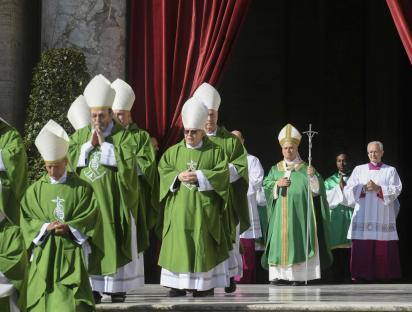
The first part of the inauguration of Pope Leo XIV will begin underground at the tomb of St. Peter, the first Bishop of Rome. Then the inauguration Mass will be celebrated in St. Peter’s Square. Elements of the Mass will be in Latin, but other languages may be used too, especially in the readings and Pope Leo XIV’s homily. During the inauguration ceremony, the pope will receive two more symbols of his pastoral authority. First, the pallium—a stole with one pendant hanging in the front and another in the back—will be placed around his neck. This liturgical vestment has its origins in the fourth century, and usually features wool from lambs offered to the pope on the Feast of St. Agnes (January 21). The imposition of the pallium shows the pope as the good shepherd and highlights his jurisdiction over the universal Catholic Church. The pope will also receive a new fisherman’s ring: a signet ring that shows an image of St. Peter and identifies the pope as a “fisher of men” (Matthew 4:19). Each of these acts underscores Pope Leo XIV’s role as both Bishop of Rome and head of the universal Catholic Church.
Following the Mass, Pope Leo XIV will formally receive global dignitaries in St. Peter’s Basilica. In his first Sunday address, Pope Leo stated, “I would also like to address the powerful people of the world, repeating the always current call: ‘No more war.’” One can imagine his homily and individual conversations with world leaders on Sunday will carry a similar message.
In the following days, Pope Leo XIV will also take formal possession of the other major basilicas in Rome. On May 20, he will visit St. Paul Outside the Walls. He will take possession of St. John Lateran, the oldest and highest ranking of the major basilicas, on May 25, formally marking him as Bishop of Rome. On that same day, he will also return to the Basilica of Mary Major—the oldest Marian church in Rome and the site where Pope Francis is buried. With those ceremonies behind him, Pope Leo XIV will begin his formal work—and Catholics around the world will continue to watch for the words and signs of what this papacy will bring.