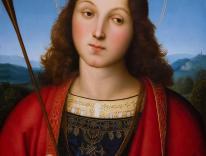
I sat in my friend Adeena’s Harlem apartment last summer, holding a deck of tarot cards. In response to her query about the state of her love life, I pulled the final card and set it in front of her: the Devil. A card that questions a person’s ability to discern whether a risky decision is self-liberating or self-limiting seemed like a generous interpretation of her “situationship” with a man who wore “God Is Dead” T-shirts under silver chain necklaces with crucifixes. Adeena, a product manager at an AI company who told me she had only been inside a church twice in her life, begrudgingly sighed at the tarot’s warning. Packing away the cards, I wondered: How could a woman so void of religious curiosity trust a spiritual channel sold at The Oracle Shop, a wellness and metaphysical supply store in Brooklyn?
The beginning of an answer may be found at the Morgan Library and Museum’s new exhibition, Tarot! Renaissance Symbols, Modern Visions, on view in New York through October 4, 2026. As the title hints, the show tracks the history of tarot from a courtly card game in fifteenth-century Milan to a map of the modern subconscious.
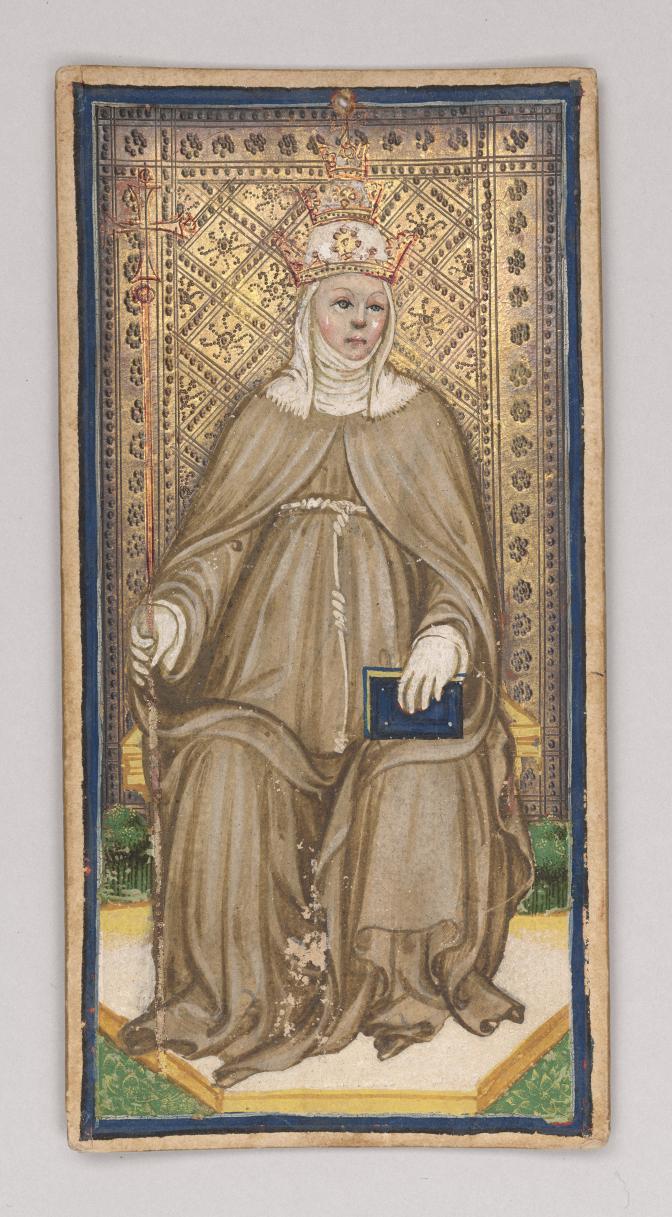
The first half of the exhibit, Renaissance Symbols, showcases a significant portion of cards from the original Visconti-Sforza deck (circa 1456–8), originally commissioned by the aristocratic Visconti and Sforza families as a skilled trick-taking game. The twenty-one “Major Arcana” cards illustrate allegorical and conceptual forces like Fortitude, the Devil, and the World, while the rest of the deck, the “Minor Arcana,” is divided into four suits. Renaissance Symbols concludes by tracing tarot’s later spiritual turn, first cultivated by eighteenth-century French occultists who assigned mystical Egyptian origins to the practice. They claimed tarot could reveal the hidden order of a world repressed by Christianity and national bureaucracies.
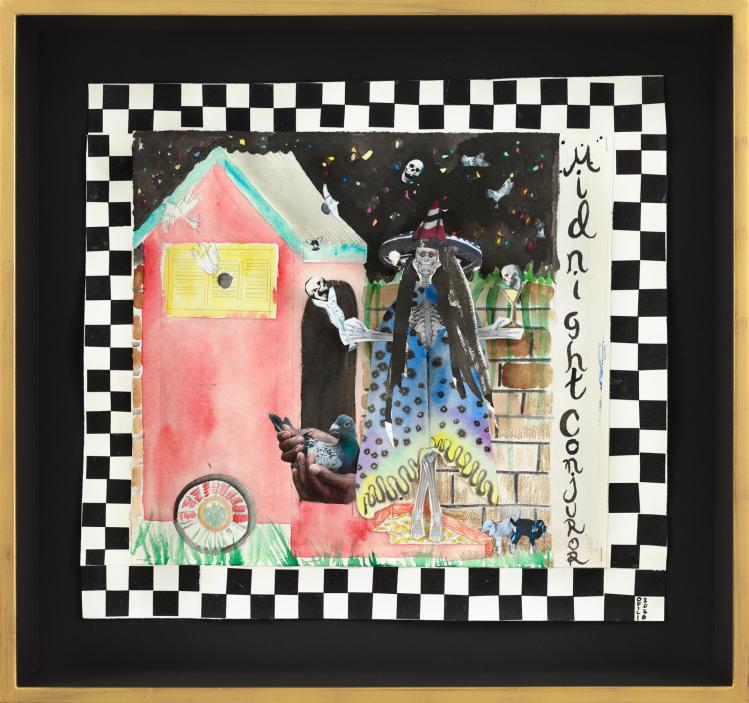
The exhibition’s second half, Modern Visions, begins after British industrialization, with Pamela Colman Smith’s 1909 Rider-Waite-Smith deck, the first designed expressly for esoteric reading. That deck solidified tarot’s now-standard structure of seventy-eight cards, with twenty-two Major Arcana that included the Fool: a figure on a journey to enlightenment who passes through the deck’s succession of archetypes, including Justice, the Emperor, and the Lovers. From there, the show moves on to figures like Aleister Crowley, whose surrealist circle produced its own deck in the early 1940s, and into the twenty-first century. It concludes with more recent work, like British artist Chris Ofili’s new Trinidad Carnival–inspired illustrations.
While the two halves of the exhibit showcase intricate canvas art inspired by tarot cards, the interstitial gallery between them features a film reel of tarot’s influence on world cinema and pop culture. Featured are scenes from Alejandro Jodorowsky’s psychedelic masterpiece The Holy Mountain (1973), the favorite weird-girl classic of me and my friend Miranda, who gifted me my first tarot deck. (As custom—or superstition—now demands, your first deck must be gifted to you.)
The clip reminded me of a day trip we took to San Francisco together five years ago. We had been discussing how to petition our college’s financial-aid office to buy us winter boots (specifically, vintage Demonia combat boots from eBay) when we witnessed a man in a Patagonia quarter-zip and an Apple Watch spray paint the phrase “turn on, tune in, drop out” on the side of a boutique coffee shop. We mocked him all the way to the Castro District, where Miranda bought me the Tarot de Marseilles deck that The Holy Mountain is based on. One yuppie’s rebellion is another shabby bohemian’s sign.
Miranda had learned tarot from her mom, who had learned it from her own mother in Brazil, where New Age spiritual rituals took off in the 1960s and ’70s. For them, tarot was a part of their practice of Umbanda, a Brazilian religion that combines African deities, Spiritism, and Catholicism. Miranda’s grandmother had learned it during the 1964–85 military dictatorship that imprisoned her first husband. Miranda explained to me that honest tarot readers have stakes—that is, they must have a force behind them that encourages them to discern something obscured by outside forces. She encouraged me to meditate on the sights and scenes of my Mexican-American upbringing in the Texas borderlands. Tarot, she explained, was a tool to connect with the people and places lost to time, especially those lost to violence.
Each tarot spread can include any number of cards, up to seventy-eight total, with each representing a different feature of the emotional or psychological processing by the “querent” (the “seeker” who sits opposite the reader). Together, the cards present a narrative about the situation and its possible ramifications for the querent. I asked Miranda if her grandmother used them to discern something about the dictatorship. No. Her grandma first learned how to pull cards to decide whether she wanted to marry her second husband…and then her third. Then she used the cards to ask where she went wrong as a mother after her daughter had premarital sex. She consulted them one last time when she wondered whether it was finally okay for her to rest in old age.
I took Miranda’s view to heart that despite popular belief, tarot is not a predictive practice so much as a connective one. Whether it be from ancestral resonance or the relationship between the person reading the cards and the querent, at its best, tarot provides a means of confronting our unspoken and perhaps unconscious anxieties. It’s not surprising that the overwhelming majority of people who practice tarot are women and queer folks, whose social and sexual and interior experiences are often pushed aside or flatly rejected by religious and governmental institutions. The tarot deck allows them to express their desires from a nondefensive standpoint.
I considered this even when reading cards for Adeena’s situationship. Unlike Miranda’s grandmother anticipating state violence in Brazil during the 1960s, Adeena fills her days with white-collar work, kickboxing classes, happy hours, and museums. She exemplifies the material successes of feminism and capitalism. Yet, despite their disparate realities, both women were seeking emotional fulfillment and human connection in a world that alienates them from those deeper desires. Both were unable to believe in a system that prioritized those needs equally with power and money. All that was left was the self and each woman’s focus on crafting her individual internal narrative.
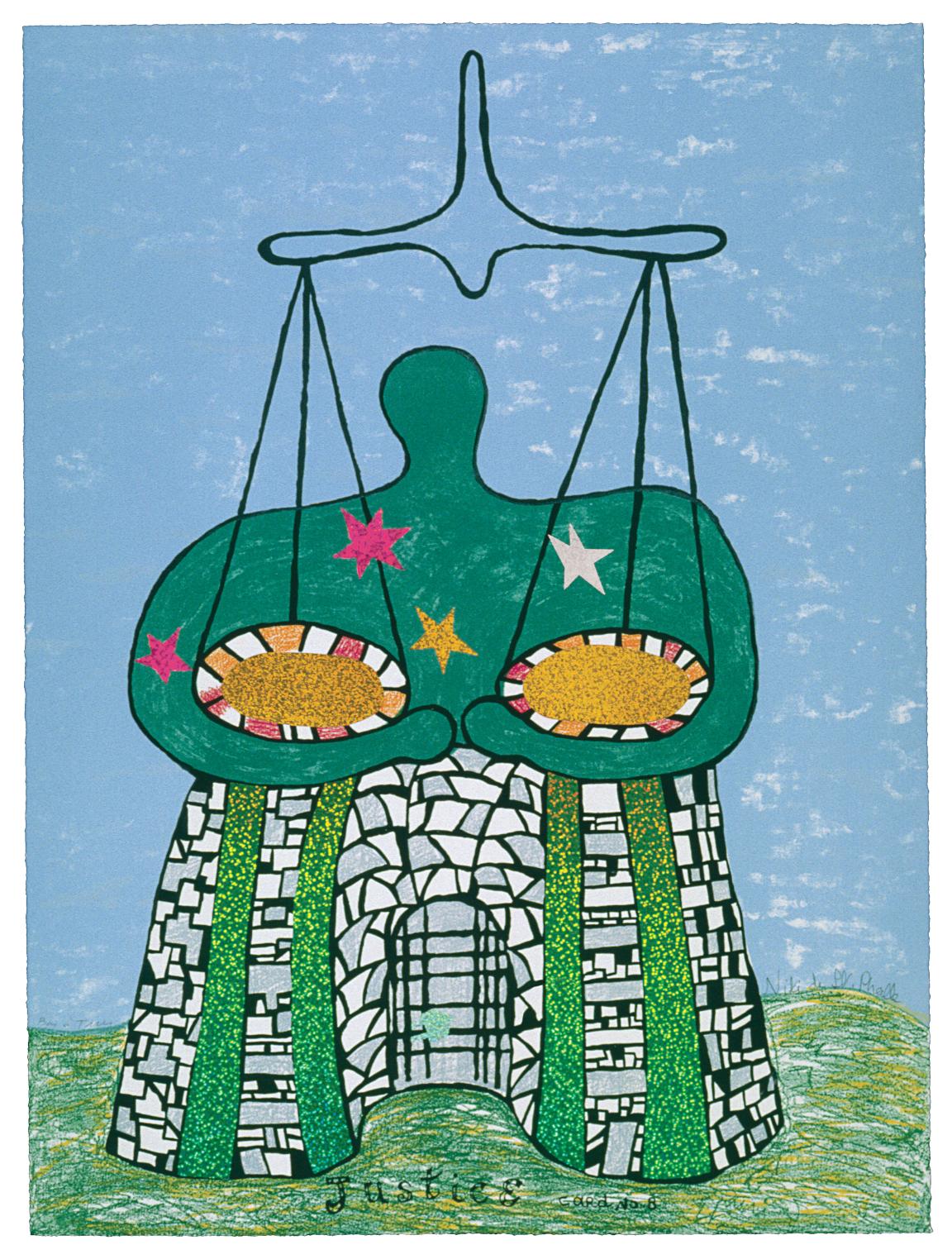
Therein lies tarot’s irresolvable tension: while it has become part of a spiritual practice that encourages self-actualization, tarot mimics the same individualism that produces the need for it in the first place. Without any religious or political obligations, tarot as practiced in the wealthy industrialized West transforms into a cultural product aligned with self-help guides and self-monitoring practices. In the Global South, specifically Latin America, scholar Isabel Ortiz worries that
tarot cards are shown to ultimately help characters tell stories of themselves as much stronger than they might feel in the moment, but often at the expense of being able to name or directly face the social forces to which they are vulnerable, that have so starkly exposed their fragility in the first place.
Even when sincerely practiced, tarot is awash in contradictions.
The Morgan show, despite the curators’ good intentions, is hardly immune from those contradictions. In his specially commissioned collages, Chris Ofili intertwines colonial history, Catholicism, and Trinidadian Carnival characters with the intent of representing how archetypes like the Devil appear under capitalism. A focal point in his Diablo illustration is a white masquerader painted in blackface with a stomach full of Trinidadian Crix biscuits, in reference to Paul’s assertion in Philippians 3:19 that enemies of Christ’s cross are those “whose god is their belly.” The work is vibrant and beautiful; and yet, it’s more than a little ironic that it’s displayed in the belly of an institution founded by archcapitalist John Pierpont Morgan.
Like most museums, the Morgan Museum and Library is deeply implicated in legacies of colonialism and capitalism. Why should we revere it? But perhaps protesting is often as naïve as it is selfish. It would also be oppressive to refuse artists of color access to global recognition or the resources provided by wealthy institutions like the Morgan. Much like tarot, the art world constantly negotiates the need for self-preservation and submission to financial reality. This is true of the show, too; who can blame the curators and the artists for making accommodations? Not me—and maybe that’s okay. Maybe it’s okay, too, that our spiritual lives are not constantly tied to the pressures of liberation. Perhaps, sometimes, it is enough to have somewhere to turn when you really like a boy who won’t get a job so he can focus on his jewelry-making.
We welcome your comments about this article. Please send your response to [email protected].