For many critics of the Trump administration’s ever more violent and indiscriminate campaign of mass deportation, one of its most disturbing features has been the increased penchant of Immigration and Customs Enforcement (ICE) officers for hiding their faces during raids. Some have maintained that the proliferation of balaclava-clad ICE agents, who call to mind the “secret police” of totalitarian states, is yet another warning sign that the United States is descending into autocracy.
Prominent Democrats have begun to push back against this trend. In September, California governor Gavin Newsom signed into law a measure that prohibits all law-enforcement officers—whether federal, state, or local—from wearing face coverings while interacting with members of the public. Similar bills have been filed in places like Florida, Illinois, and Seattle, and New Jersey’s Governor-elect Mikie Sherrill has pledged to advance one when she is sworn in early next year. At the national level, dozens of Democratic senators and representatives have now signed on to the Visible Identification Standards for Immigration-Based Law Enforcement (VISIBLE) Act, which would forbid ICE agents to wear masks.
Major questions remain about whether such laws, especially when they involve states attempting to regulate actions of the federal government, can survive the court challenges they will inevitably draw. And for its part, ICE has already declared that it will ignore the one in California. But there are nevertheless some indications that the backlash may already be having an effect: in mid-November, Trump’s own FBI released a memo requesting that ICE officials stop wearing face coverings while on duty, citing instances of masked individuals committing crimes while claiming to be from law enforcement.
For the most part, though, Republican politicians have defended the practice, citing ICE agents’ understandable desire to avoid being targeted by activists opposed to the administration’s immigration policies. Trump’s “border czar” Tom Homan has conceded that he doesn’t “particularly like masks,” but has still argued that “the ICE officers need the mask because their families are being doxed.” Yet despite the contentious debate over whether immigration officials should have the right to cover their faces, there is one thing that leading figures in both major parties do seem to agree on: anyone else who masks in public is probably a criminal—and ought to be treated accordingly.
After the onset of the Covid pandemic half a decade ago, mask-wearing was, for a time, broadly encouraged by public-health officials, and even made mandatory in certain contexts. Yet the pendulum has now swung far in the other direction. Since the war in Gaza began in October 2023, masks and other face coverings have become associated with large-scale protests in support of the Palestinians, and politicians in both major parties have moved to crack down on their use.
New York governor Kathy Hochul, a Democrat, first floated the idea of reviving her state’s prepandemic ban on face coverings in June 2024, claiming that restrictions on masking would help to combat antisemitism and public disorder. If “you’re sitting on a subway train and someone puts on a mask,” she told an interviewer, “you don’t know if they’re going to be committing a crime, they’re going to have a gun, or whether they’re just going to be threatening or intimidating you because you are Jewish.” Los Angeles mayor Karen Bass, another Democrat, mused about banning masks in her own city, citing the same concerns over alleged antisemitic incidents involving masked perpetrators. And later that summer, the Republican-led legislature in Nassau County, New York, passed a first-of-its-kind law creating a new misdemeanor charge for wearing a mask in public, with violators facing fines of up to $1,000 and jail time of up to a year.
Identity-based harassment is always deplorable. But many who wear masks at pro-Palestine demonstrations do so not because they are trying to bully others, but because they too fear being subject to doxxing or retaliation for expressing their views. Indeed, the Trump administration’s efforts to detain and deport student activists like Columbia University’s Mahmoud Khalil and Mohsen Mahdawi or Tufts University’s Rümeysa Öztürk—who was taken into custody by masked plainclothes officers in March—prove that such fear is entirely rational.
This puts the hypocrisy of the GOP position on masks into stark relief. Why should ICE agents be able to wear them to avoid being targeted, but not undergraduates exercising their constitutional rights to free speech and assembly? At least the position of many establishment Democrats is consistent: they now treat every mask as an indicator of unlawful behavior, regardless of whether the person wearing it is an immigration officer or a student speaking out against ethnic cleansing. This is a dangerous view not only because of the equation of peaceful protest with criminality, but because the drive to ban masks, even where it does not meet with legislative success, will have deleterious consequences for public health.
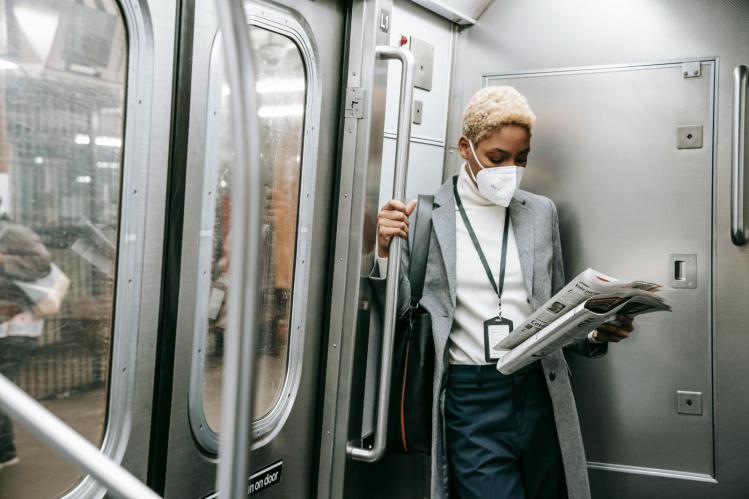
High-filtration masks like N95 respirators remain a valuable tool for curbing transmission of airborne diseases, an underappreciated cause of significant mortality and morbidity. Measles, once all but banished by high childhood-vaccination rates, is now resurgent—largely because of growing antivaccine sentiment. Influenza, often written off as a minor nuisance, is still difficult to control through immunization alone and leads to a minimum of several thousand deaths in the United States each year. And when it comes to Covid, Duke University medical professor Cameron R. Wolfe notes that “most people, including clinicians and policy makers, are not aware that COVID-19 killed more Americans [in 2024] than breast cancer or car accidents…. There is still an unacceptable burden of severe sickness and hospitalization, not to mention Long COVID, all of which is borne disproportionately by immunocompromised persons.”
Some have erroneously insisted that N95s are unable to prevent the spread of viruses like SARS-CoV-2, which causes Covid, because these pathogens are too small for such masks to capture. But the Occupational Safety and Health Administration, citing results from real-world testing, has made clear that this “mistaken claim appears to result from a misunderstanding of how respirators work.” When used properly, N95s are extremely effective at filtering out even the tiniest of particles.
Nor are the health benefits of respirators limited to infectious disease prevention. N95s are also one of the best forms of protection against the inhalation of harmful smoke from wildfires, which have been growing in frequency and intensity across North America. Opposition to masking only makes society less prepared for dealing with such crises. When the Eaton and Palisades fires struck the Los Angeles area in early 2025—less than a year after the mayor called for banning masks in the city—it was primarily local mutual-aid groups and “mask blocs” formed in response to Covid that led the distribution of respirators and other protective supplies.
Defenders of mask bans will contend that they usually have at least some exceptions for health-related uses, as well as for those who cover their faces for religious reasons. But these exceptions can be quite narrow: while Nassau County’s law exempts “facial coverings worn to protect the health or safety of the wearer,” the New York Civil Liberties Union (NYCLU) has pointed out that “someone who wears a mask for the sole purpose of protecting a family member who is immunocompromised from exposure to illness” would not be covered by this proviso, nor would anyone who masks to avoid spreading a contagious disease to others. Worse, turning law-enforcement officers into arbiters of who has the right to mask opens the door to discriminatory application of the ban. As the NYCLU puts it, “Nassau County police officers are not health professionals or religious experts capable of deciding who needs a mask and who doesn’t.”
How did we get to this point? Rather than shifting societal norms toward broader acceptance of masking, like that seen in some Asian cultures, the pandemic seems to have had the opposite effect. In part, this is the result of messaging from the top: after the Biden administration began treating Covid as over and done with, officials started talking about masks as a “scarlet letter” and those who chose to wear them for health reasons as “fringe.” This heightened stigma is both cause and consequence of antimask rhetoric from political leaders. Shifting attitudes have made it possible for elected officials to press for bans, but even when masks aren’t actually outlawed, talking about them as if they somehow jeopardize public safety discourages their use.
In states around the country, disability advocates are now fighting back. In Illinois, a coalition of organizers has partnered with a state representative to introduce the Protective Medical Equipment Freedom Act, which would codify into law a right to wear protective medical equipment, including N95 respirators, in public places. A group of almost a hundred grassroots organizations was also able to head off Governor Hochul’s attempt to slip a mask ban into the state budget this past spring. (Instead, state lawmakers agreed to a different provision that creates a new charge for concealing one’s identity while committing another crime, without declaring masking itself illegal.) And while New York City mayor Eric Adams, a longtime opponent of masks, vowed thereafter to continue his push to criminalize them locally, Adams’s successor, democratic socialist Zohran Mamdani, has signaled he will take a different approach.
To return to the topic du jour: Would firmer legal protections for masking mean that ICE agents would get to keep their balaclavas? In a sense, this question is beside the point. Even if immigration officers could be compelled to show their faces, that alone would not put an end to ICE’s lawless conduct, which may be beyond the possibility of reform. The debate should no longer be narrowly focused on the agency’s dress code, but whether it ought to exist at all.
So long as it does exist, however, it’s worth noting that most of the legislative proposals aimed at unmasking ICE do contain exceptions for masks that are worn for health-related reasons. Right-to-mask bills, therefore, would not grant any prerogatives that aren’t already contemplated by legislation like the VISIBLE Act. (The right-to-mask coalition in Illinois, for one, has explicitly stated that “ski masks and balaclavas are not, in fact, protective medical equipment.”)
It’s also important to remember that ICE agents have been taking other steps to conceal their identities, like failing to show badges or name tags, so banning masks would not necessarily ensure that agents of the state could always be identified as such. This has not escaped the notice of those who drafted the VISIBLE Act, which would also require immigration officers to “display clearly legible identification—including their agency name or initials and either their name or badge number—in a manner that remains visible and unobscured by tactical gear or clothing.” In fact, the California legislature passed a companion bill with similar stipulations at the same time that it proscribed masks for law enforcement.
Our country is at a perilous juncture, confronting escalating threats to democracy, the environment, and public health all at once. Against that backdrop, it can be tempting to look for scapegoats or easy fixes. But the preoccupation with masks is a distraction that gets us no closer to addressing deeper issues, like hatred of immigrants and popular support for leaders who persecute them. ICE unmasked is still ICE; the real problem isn’t its wardrobe, but its mission.