While the recent attack on Venezuela and the capture of President Nicolás Maduro have been a startling and disturbing escalation of U.S. antagonism toward the country, U.S. economic sanctions against Venezuela for the past two decades have done considerable damage in their own right and serve as a precursor to the recent military aggression.
Economic measures have often been employed in the context of warfare, sometimes with devastating effect, as in the siege of Leningrad and the British blockade of Germany during World Wars I and II. But as economic sanctions emerged as a form of global governance—first with the League of Nations, and later with the United Nations—there was also an expectation that sanctions employed for this purpose must not be used in a way that would violate human rights and international law. In the 1980s, sanctions came to be seen as an important means of securing rights, as the sanctions and divestment movement against South Africa played a critical role in the end of its apartheid regime. After Iraq’s invasion of Kuwait in 1990, everyone from pacifists to realists urged the imposition of sanctions against Iraq to compel Saddam Hussein to withdraw from Kuwait. The UN Security Council’s comprehensive sanctions on Iraq, binding upon every member state of the UN, deeply disrupted Iraq’s economy and put enormous pressure on the state. But in short order, as the first Bush administration began pressing for a military incursion into Iraq, it became clear that the U.S. government had not meant for the sanctions to resolve the problem, but rather to serve as a precursor to a military attack, over the objections of leading American statesmen and military leaders. It was a version of the “last resort” principle under just-war doctrine: declare that the sanctions have not worked, so that the only choice is to escalate to war. At the same time, because the sanctions undermine the country’s military and industrial capacity, the sanctions serve to “soften up” the target in anticipation of a military attack.
We have seen something similar play out in Venezuela. The United States first imposed sanctions in 2005, on the grounds of corruption and antidemocratic policies. Other sanctions, related to drug trafficking and human-rights violations, were imposed in 2009 and 2015. But the first Trump administration began a “maximum pressure” campaign that greatly intensified the sanctions regime. In 2018, the Trump administration prohibited lenders from extending credit to Venezuela, preventing the country from restructuring its debt; the United States also blacklisted the government officials who would have negotiated the debt. Sanctions targeted at individuals can be just as crippling to the economy and the capacity of the state to provide basic services. For example, when Venezuela’s minister of agriculture was blacklisted, anyone who engaged in business transactions with him risked severe penalties by the United States. As a result, the state’s ability to purchase agricultural inputs was deeply compromised. So was the agency that purchased medicines for chronic illnesses when the head of that agency was blacklisted. In 2019, the Treasury sanctioned Venezuela’s Central Bank, making it even more difficult to clear foreign transactions. The United States also sanctioned Venezuela’s national development bank and its state-owned gold company, Minerven.
That same year, the United States blacklisted Venezuela’s national oil company, Petróleos de Venezuela S.A. (PDVSA), on which much of the country’s economy depends. PDVSA is responsible for nearly 95 percent of Venezuela’s revenue from exports and 25 percent of its GDP. The sanctions on PDVSA were tremendously damaging. Revenue from oil exports plummeted from $4.8 billion in 2018 to less than one-tenth of that—$477 million—in 2020. After his reelection, Trump again tightened the sanctions severely, not only blocking U.S. nationals from engaging in trade with Venezuela, but further compelling third-country parties to sever ties. Last April, the administration announced that any country that imports Venezuelan oil would be subject to 25 percent tariffs on its exports to the United States.
While Venezuela’s economic crisis has been attributed in part to the Maduro government’s mismanagement, as well as declining oil prices, U.S. sanctions—particularly those imposed after 2017—contributed significantly. The Congressional Research Service noted that in 2024 Venezuela’s economy was less than half of what it was in 2013.
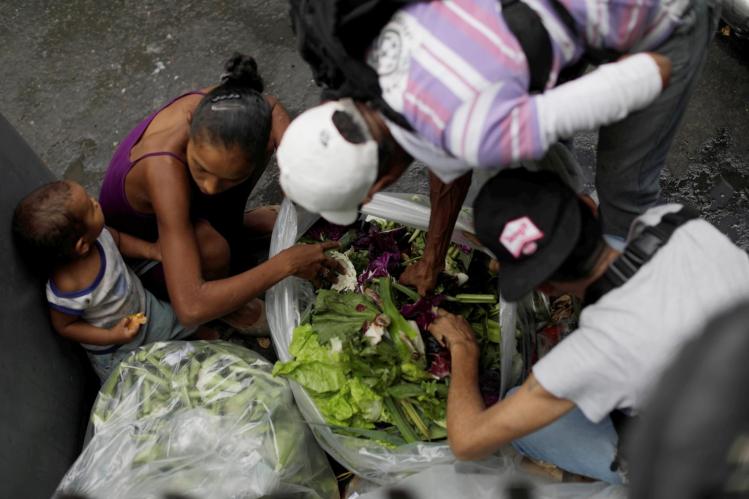
The humanitarian consequences of Venezuela’s economic crisis have been severe. In 2024, almost three-quarters of the country’s population lived in poverty. In 2025, the UN reported that nearly eight million Venezuelans required humanitarian assistance. Basic services, such as potable water, electricity, and gas were often disrupted. An estimated 7.9 million Venezuelans have fled the country’s poverty and chaos. Although 40 percent of Venezuelans do not have adequate and reliable sources of food, the UN’s World Food Programme cut its aid program in half last August because of insufficient funding from donors—including the United States, a major contributor that withdrew its support.
As the humanitarian crisis has worsened, the United States has denied that the sanctions are responsible, citing humanitarian exemptions as well as licenses available to companies and aid organizations. There is an exemption, for example, for transactions related to the provision of food, clothing, and medicine intended to relieve human suffering. Similarly, the Treasury issued a general license that permits individuals and companies from the United States to engage in transactions to sell medicine and medical devices to Venezuela without having to get specific permission. But these measures have not done nearly enough to mitigate the damage caused by the sanctions. To begin with, humanitarian exemptions do not include the equipment necessary to build and maintain infrastructure, such as the electrical grid, water-treatment facilities, and transportation. Yet these are just as essential for humanitarian needs as food and medicine. Without sufficient electricity, water-treatment plants cannot operate, and the cold chain necessary to store medicines cannot be maintained. Without trucks—and the parts and equipment needed to maintain them—food cannot be distributed.
But even where sanctions permit the sale of food or other humanitarian goods in theory, those exemptions often provide little relief. This is due to a practice that has come to be known as “overcompliance.” The penalties imposed by the United States in the enforcement of its sanctions have sometimes been shockingly severe, as when the Treasury fined the French bank BNP Paribas $9 billion. At the same time, the sanctions regulations may not be entirely explicit, as when businesses and individuals are expected to exercise “due diligence” in their financial dealings, but it is not entirely clear what constitutes sufficient due diligence. As a result of these two conditions—catastrophically severe penalties and vague compliance requirements—businesses will seek to minimize their risk by withdrawing entirely from markets. Banks will simply refuse to facilitate transactions such as food purchases by a sanctioned country; shipping companies will refuse to transport vaccines; humanitarian organizations will terminate their aid programs.
That is what has happened in Venezuela. The U.S. Government Accountability Office conducted a study in which it interviewed the organizations partnering with USAID about their ability to provide humanitarian aid in Venezuela. Every organization it interviewed reported difficulties in undertaking humanitarian aid projects that were clearly legal. They reported that banks had closed their accounts or refused to transfer funds. As a result, humanitarian organizations working in Venezuela face barriers to even basic operational functions, such as paying staff or purchasing supplies.
While the primary target of these sanctions may be Venezuela, the resulting damage and disruption is not limited to Venezuela alone. Cuba, which is in a severe economic crisis, has been deeply impacted as well. Cuba has been a close ally of Venezuela since Hugo Chávez’s presidency twenty-five years ago, when Cuba sent thousands of doctors to Venezuela to provide medical services to the poor in exchange for cheap Venezuelan oil. When the first Trump administration adopted its “maximum pressure” campaign against Cuba, Cuba’s access to fuel imports was disrupted, and Venezuela became an even more important source of oil. Ten years ago, Venezuela provided Cuba with more than a hundred thousand barrels per day. But as Venezuela’s oil production declined, its oil exports to Cuba have plummeted, with a decrease between 75 and 90 percent. As Cuba struggles with power outages, the collapse of public transportation, and food shortages, the loss of Venezuela’s support will only worsen its own economic crisis.
While sanctions are not the same as siege warfare, in the end they share many of the same qualities: the slow erosion of the necessities for human well-being and the growing misery that follows. As daily life becomes intolerable, those with resources flee to other lands. The political and military elite remain insulated from the worst of the privations, while black markets flourish and criminals thrive. Within just-war doctrine, the principles of discrimination and proportionality capture two of our most basic intuitions about what is owed to all persons, even enemies in a time of war. It seems indecent to cause indiscriminate suffering to a population where civilians—particularly vulnerable populations such as women, children, the elderly, and the sick—bear the brunt of the deprivation. It also seems gratuitous to impose or worsen such suffering without a cause that is at least as urgent. One’s own survival might warrant causing terrible harm to others, but gaining control of additional oil reserves isn’t a sufficient reason to impoverish an entire country. While the official rationale may be defending human rights and deposing a corrupt regime, it could not be clearer that the Trump administration has no regard whatsoever for the people of Venezuela. The sanctions imposed by the United States on Venezuela may not be the only cause of its current plight. But they are surely a significant one. And whatever rhetoric is used to claim legitimacy for the most recent U.S. aggression—including the sanctions themselves, the murder of those clinging to a small boat, and the kidnapping of Nicolás Maduro—the reality is clear to all.