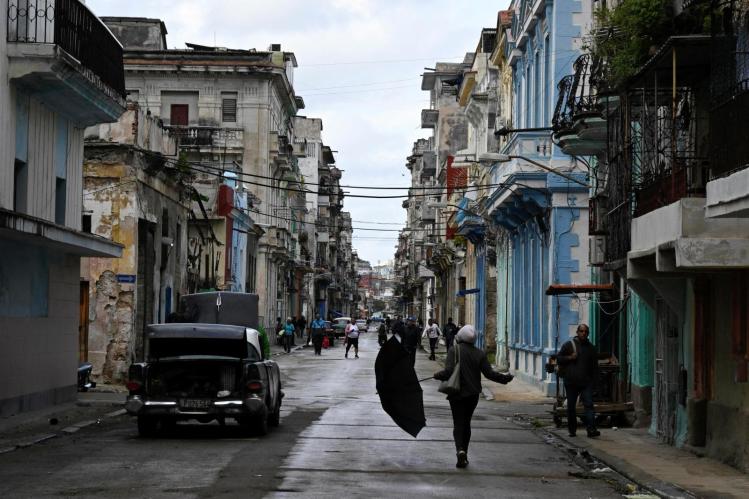
As I walked around Havana recently, it was difficult to recognize it as a city of 1.5 million people—a city of two million before the massive recent emigration. If you look down the major highway that traverses the city, the Malecón, you will see perhaps two or three cars in the distance. On Havana’s main streets, there are a handful of small electric vehicles, each carrying a half dozen people, along with some motorbikes, bicycles, and the occasional taxi. It is a city that is now mostly silent, without the sounds of traffic or radios or nightlife. It is also a city of darkness: there are no streetlights, and whole sectors of the city are blacked out for twenty or thirty hours at a time, with only the occasional bit of light seeping out of homes that have managed to acquire small rechargeable lamps. Electricity is a topic of almost constant conversation, a thread that comes up with incalculable frequency over the course of the day. You see a neighbor as you enter your apartment building: ah, she says, too bad, we just had electricity but now la luz se fue. So you walk past the inert elevator while you reach for your flashlight and head toward the pitch-dark stairwell to start the long trudge up to your apartment.
The U.S. sanctions on Cuba, which have lasted for more than six decades, have taken their toll. But the recent fuel blockade has worsened the situation immeasurably. Over the past year, the United States has seized Venezuelan ships carrying fuel bound for Cuba. The kidnapping of Nicolás Maduro allowed the United States to take control of Venezuela’s national oil company, which had long been a major supplier to Cuba. In January, President Trump announced, “There will be no more oil or money going to Cuba - Zero!” On January 29, he signed an executive order declaring a national emergency, on the bizarre premise that Cuba’s survival constitutes a national emergency for the United States. The order threatens to impose tariffs on any country that directly or indirectly supplies Cuba with oil, forcing Mexico and other suppliers to terminate fuel sales.
Cuba consumes one hundred thousand barrels of oil per day, and that only covers 65 percent of its basic needs. The country produces about 40 percent of the oil it consumes; until recently, it was importing another 30 percent from Venezuela and 20 percent from Mexico. But the oil that Cuba produces domestically has a high sulfur content, and therefore can be used only in power plants, where it corrodes the already deteriorating machinery. Although solar plants are also generating electricity, there is still not nearly enough. During the winter, Cuba has typically used 3,200 megawatts each day. Today, only about 1,000 megawatts per day are being generated, and in the hot summer months to come, the shortfall will be even greater. There are a few small oil deliveries that have made it to Cuba, but they barely begin to meet the country’s needs. Even the Russian tanker that arrived on March 31 carried enough fuel for only one week.
The oil blockade is catastrophic. Everything has been affected by the loss of fuel imports: not only the electrical grid, but also food, health care, employment, transportation, education, and telecommunications. In Havana, the level of anxiety is overwhelming. A friend of mine commented, “Sometimes I believe we are an experiment—how much can a modern human being endure while immersed in the complete degradation of everything?” But of course, it is not an experiment. It is a strategy—a deliberate effort on the part of the U.S. administration to drive the population to such desperation as to cause the collapse or overthrow of Cuba’s government.
Violence is easily recognized when it takes the form of bullets or bombs. The causality is indisputable, the human impact immediately visible. But economic violence works very differently. Deprivation does not kill or maim directly. Rather, it creates the conditions that bring suffering and hardship. When these are severe, infant and child mortality rates increase, illnesses and injuries are more likely to be fatal, and life expectancy decreases. We know that sanctions may have all those results. Unilateral sanctions, which the United States has imposed on numerous countries and thousands of individuals, have a massive impact on mortality, causing more than five hundred thousand deaths every year.
Siege warfare—surrounding a city and choking off its access to food and water—is the military version of this. Siege warfare runs counter to one of the most basic principles of just-war theory: that the use of force must distinguish between combatants and civilians. Military attacks that target both soldiers and civilians indiscriminately are prohibited. But a siege is actually worse than that. When severe shortages set in, those who are affected first and worst are the most vulnerable: infants and children, the elderly, the sick, and the poor. Those who are affected last and least are the political leaders, the military, and the wealthy. In other words, siege warfare is all too discriminate: those who should be protected are harmed most severely, while many of those who might be legitimate military targets are exempted.
International humanitarian law, which addresses atrocities such as genocide and crimes against humanity, recognizes that compromising access to food and other necessities is indeed a form of violence, even if it looks very different from the use of guns and bombs. Under the Rome Statute, genocide may take place by “deliberately inflicting on the group conditions of life calculated to bring about its physical destruction in whole or in part.” It is a war crime to “intentionally us[e] starvation of civilians as a method of warfare by depriving them of objects indispensable to their survival.”
Not all economic sanctions can be fairly described as siege warfare; some are narrower in their impact. But the sanctions imposed by the United States on Cuba, particularly the current fuel blockade, do in fact amount to siege warfare. And while the recent measures have been particularly brutal, they differ only in degree from the sanctions that have been in place since the early 1990s. These were tightened during Trump’s first term and remained in place during Joe Biden’s presidency. The pandemic also worsened Cuba’s economic crisis significantly, but once the pandemic had ended, the sanctions did much to prevent an economic recovery.
One result of this crisis has been that food insecurity has gotten progressively worse. Although the United States permits Cuba to purchase food from U.S. vendors, that does nothing to resolve the shortage of cash needed to purchase the food, or to import agricultural inputs to grow food within the country, or to maintain the refrigeration and trucks needed to store and distribute food. The food crisis is apparent both in shortages and in the high prices. The Cuban government has long provided each household with an array of highly subsidized basic goods—rice, beans, eggs, cooking oil, coffee, bread, chicken, and so forth. Each household’s allotments are based on the number of people in the family, and they are recorded in a small government-issued notebook, the libreta. But the goods available with the libreta have declined steadily in the past several years, so families have been turning instead to the open market, where food is more expensive, or to the black market, where food is much more expensive. The government used to guarantee fresh milk for all children up to the age of six. Now all that’s guaranteed is powdered milk for infants. Hospitals and homes for the elderly are receiving only 20–30 percent of the food they used to get.
One of the ways of gauging food insecurity is to track the percentage of household income spent on food. Those who spend between 65 and 75 percent of their income on food are at high risk of severe food insecurity, while those who spend more than 75 percent are at very high risk. A few years ago, I asked my friends in Cuba how much of their family budget was spent on food, and their answer was, “All of it.” Although my friends are, in Cuban terms, middle-class, no money is spent on clothing or really any other consumer goods, partly because there are few such goods available—and those only at exorbitant prices. Even buying a pair of shoes can be virtually impossible, for both reasons. Some expenses, such as rent and utilities, are highly subsidized. But nearly all the money not spent on these things goes to food.
As with money, so with time, as getting food becomes the consuming occupation to which all other activities and resources are subordinated. A few years ago—with the shutting down of many workplaces, the decimation of tourism, and the closing of restaurants and small businesses—in the households of some of my Cuban friends, it became the occupation of every adult in the family to look for food. They would travel far outside their own neighborhood, waiting in long lines for crowded buses, because they heard a rumor that powdered milk had arrived in Centro Habana, or because yesterday someone was able to procure two bars of soap, and today she would go across the city to give one to her daughter.
Today, the situation is actually much worse. Very little food can be brought in from the provinces or even distributed within the city, because there is no gasoline and because the state does not have the money to import replacement parts for the delivery trucks. And even if it did, the U.S. sanctions would, directly or indirectly, make it nearly impossible to find companies willing to sell vehicles or parts to Cuba. There is not enough fuel for tractors, so farmers are increasingly forced to use animal traction—oxen, horses, and donkeys—to plow their fields.
Cooking gas is still regularly available in some Havana neighborhoods. But in the countryside, where cooking gas is delivered in tanks to each home, the collapse in transportation has meant that many households no longer have gas. A Cuban colleague of mine told me that he had visited some friends who owned a farm, and some foreigners were with him. The foreigners marveled at the ingenuity of the farmers, who had built a firepit and now did all their cooking outdoors using wood or charcoal. There is nothing quaint about this, my colleague explained to them; they do this because they can no longer use their kitchen—there is no cooking gas and no electricity.
The sociologist Mayra Espina estimates that about ten percent of the Cuban population is relatively well off, with incomes that allow for a standard of living comparable to that of the middle classes elsewhere in the world. She estimates that about 40 percent of the population has enough to meet their essential needs, though not always easily. The rest of the population—at least 45 percent—is simply in poverty, without the resources to meet even the most basic needs. A friend of mine commented that these are the people who receive no remittances from family living abroad, have no access to foreign income, and often include the elderly, the disabled, and single mothers. This is the population that is most dependent on the libreta for food. But the U.S. measures impact the libreta as well. A friend of mine commented, “Everyone has been focused on the fuel blockade and the physical impact. But the financial impact is just as urgent.” The income from Cuba’s medical missions is about half of Cuba’s export earnings. With the loss of income from Venezuela after the U.S. intervention, as well as U.S. pressure against countries in Latin America and the Caribbean to cancel their medical programs with Cuba, state revenues have been decimated. Without this income, the state will not have the funds to buy food for the libreta. “In a couple months,” he said, “for those with no access to outside support—nearly half of Cuba’s population—there is going to be real hunger.”
The one area of significant growth in the economy has been the private sector. There are now stores selling imported meat, canned goods, and household goods, along with ice cream and American candy bars. There are also online services, like the app Supermarket23, that deliver imported food to households within Cuba, with orders placed outside the country. The prices are exorbitant by Cuban standards. In 2024, the average salary for a state employee was about 5,800 pesos per month. A box of thirty eggs costs between 2,000 and 3,500 pesos—nearly half a month’s income. Even so, the private retail sector has grown rapidly, now accounting for about 55 percent of retail goods and services. For those with family abroad, these services have been a lifeline. But the fuel blockade disrupts even this last remaining source of food access. Gas stations rarely have any gas to sell. On the black market, the price of gasoline was recently $10 per liter, but even at that price, gas cannot always be found. Supermarket23, the largest food-delivery company, recently had to suspend its operations for weeks because it could not get gas for its delivery trucks.
The electricity blackouts, called apagones, worsen the food situation in other ways as well. For perishable foods, such as poultry, meat, and dairy, whether the refrigerator will continue to function is a daily concern. Those who can afford it buy backup generators. But finding the gasoline to power them in case of emergency presents another problem. In homes with sufficient resources, it is now common to see EcoFlow power stations, which can provide backup electricity to a refrigerator or a freezer during a blackout and then be recharged when the electricity returns. But as the blackouts have increased not only in frequency but in duration, lasting as long as thirty hours, it’s no longer possible to recharge the power stations to provide a steady flow of electricity. So, for those who can afford it—or whose family abroad can—there are increasingly elaborate backups for the backups. A friend of mine has a backup generator for his family’s freezer, an additional battery for the generator, and a portable solar panel that can be used to recharge the battery. He calculates wattage the way a pensioner might calculate, down to the penny, his monthly budget: the freezer requires sixty watts per hour; the power station can run for four hours a day, for between five and seven days. After that, it needs to be recharged by the portable solar panel, which theoretically provides a hundred watts per hour, but only with direct sunlight, which is available for only about five hours a day. Even then, the solar panel probably won’t work at peak efficiency, so it will likely yield only eighty watts per hour. All in all, if everything goes according to plan, there should be just enough electricity to maintain the small freezer that holds the family’s supply of meat and poultry.
Yet even those increasingly elaborate arrangements are often insufficient. I spent one evening with a friend who has an extensive system of generators and batteries for her home. But there hadn’t been enough time after the last blackout for the system to recharge. So, in the middle of our conversation, all the lights in the home went out, and we spent the rest of the evening talking by the light of a flashlight. Because the stove relied on electricity, she wasn’t able to cook for her children. That particular blackout was caused by the failure of the largest thermal power plant in the country. It triggered a blackout across the entire country, which lasted for nearly thirty hours.
Every part of the country’s infrastructure is affected by apagones. Last fall, the government noted that the daily power deficits were compromising Cubans’ access to water, which is pumped from reservoirs using electric pumps. Lack of electricity causes an estimated half of the water shortages. It also causes cell towers to shut down. Even if their cell phones are charged, people can’t get internet. Nor can they get updates on the status of the electrical grid, because the blackouts mean that television is not available.
While Cuba has reached a new level of crisis because of the Trump administration’s fuel blockade, it’s important to understand that longstanding U.S. sanctions have methodically laid the groundwork for the deterioration of Cuba’s infrastructure and the collapse of its economy. Although the United States first prohibited trade with Cuba shortly after the Cuban Revolution of 1959, the impact of U.S. measures was for a long time limited because of Cuba’s extensive economic ties with the Soviet Union. Cuba exported sugar to the Eastern Bloc and imported subsidized oil, as well as cars, trucks, tractors, fertilizers, and industrial equipment. By 1990, Cuba had grown economically for several years and had invested in health care and education. But with the fall of the Soviet Union in 1991, Cuba abruptly lost between 75 and 80 percent of its trade, triggering an economic crisis known as the “Special Period.” Between 1990 and 1994, Cuba’s GDP contracted by one-third.
As the country scrambled to restructure its economy, the United States adopted two major pieces of legislation that undermined Cuba’s efforts at every turn: the 1992 Torricelli Act and the 1996 Helms-Burton Act. In combination, these two statutes targeted nearly every major component of Cuba’s economy. One of Cuba’s most significant achievements was in training extraordinary numbers of doctors and scientists. In the 1980s, Cuba had invested heavily in developing pharmaceuticals and medical products, and had used biotechnology to develop inputs for agriculture, such as biopesticides, biofertilizers, and disease-resistant seeds. This was an area in which Cuba operated at a first-world level; it was a source of national pride. The Torricelli Act targeted biotechnology, specifically prohibiting the sale of anything that could be used in Cuba’s work in this area.
The Helms-Burton Act allowed U.S. nationals to bring lawsuits against foreign companies that had invested in developing properties in Cuba that had been abandoned or confiscated after the revolution. Under Title III of the statute, for example, a Spanish hotel chain with no ties to the United States could be sued by a Cuban-American in Florida over a property located in Cuba. Ordinarily the United States would have no jurisdiction over cases involving only foreign persons, foreign companies, and property in a foreign country. The international community, including many major allies and trading partners of the United States, condemned this as “extraterritorial”—that is, the United States was meddling in the economic affairs of countries and non-U.S. nationals outside its territory. Even so, the threat of being sued in the United States would serve as a deterrent to European and Latin American companies that were investing heavily in Cuba’s tourism industry. Unsurprisingly, many of these companies backed out of trade deals with Cuba for fear of litigation in the United States.
The Helms-Burton Act also targeted Cuba’s exports. Sugar had long been a mainstay of the Cuban economy. Cuba also has the world’s fourth-largest nickel reserves. Sugar and nickel were Cuba’s leading exports and a critical source of hard currency. The Helms-Burton Act prohibited foreign companies from exporting to the United States any goods that contained even trace amounts of Cuban materials. So, for example, a Belgian company that made chocolate with Cuban sugar could not export it to the United States. A French manufacturer could not export anything made of steel to the United States if the steel contained even miniscule amounts of Cuban nickel. Once again, the international community condemned this measure as extraterritorial, on the grounds that the United States has no right under international law to interfere in trade relations between two foreign companies.
The extreme U.S. sanction measures of the 1990s had other provisions that were even more far-reaching. As Cuba reached out to establish trade with companies around the world, the Torricelli Act prohibited foreign subsidiaries of U.S. companies from trading with Cuba. This was a departure from earlier U.S. policy. Throughout the 1980s, Cuba had traded actively with foreign companies owned by U.S. parent companies. This was consistent with international law. The nationality of a corporation is usually determined by the country where it is incorporated, not by the nationality of its shareholders or parent company. So, while the United States may restrict its own nationals from engaging in trade with a country targeted by sanctions, under international-trade law, it cannot restrict the business activities of the foreign subsidiaries of U.S. companies. But these provisions of the Torricelli Act meant that Cuba was not only excluded from the U.S. market, by far both the closest and largest, but also that it could not trade with the thousands of other companies around the world that were owned by U.S. companies.
The Torricelli Act also targeted Cuba’s access to shipping, which was essential for the island nation. The statute prohibited ships that entered a Cuban port from coming to the United States for six months. The potential risks were catastrophic. Any ship that delivered or picked up cargo in Cuba in violation of the six-month rule was subject to confiscation. Even UN aid agencies were affected. The World Food Programme reported that there were delays in delivering urgent food supplies to Cuba because it could not find ships willing to enter Cuban ports.
The sanctions not only hurt trade, but also limited Cuba’s access to financial resources. The Helms-Burton Act blocked Cuba from critical international financial institutions, including the International Monetary Fund (IMF) and the World Bank. The Helms-Burton Act requires the U.S. representatives in those organizations to vote against any proposals to grant membership to Cuba or to provide loans or other assistance. This ensures that Cuba has no access to those (and other) global financial resources. The system of weighted voting in those organizations effectively amounts to a United States veto. In the IMF, the United States holds about 16.5 percent of the vote. Japan and China each hold about 6 percent, while Germany’s share is 5.3 percent, the United Kingdom’s is 4 percent, Russia’s is 2.6 percent, and Saudi Arabia’s is 2 percent. Meanwhile, scores of other countries have only miniscule voting power in the IMF, often just a few hundredths of a percentage point. To provide Cuba with financial or development resources, several close U.S. allies would have to vote against the United States. In the unlikely event that ever happened, the Helms-Burton Act would require the United States to withhold from its dues as much money as the IMF was sending to Cuba. And there are similar provisions for the World Bank and other leading global financial institutions. Even after renegotiating its debt with the Paris Club last year, the Cuban government still owes about $30 billion. As Cuba struggles to manage its debt burden and access resources for economic development, a UN official has noted that its exclusion from those global resources creates unique difficulties—Cuba is one of the few countries in the world trying to restructure its economy without access to major international financial institutions.
The international community—including almost all of the United States’ major allies and trade partners—was vocal in its opposition to the Torricelli and Helms-Burton Acts. Canada, Mexico, and the European Union adopted retaliatory “clawback” legislation for any judgments that a U.S. court might issue against its nationals under these laws. The United Kingdom brought an action against the United States before the World Trade Organization. And starting in 1992, the UN General Assembly adopted annual resolutions condemning the United States for violating international-trade law. The assembly resolutions consistently draw the overwhelming support of the international community. The vote in 2024 was typical, with 187 countries supporting Cuba’s resolution, one abstaining, and only two opposed—the United States and Israel. Last fall, under pressure from the Trump administration, a few more countries sided with the United States, and a dozen abstained. Even so, the large majority of the member states (165 out of 193) condemned the United States for its damaging and illegal unilateral measures.
In the face of international pressure, the United States has made—or has appeared to make—occasional humanitarian concessions to address the massive harm done to Cuba’s economy by its sanctions. In 2000, Congress adopted the Trade Sanctions Reform and Export Enhancement Act (TSRA). This authorized U.S. producers to sell food and agricultural goods to Cuba, which has turned out to be an important source of food imports. But these are allowed only on adverse terms—Cuba must pay in cash, and it must pay in advance. For U.S. exporters, this is a wonderful arrangement: the Cuban government buys food for the entire country, and the American companies are paid up front in cash. So what is presented as a humanitarian concession is also a tremendously beneficial business opportunity for U.S. grain producers and other food exporters. Other “humanitarian” measures have turned out to be of little value. In December 2022, for example, the U.S. Treasury Department announced broad licenses for U.S. nationals to export goods to Cuba in a wide range of humanitarian areas, such as education. But Cuba has also been listed by the State Department as a “State Sponsor of Terrorism” (SSOT), in part because of its role as a mediator in peace negotiations between the Colombian government and the Revolutionary Armed Forces of Colombia (FARC). This designation has extensive consequences. U.S. banks are generally prohibited from engaging in financial transactions involving countries on the SSOT list. As a result, humanitarian organizations looking to send, say, school supplies to Cuba will find it difficult or impossible to find a bank that will handle the necessary transactions, even though the project is explicitly permitted by the Treasury Department license.
In addition to the explicit prohibitions in U.S. sanctions law, there is another reason that banks, shipping companies, investors, and trade partners are fearful of doing business with Cuba. Starting around 2012, the fines imposed by the United States for sanctions violations increased astronomically. Penalties are now in the hundreds of millions, sometimes billions, of dollars. In 2012, the United States fined the Dutch bank ING more than $600 million for its transactions involving sanctioned countries. The British bank HSBC was fined nearly $2 billion; Crédit Agricole, almost $800 million; and the French bank BNP Paribas paid an astonishing $9 billion in fines to the U.S. Treasury Department and U.S. banking regulators, sending a chill throughout the global banking community. But the massive fines were not actually the worst of it: BNP Paribas was also temporarily and partially suspended from the U.S. Federal Reserve System. Any bank that transacts business in U.S. dollars must be able to access the Federal Reserve to reconcile its dollar accounts, or it will go out of business. In the international financial world, for a bank to lose this access is known as the “death penalty.”
The regulations are not entirely clear as to what exactly banks are expected to do. Banks are required to exercise due diligence in meeting KYC—“Know Your Customer”—requirements. But the regulations do not specify just how much diligence is expected. Given this lack of clarity and the potentially devastating penalties, it is not surprising that banks are increasingly eager to lower their risks. The result is a practice known as “overcompliance,” in which banks withdraw altogether from markets perceived to be risky. Western banks have increasingly terminated their services not only to countries that are explicitly sanctioned by the United States but to entire regions, such as Africa and the Arab world. As a result, it is extremely difficult for Cuba to find banks that will facilitate its purchase of fuel, its export of nickel, its joint ventures with investors, and all its other international transactions. The UN Special Rapporteur on Unilateral Coercive Measures reported that, due to U.S. sanctions and the inclusion of Cuba on the SSOT list, about two hundred banks and financial institutions have terminated their relations with Cuba in the past five years.
While Cuba’s economic policies have been criticized for various reasons, the conditions created by U.S. sanctions would make it nearly impossible for any country to function. They have, quite literally, done much to reduce Cuba to a preindustrial condition. As the sanctions have choked off exports and tourism, state revenues have been gutted. Although Cuba has rich natural resources and a highly educated population, foreign investors are wary, and the international financial institutions available to every other struggling country in the world are not available to Cuba. In the face of these conditions, the country’s infrastructure has deteriorated on every level. Its highest priorities, such as its commitment to provide all citizens with health care, can no longer be sustained, as sanctions have made it impossible to obtain medicines and medical equipment, secure repair parts, or, since the fuel blockade began, even to operate hospitals and clinics beyond a minimal level.
The historian Flavius Josephus, describing the siege of Jerusalem, wrote: “For all this calamity, there was no weeping nor lamentation, for famine overcame all affections. There was no noise heard within the city.” In the unnerving silence of Havana, with its dark and empty streets, it is hard not to think: “So this is what a siege feels like.” As I said goodbye to my Cuban friends and colleagues a few weeks ago, we embraced each other much more tightly than usual. We said “See you soon” much too brightly, with a catch in our throats, since it seems that we may not in fact ever see each other again, whether because of an even greater deterioration and isolation of the country or because the Trump administration becomes impatient and simply starts bombing Havana. We do not mention the chasm that separates us. We do not acknowledge that I am the beneficiary of the deepest and most arbitrary of inequalities: that they live in a country where much of the population is rapidly being reduced to starvation and sickness, exhaustion and indignity; and that I will return home to the country whose government is doing the starving, albeit at the instruction of a president for whom I did not vote, and for whose policies I feel shame and revulsion.
There is some debate as to whether Cuba’s current economic crisis is worse than the Special Period of the 1990s. Even during the worst of the Special Period, it is argued, infant and child mortality rates actually declined for almost twelve years in a row, as the state redirected food and health-care resources to pregnant women, nursing mothers, and infants and young children. By contrast, infant mortality has more than doubled in the past decade—evidence of the accelerating collapse of infrastructure and the inability of the state to provide essential social services.
During the Special Period, when Havana’s bus system failed, the state built camellos, tractor-trailers that could carry between two hundred and three hundred people, and the city’s streets were quickly filled with thousands of Flying Pigeon bicycles that the Cuban government bought from China. Today, there are only a few vehicles of any sort on Havana’s streets. During the Special Period, the Cuban government responded to the loss of trade with the Soviet bloc by quickly restructuring the economy and establishing new trade relations in many parts of the world. Now, by contrast, the U.S. government has moved aggressively to threaten Cuba’s remaining trade partners with tariffs, and banks and investors, afraid of billion-dollar fines and expulsion from the U.S. market, are leery of engaging with Cuba.
But the real difference is this: in the Special Period, it was possible for both the Cuban government and individuals and their families to find solutions. Now, no matter how many allies Cuba looks to for help, and no matter how resourceful Cubans may be, the Trump administration has ensured that no solutions will be possible, as with a siege that is executed without mercy and without escape.
We welcome your comments about this article. Please send your response to [email protected].