My Ancient Ethics class meets in the basement of the chemistry building. In our bookish bunker, we’re reading Plato’s Republic, where my students encounter some of the most durable ideas in ancient philosophy: Thrasymachus’s infamous definition of justice as “the advantage of the stronger”; Socrates’s tripartite model of the soul; and his so-called Allegory of the Cave, where prisoners are forced to watch shadows flicker on the wall, mistaking this subterranean pageant for the reality of the sunlit world above. Despite our austere setting, my students remain enthusiastic and earnest. Our classroom, in fact, often feels like some inversion of Plato’s allegory. Leaving our discussions of justice and wisdom underground, we emerge into a sunny simulacrum of Red Bull samples and Instagram usernames.
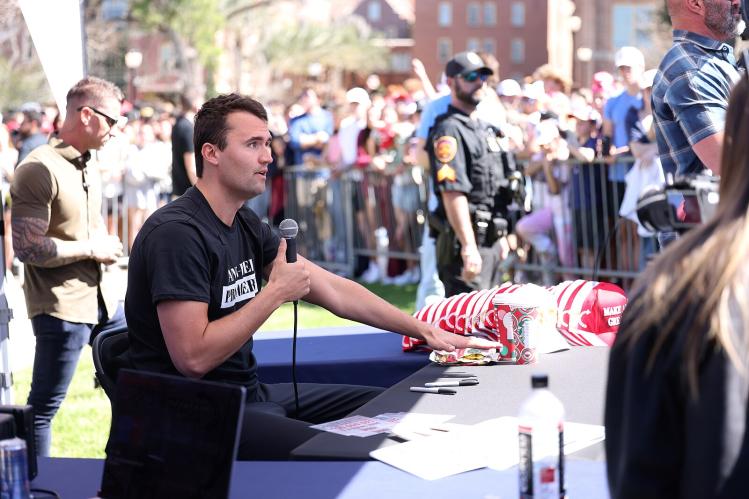
One day last month, that contrast was especially jarring. Our Minneapolis campus’s grassy quad had transformed into a labyrinth of metal barricades in anticipation of a rally for Turning Point USA, the organization helmed by Charlie Kirk before he was murdered on September 10. In the wake of the fatal shootings at Minneapolis’s Cristo Rey and Annunciation schools, as well as the assassination of Minnesota state representative Melissa Hortman and her husband, the specter of gun violence haunts the Twin Cities. Indeed, there have been moments when I’ve felt grimly relieved to teach in our windowless, sunken fortress.
Outbursts of political violence should alarm everyone who cares about higher education. My worry is not simply about our immediate safety but also about the feasibility of the slow-paced rituals of humanistic learning. As Plato’s works dramatize, our students’ education—arduous but cooperative—demands consistent, attentive presence. Socrates offers us dialogues, not asynchronous content modules. But interpersonal learning is simply impossible when our universities, under threat from aggrieved radicals, must advise students to stay home “out of an abundance of caution.”
This academic disorder could not come at a worse moment. As the nation rushes into authoritarianism and as young people in particular are “losing faith in democracy,” universities must urgently recommit to the project of civic education: advanced literacy, moral reasoning, deliberation. Many people, including Charlie Kirk, have correctly diagnosed our colleges’ anemic efforts to produce good citizens. But his prescription of partisan spectacle—what figures like Ezra Klein and Gavin Newsom have euphemistically called his “spirited discourse” and “moxie”—was more ailment than antidote. Practicing politics as Kirk did might be good content, but it is not good education.
Turning Point’s vision of academic debate has been posted across every corner of the internet. In scores of TikTok videos, Kirk “destroys” liberals, “decimates” undergraduates, and “shreds” left-leaning ideas. In punchy YouTube shorts, he asks students to define womanhood and then, if he doesn’t like their answer, “obliterates” them with one-liners. Taken together, these clips reveal a sadistic notion of the life of the mind: combat rather than cooperation, gladiatorial victory rather than patient skepticism.
Since I’m deep in the weeds with Plato this term, I’m struck by how different this combativeness is from Socrates’s own style of debate. In the Apology, he famously calls himself a gadfly, a pesky insect that rouses lazy horses. But elsewhere, as in the Theaetetus, he calls himself a midwife: his role is to help others who are struggling to bring forth new ideas. A case in point, the fifth book of the Republic features Socrates convincing his reluctant interlocutors to admit that women and men, despite their physical differences, have the same tripartite souls. As far as political acumen goes, he continues, they “can have the same nature.” This bedrock text of Western philosophy doesn’t “obliterate” novel theories of sex and gender. On the contrary, it proposes one.
But intellectual midwifery has lost favor on the right. In the weeks since Kirk’s murder—which was, to be clear, morally abhorrent and indefensible—the MAGA movement has been quick to present his cruel punditry as a model not just of political life, but also of academic life. Lawmakers in Oklahoma have proposed legislation that would require each public university in the state to build a “Charlie Kirk Memorial Plaza” with “a statue of Charlie Kirk sitting at a table with an empty seat across from him.” Such a memorial, the bill explains, would commemorate Kirk as a “transformative force in empowering young Americans to engage in open, robust discourse on college campuses.”
Turning Point strategically holds its events at universities rather than, say, city parks, implying that its “robust discourse” of decimating liberals and obliterating feminists is somehow academic—rather than partisan—in nature. But monuments like those proposed in Oklahoma will formalize what has been merely implicit until now. These statues will erase the crucial difference between pundits and professors, and they will make official the transformation of college campuses from spaces of open inquiry into arenas for verbal cage-fighting.
In my view, colleges and universities already have monuments to “open, robust discourse.” They’re called libraries. In their quiet stacks, one can find John Rawls’s A Theory of Justice not far from Robert Nozick’s libertarian response, Anarchy, State, and Utopia. Library patrons can read Frantz Fanon’s defense of political violence in The Wretched of the Earth, but they can also pick up a copy of Hannah Arendt’s On Violence, her rejection of bloodshed in the pursuit of political power. Spirited disagreement can be found on every American campus. We simply need to pull it off the shelf.
I realize how naïve this may seem amid the chorus of articles reporting that college students can’t read selections from demanding books, let alone entire volumes. Even so, colleges must promote their own literate vision of “robust discourse” and hold firm to their identity and mission against opportunistic political actors. They make a grave, self-destructive error if they accept that intellectual life is best represented by a tent emblazoned with the insincere taunt “Prove Me Wrong.”
As I have argued before in these pages, academics can never separate themselves completely from their political situation. But amid a growing authoritarian intrusion, they must defend their own purview and practices. Academic communities thrive on charitable critique and well-documented sources. Politicians—the most successful ones of the current era, at least—thrive instead on dunks and half-truths. Universities must remind the public that they are committed to substantive principles like toleration, moral freedom, and openness to doubt. These virtues, developed over millennia since Plato’s original Academy, are not natural features of any human society. It takes years to instill them in young people, and academics must redouble those efforts or else risk obsolescence.
In describing the particular virtues of academic life, I’m reminded of my subterranean discussions of the Republic. Socrates often talks about “excellence” or “virtue” or aretē—the fulfillment of one’s proper function. Sharpness, he says, is the aretē of a knife; swiftness, the aretē of a horse. Academics, too, have developed their own distinctive virtues, particular norms of excellence in teaching and research. We may not always live up to those aspirations, just as knives can become blunt or horses can get injured. But like our ancient predecessors, intellectuals aim for an ideal.
While I don’t imagine the White House is brimming with copies of the Phaedo,the MAGA movement nevertheless seems to be obsessed with ideas of excellence. Secretary of Defense Pete Hegseth champions “a culture of excellence in our Armed Forces,” and the president similarly praises the “traditional American values of hard work, excellence, and individual achievement.” May Mailman, one of the architects of Trump’s attack on universities, wants to foster a “culture of excellence” in “excellent institutions.”
As my students have pointed out, we need to be careful when we talk about excellence and virtue as a kind of strength. A horse’s strength might be swiftness. But cyanide’s is toxicity. In a similar vein, the Trump administration’s new “Compact for Academic Excellence in Higher Education” assigns the wrong kind of aretē to our universities. It charges them with the task of protecting “conservative ideas” and guaranteeing their place “within every field, department, school, and teaching unit.” Especially when personalist politics dominates the right, the “conservative” stance—on everything from tariffs to TikTok—changes with the president’s mood. In effect, a demand for conservative representation amounts to a demand for faculty loyalty. That may make for an excellent lapdog, but it makes for a worthless professor.
Rather than simply adhere to “correct” opinions, academics often strive for provisional knowledge that is open to both confirmation and critique. I try to cultivate this particular notion of excellence in my students. They’ll finish my ethics class as reflective thinkers rather than faultless saints. But training young minds to be judicious is hard work, chiefly because we are imparting cultural attitudes, not political viewpoints. The MAGA movement, however, wants to replace this culture of self-reflection with one of partisan fealty. If our institutions trade academic inquiry for political loyalty, we will all end up just where Plato predicts in the Republic’s final books, in which an anxious tyrant tracks down dissidents. And whenever he discovers “some free-thinking people he suspects of rejecting his rule,” he must destroy them.