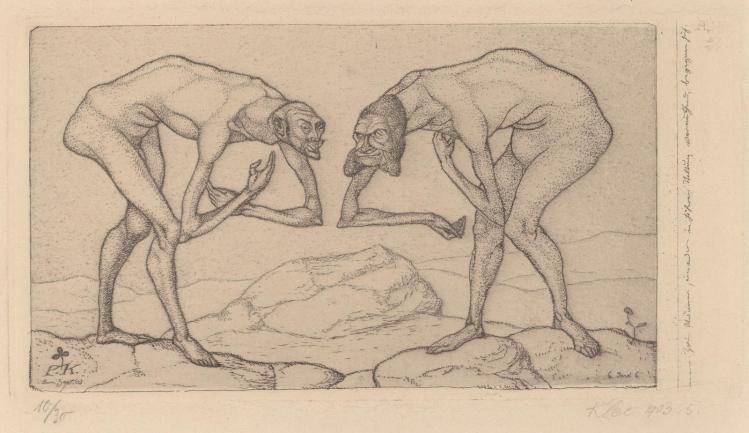
Paul Klee’s Two Men Meet, Each Believing the Other to Be of Higher Rank captures a moment of hesitant, ritualized encounter. Neither figure clearly dominates; instead, as the title indicates, each performs a gesture of deference, convinced that the other outranks him. The dual obsequiousness masks an underlying tension—an ambiguous power dynamic between equals or near-equals.
This dynamic is common in high-stakes diplomacy, where leaders must balance the desire to assert authority with the need to signal respect. The stylized figures in Klee’s 1903 etching serve as a subtle allegory: beneath narratives of bold leadership lies a delicate choreography of influence and deference, as leaders negotiate both alliance and self-preservation.
Klee’s etching was not intended as explicit political allegory, but its evocative depiction of reciprocal deference has made it a useful illustration of fragile power balances throughout the twentieth century. Some European observers used Klee’s image to satirize the performative power dynamics between Adolf Hitler and Benito Mussolini during the 1930s and 1940s. Both leaders engaged in ritualized displays of respect and submission to maintain their alliance, while underlying competition persisted. The etching resonated with the awkward balance of power between these fascist leaders.
Similarly, the image was sometimes invoked to reflect the uneasy diplomatic minuet between Hitler and Neville Chamberlain, culminating in their September 1938 Munich summit, which occasioned international praise for avoiding war and achieving what Chamberlain proclaimed as “peace for our time.” But after Hitler violated the agreement by seizing the rest of Czechoslovakia in March 1939, public and political opinion shifted. What had been viewed as Chamberlain’s feat of statesmanship came to be seen as his foolish appeasement; Klee’s image, in retrospect, seemed to have forecast the tragic missteps of a diplomacy that merely served as prelude to world war.
Decades later, critics on the left drew parallels between Klee’s etching and the close but complex relationship between Reagan and Thatcher in the 1980s. Their alliance involved both mutual respect and occasional competition, balancing personal camaraderie with political power plays.
There is no firm evidence that Klee intended to portray specific historical figures in Two Men Meet, yet some art historians have noted suggestive resemblances. The figure on the viewer’s right, with a full head of hair and pronounced mutton-chop sideburns, bears a strong likeness to Austrian Emperor Franz Joseph I, then seventy-two years old and known for his rigid ceremonialism. Opposite him, the figure on the viewer’s left, more angular and stylized, with a sharp, upturned hairstyle and assertive stance, evokes the younger and more flamboyant German Emperor Wilhelm II, aged forty-four at the time. Whether or not Klee consciously referenced these rulers, the visual cues have encouraged interpretations of the etching as a satirical reflection on imperial vanity and the precarious rituals of deference between unequal—but similarly self-important—men in the twilight of European monarchy.
The relationship between Donald Trump and Benjamin Netanyahu—especially during the fraught summer of 2025—offers a vivid real-world enactment of Klee’s motif. As tensions with Iran escalated and the United States and Israel launched coordinated strikes on Iranian nuclear infrastructure, the two leaders engaged in a carefully choreographed dance of praise, reassurance, and symbolic submission.
At a June 21 press event following U.S. strikes on three Iranian nuclear facilities, Trump remarked, “I want to thank and congratulate Prime Minister Bibi Netanyahu. We worked as a team like perhaps no team has ever worked before.” Just days earlier, Netanyahu had released a video statement hailing Trump not just as a political ally, but as a personal friend: “You’ve been an extraordinary friend to the Jewish state and to me personally.” On June 22, Netanyahu followed up with soaring rhetoric explicitly aligning his actions with Trump’s leadership: “President Trump and the United States acted with a lot of strength…. Your bold decision…will change history.” Trump returned the favor three days later by elevating Netanyahu’s role in shaping the conflict: “Netanyahu is strong. He doesn’t back down. He’s done more to stop Iran than anyone.” When Netanyahu visited the White House in July, he presented his host with a copy of a letter in which he nominated Trump for a Nobel Peace Prize.
This two-man mutual-admiration society did not begin in June—it has gone on for years—but it does seem to have intensified during the first months of Trump’s second term. In a March address to the Knesset, following Israeli-linked strikes on Iranian nuclear facilities, Netanyahu declared: “Our partnership with the United States under President Trump’s leadership is unparalleled. His unwavering support safeguards Israel’s security and sends a clear message to Tehran that aggression will not be tolerated.” Trump soon returned the praise at a press briefing: “Prime Minister Netanyahu is a tremendous leader—strong, wise, and determined. Our nations stand united against threats, and Israel’s resolve inspires the free world.”
Such flattery is not a mere formality. It reveals how both leaders rely on symbolic deference to manage domestic and international pressures. Trump knows that he needs to project dominance without appearing unilaterally aggressive. Netanyahu, meanwhile, is facing political instability at home, legal threats, and ideological divisions within his own coalition. Publicly aligning himself with Trump enhances his stature as Israel’s foremost protector. Their mutual praise thus serves a strategic function: distributing responsibility for hardline actions while projecting unified resolve.
Observers have long debated who truly leads whom when policy on Iran is at issue. Is it the American president with global military reach or the Israeli prime minister whose country has the most at stake? A leaked June 2025 diplomatic cable captured the ambiguity. “Netanyahu exerts considerable influence on Trump’s Iran stance,” a senior U.S. official reportedly noted, “but Trump carefully manages the optics to retain ultimate control. Their interactions are a delicate balance of mutual respect and underlying competition.”
The ambiguity extends to their public appearances. At the April 2025 U.S.–Israel strategic summit, the symbolic gestures were parsed as closely as the statements. When Netanyahu offered a slight nod of deference, Trump responded with a broad smile and signature thumbs-up—gestures that suggested camaraderie but also a claim to seniority. Before and since that meeting, political commentators in America and Israel have referred to Trump’s craven “dance to Bibi’s tune” (The New Republic) and to the “choreographed” “dance” (The Times of Israel) or “calculated dance” (JFeed) of the Trump-Netanyahu relationship. Indeed, JFeed’s detailed description in February 2025 of the Trump-Netanyahu “diplomatic dance” calls to mind the encounter portrayed in Klee’s etching: two powerful men meeting with reciprocal bows, each navigating the tension between yielding and asserting.
These performances served several purposes. They reassured domestic constituencies by affirming the strength of the alliance. They projected an image of international coordination aimed at deterring adversaries like Iran. And they conferred personal legitimacy—each man reinforcing his leadership credentials by association with the other. Two Men Meet distills this political theater into a single frozen moment. The outward appearance of humility masks strategic calculation. Public deference, in this context, becomes a tool of assertion rather than submission.
In the end, Trump and Netanyahu’s relationship in 2025 underscores how modern leadership often hinges less on clear hierarchies than on the artful negotiation of rank. Their carefully choreographed statements and gestures in June—during a period of real geopolitical volatility—demonstrate a pattern of shared ambition, strategic rivalry, and symbolic exchange. Klee’s image reminds us that even in the arena of power politics, influence is often performed rather than declared. Leadership, at its core, may be less about open domination than about who bows first—and why.