“Nobody builds walls better than me.” I don’t have to tell you who said that, do I? When Donald Trump launched his campaign for president in front of a crowd of hired extras at Trump Tower in 2015, he was counting on his reputation as a real-estate developer to lend him credibility. His name was on the building, after all. That day, he made headlines with his racist anti-immigrant rhetoric. He also floated a promise that became a major part of his sales pitch: “I will build a great, great wall on our southern border, and I will have Mexico pay for that wall.”
However you might define the “problem” of immigration, “Build the Wall” was not a serious solution. It had power as a rallying cry precisely because it rejected the responsibility of taking human suffering seriously. The pretense Trump was selling was that curbing undocumented immigration was not complicated at all for a leader with the right disposition—someone who won’t get distracted by appeals to decency; someone who knows how to put up a wall and get it done cheap. He allowed his supporters to imagine immigration policy as a form of pest control, and international relations as might-makes-right transactions where the terms would always be in America’s favor.
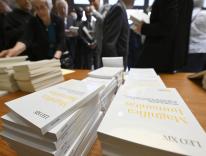
I wondered, when I read Magnifica humanitas, if Pope Leo XIV had Trump and his wall in mind when he was writing it. The encyclical is officially about “safeguarding the human person in the time of artificial intelligence,” but it doesn’t limit its insights to computer technology. It carefully explains the obligation to center human dignity and the promotion of the common good in every aspect of political life, and it uses the imagery of construction sites to illustrate how human initiative can build the “civilization of love.” The Old Testament hero Nehemiah is invoked as a builder of walls—one of the best, you might say—but in Leo’s telling, the walls of Jerusalem that Nehemiah restores are a symbol of cooperation and mutual concern.
Reading Leo’s reflections on social justice, I thought of the many Christians who offer bad-faith defenses of Trump’s persecution of migrants, and of how Trump himself has sulked, “When they say the wall’s immoral, well then, you got to do something about the Vatican, because the Vatican has the biggest wall of them all.” A Catholic case for Trump must pretend the Church’s position begins and ends with the observation that nations have a right to control their borders, and ignore the part about how states have a duty to respect and promote human rights. Leo does not waste time in Magnifica humanitas on such obtuseness. Migrants and refugees are “people with dignity, resources and dreams,” he writes. “The way a society treats them reveals whether its sense of justice is driven by fear or by the spirit of fraternity.” Leo further condemns the “culture of power” in international relations and insists on the shared duty of peacemaking. And he uses the image of constructing a wall in a disarmingly novel way, one that challenges every exclusionary and isolationist impulse.
Trump’s name doesn’t come up in Magnifica humanitas, but his spirit can be felt among the ancient Israelites who designed Babel. They announce their motivations in Genesis: “Let us build ourselves a city and a tower with its top in the sky, and so make a name for ourselves; otherwise we shall be scattered all over the earth.” The collapse of that project is well known, as is its ironic result: the dispersal of Noah’s descendants into many languages, cultures, and lands. On the surface, it’s a just-so story, a mythical explanation for how humankind became divided after the Flood. But Leo has a striking take on Babel’s downfall: in his telling, the builders’ desire to preserve unity hides an oppressive uniformity, while their ultimate dispersal is a prelude to the diverse and cooperative community the Israelites will form to rebuild the walls of Jerusalem in the Book of Nehemiah. Humankind today faces a choice, Leo says, “between constructing Babel or rebuilding Jerusalem; between a power that claims to dominate the heavens and a people who work together in the presence of God to rebuild the walls of fraternal coexistence.”
As a reader, you can’t rush through this section of Magnifica humanitas, because what Leo is doing with the Old Testament passages he selects is nuanced and subtle. His phrase “rebuild the walls of fraternal coexistence” seems designed to stop you in your tracks; it is not simply a rebuttal to “Build the Wall,” but is its rhetorical opposite, an invitation to adopt an attitude of thoughtfulness, humility, and generosity in envisioning the future.
Throughout the encyclical, Leo describes what a safe and stable “city” could look like, whom its walls should protect, and what sort of effort it would take to build it. From the Book of Nehemiah, Leo draws the example of the Israelites returning from the Babylonian exile and reconstructing the ruined walls of Jerusalem. They are directed by Nehemiah, who is directed by prayer and attentiveness to the people’s suffering. The project is a communal one, each family and tribe working on its own section—“fraternal coexistence” in action. In building a society shaped by technology, Leo urges, “Let us choose the ‘way of Nehemiah,’ which highlights the importance of working together to make the City of God a safe place for returning exiles.”
Having put those two stories in conversation, Leo adds a third scriptural reference, this time from the New Testament, to tie it all together: John’s vision in Revelation of Jerusalem descending from heaven as “a gift for all humanity,” with walls that “are no longer defensive fortifications, but the precious adornments of the Bride of the Lamb. Its gates, which Nehemiah guarded so diligently, remain permanently open to all nations.” The goal of all our building, in this vision, is to prepare for the ultimate civilization of love, the city whose walls protect and sustain without excluding.
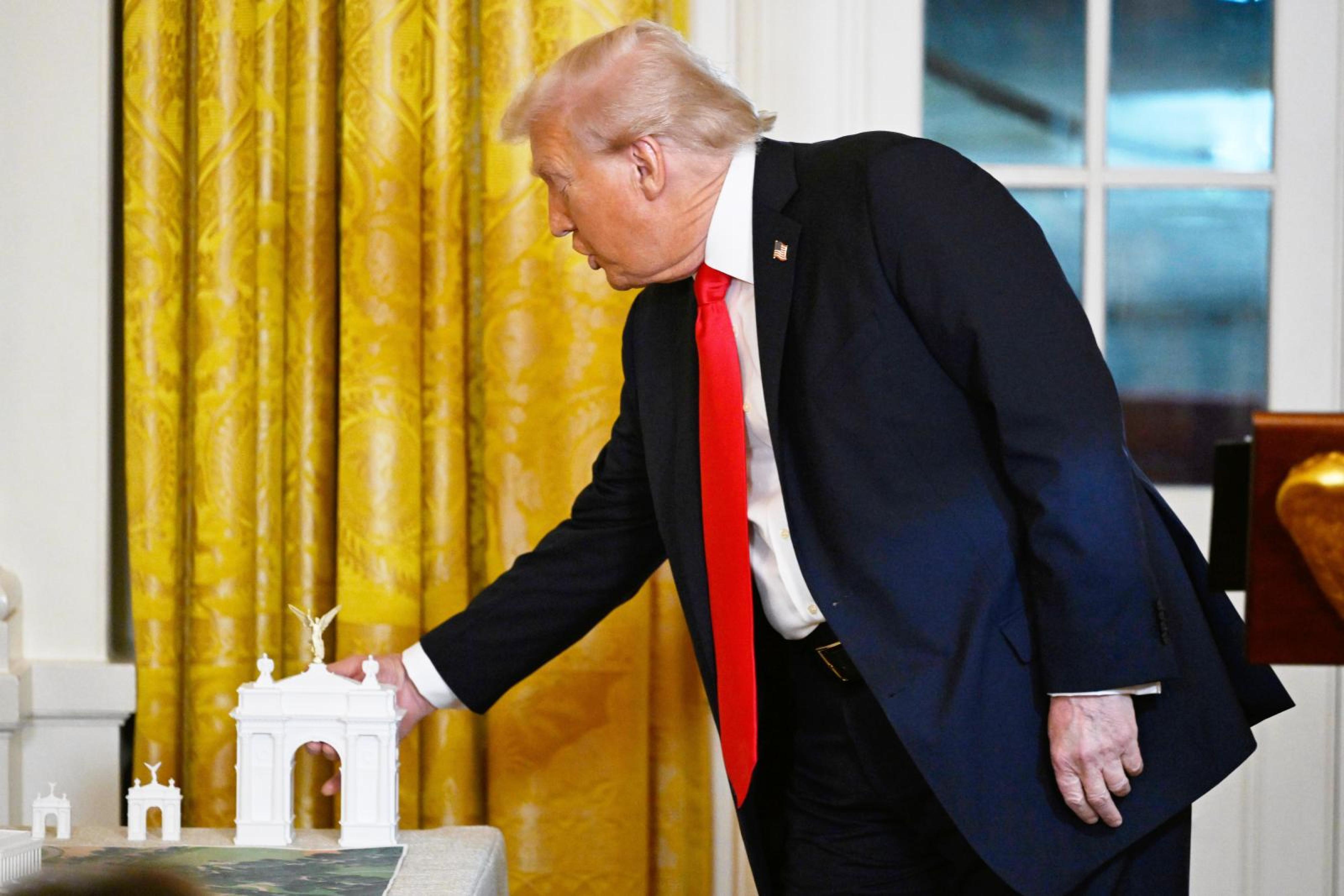
As Trump’s second term in office grows ever more disastrous, he distracts himself by focusing on renovating whatever he can get his hands on. “I know more about stone than anybody imaginable,” he told New York Magazine’s Ben Terris, giving him a tour of his White House projects. “A lot of people who don’t do construction, it drives them crazy. For me, it’s actually relaxing because I’m really good at it.” The relaxation regimen is extensive. There’s the new White House ballroom, a gilded behemoth whose construction began with a total demolition of the landmark mansion’s East Wing (after he had sworn not to disturb the original building) and which is costing taxpayers at least $300 million to complete (despite Trump’s pledge to raise the money himself). He’s planning a gigantic triumphal arch that would dwarf the Lincoln Memorial and a private golf course in a park where a public one now stands. All the while, he continues his desperate efforts to turn the John F. Kennedy Memorial Center for the Performing Arts into the Donald J. Trump Center for Admiring Trump.
As an illustration of the folly of undertaking a project without adequate concern for the common good, Trump’s presidency has been a smashing success. And, encouragingly, people are catching on—the president’s approval ratings are the lowest they’ve ever been, and polls show strong opposition to the ballroom and arch projects. Whenever and however it ends, the Trump era seems certain to leave behind a lot of opportunities for demolition. The question then—the one Leo prompts us to ask—is, what will we build from the ruins?
The role of “people of good will” in this moment, according to Leo, is
not to be passive spectators of social and cultural fractures, nor mere commentators on what is crumbling, but men and women prepared to enter the construction sites of history—research laboratories, technology companies, schools, the media, institutions and local communities—in order to rebuild what has collapsed and protect what is threatened.
This hits hard; I spend a lot of time honing my “commentator on what is crumbling” skills, and working on construction sites sounds difficult. But I am inspired by Leo’s vision of solidarity and cooperation, and even more inspired by the creativity and clarity with which he expresses it in Magnifica humanitas. It’s the rebuilders, not the demolition crew, who have the wisdom of the ages at our backs.
We welcome your comments about this article. Please send your response to [email protected].