Our dysfunctional Constitution has helped save us from Donald Trump. That starts with the Congress. Early in Trump’s second term, Steve Bannon was sneering that Congress is now like the Duma, Putin’s poodle. To be sure, Congress has been servile. But the servility of Congress is not at all like the Duma’s servility to Putin. Whatever Putin wants, the Duma turns into law. Trump wants a lot of things that Congress hasn’t given him—and a lot of things it can’t give him.
Yes, there was the Big Beautiful Bill, a big fat kiss to America’s oligarchs, cutting their taxes at the expense of health care for much of Trump’s base. But that’s what Congress does; for many years now—since well before Trump—congressional Republicans seem to have no other purpose than to cut taxes for the rich. But if Bannon were right and Congress were just like the Duma, it would have canceled the midterm elections. The filibuster, the hopeless tangle of Senate procedural rules, all that outside money that even pro-Trump legislators have to raise to hold a seat (a lot more than it takes to get into the Duma), and at least fifty years of learned institutional incompetence all make it harder for Congress to do anything more than cut taxes for the rich. It is simply too ineffectual, too inert, to help Trump subvert our electoral system.
Yes, Trump can do many bad things by executive order, but without Congress he is stuck with the upcoming elections, gerrymandered or not. A real authoritarian takeover would require the active participation of the legislative branch. Trump wanted this to happen; he tried to get Senate Majority Leader John Thune and others to toss the filibuster. But Thune has no hope of getting his own side to go along with this. Senators—especially Republican senators—are addicted to the filibuster. Democratic senators know all about dysfunction; they knew they could block most of the president’s legislative agenda just by filing a motion for a filibuster. Much of the Democratic base is angry with the party’s leadership for failing to stand up to Trump. It does not appear to grasp just how effective a check their elected leaders have been. Had Trump a Congress capable of passing laws like the SAVE Act, he really might have rigged the midterms. His big coup was to get rid of the Voting Rights Act, but only because the Supreme Court struck it down: he could not have gotten Congress to repeal it.
But this isn’t the only important check on Trump’s power. Those who complain that elected Democrats do nothing seem to forget about all the Democratic politicians elected to serve as state attorneys general. If Congress has not been enough of a check, these other elected Democrats have acted collectively, like an extra-parliamentary body, to block Trump in the courts. Their ability to do so is partly a fringe benefit of our dysfunctional form of national government, which delegates too much power to the states. It may seem odd to give so much credit to these Democratic attorneys general. After all, the orders blocking the Trump administration come from the courts in which these attorneys general file their lawsuits, so you might say the credit belongs more properly to the judges. But courts are much more likely to issue such rulings when some kind of sovereign government seeks them. And the states, represented by the attorneys general, are some kind of government.
Our federal system of government is deemed by the Supreme Court as a form of “mixed sovereignty.” That is why both state and federal courts tend to give states their due—which is sometimes more than they give the federal government. As a lawyer, I have sued the state of Illinois several times. I can tell you from personal experience that courts are even more accommodating to state attorneys than to U.S. Justice Department (DOJ) lawyers. The state attorneys usually win motions for extensions of time, for filing their briefs, or anything else. Yes, states sometimes lose in court, but, other things being equal, federal judges who are Democrats usually defer to state attorneys general who are Democrats, and this off-the-record form of federalism has been a significant check on Trump. Or, to put it a different way: these elected Democratic attorneys general give the courts the opportunities they need to stop Trump.
Sometimes, the attorneys general even win in courts with Republican-appointed judges. Some of those legal victories happen just because, collectively, the state attorneys general can vastly out-lawyer a now-enfeebled DOJ, which has seen an exodus of lawyers from both its civil and criminal divisions. For the first time in modern history, the DOJ does not have anything like the legal resources that the Democratic elected officials representing ten or fifteen states can bring to bear. In litigation, size matters. As does competence and a passing familiarity with local court rules. Thanks to Trump, Pam Bondi, and Todd Blanche, the DOJ does not have the lawyering capacity to defend the Trump administration, even before Republican-appointed judges.
By a remarkable historical irony, we owe the Republican Party for this particular check on Trump. Starting with Nixon’s so-called New Federalism in 1970, the federal government has contracted out to the states the welfare, education, housing, and jobs programs that Washington had administered directly ever since the New Deal. It is hard to imagine, for example, a Civilian Conservation Corps today, and that’s something to be lamented. While New Federalism has served as a check on Trump, it has also vastly weakened the federal government as a force for good. Some of the regulatory delays that advocates of “abundance” gripe about today are the direct result of that shift to state delivery of federally funded programs. This arrangement was a huge impediment to Biden’s Build Back Better Plan. It is an arrangement designed to make sure that voters don’t realize that Democrats at the national level are doing anything for them. On the other hand, that shift, however deplorable in other respects, has given the states a lot of huge grants and contracts—and therewith the ability to fend off Trump and Elon Musk.
It cannot be denied that the elected Democrats in Congress look weak. And many blame Senate Minority Leader Chuck Schumer for, well, not being a real leader. But that criticism is unfair: one would think the first test of a minority leader is to keep senators—especially senators—relatively united, and he has done that. To judge Schumer as if he were shadow prime minister in a parliamentary system is a category mistake. The Senate minority leader isn’t, and shouldn’t pretend to be, the formal head of the opposition party. In fact, if he tried to assume that role—if had tried to lead rather than just gather—he would not have done as well at the job he actually has. His longtime opponent Mitch McConnell has tried to explain what Schumer’s liberal and progressive critics fail to grasp: both minority and majority leaders have the job of speaking for every senator in their caucus; they do not have the luxury of speaking only for themselves, and that is especially important when the party balance is so close. In those circumstances, unity is everything and the minority or majority leader cannot afford to alienate anyone in their caucus.
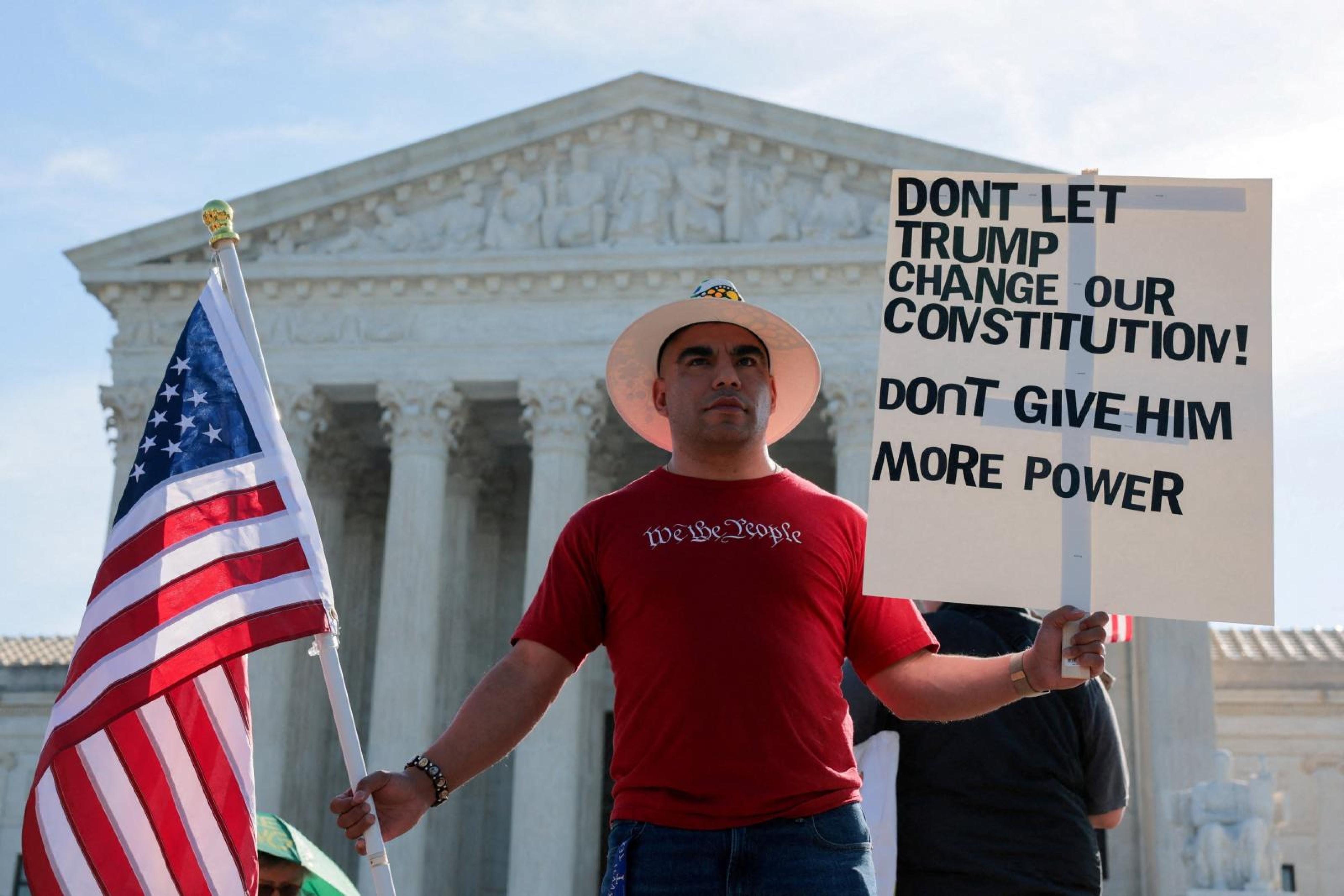
The Supreme Court is as dysfunctional as Congress, but in a completely different way. Throughout our history, it has had too big a role in shaping our form of government, and that role continues to expand. If the Supreme Court has usurped the role of Congress, it is because Congress is so weak. Nature abhors a vacuum. It’s really the high court, not the president, that Congress has let run wild. And the court, in turn, has done its Duma-like best to boost a coup—partly for Trump’s benefit, but also partly to seize power for itself. Yes, the court helps Trump. Consider just two big changes Trump could never get from Congress: the Supreme Court decision that gave Trump immunity from prosecution and the gutting of the Voting Rights Act. Not even this Congress would have given him those things. But when the court just seems to be caving in to Trump, it is often also serving its own agenda.
That’s why it also makes sense when the Court does check Trump, as it did most recently when it refused to let him use the U.S. Postal Service to interfere with mail-in voting in the November midterm elections. This was just the Court declining to commit suicide. Trump’s attempted interference was too late even for Justice Kavanaugh, who likely would have ruled for Trump otherwise. Upending the midterms at this point might have meant the end of the republic—and that might mean the end of the Court.
But in every pro-Trump Supreme Court decision, the real winner is the Court. For example, in the term just ended, the court seemed to increase the president’s power over the once-independent federal agencies. But the power it gave him is really only the power to undermine or destroy the agencies by firing commissioners; the court did not increase the power of the president to use federal agencies to break up monopolies, promote labor, or address climate change. On the contrary, in cases like West Virginia v. EPA, the court has limited the power of those agencies to do anything at all. Under the so-called major-questions doctrine, any regulatory change not directly authorized by Congress will be struck down. In short, the court has given the president more personnel power over agencies that the court has already attempted to keep from functioning. The real coup that is unfolding in slow motion right in front of us is the court’s overthrow of the administrative state. The president is being given power over the administrative state only for the sake of destroying it. If the court really were out to help Trump, then how to explain the one big check that it placed on Trump when it stripped him of his “emergency” power to impose tariffs? If the court is abetting a dictatorship, as some its critics allege, why wouldn’t it support his trade policies? Of course, most of the conservative justices did defend those policies. But why not all?
The answer is that there is a red line that even this right-of-center court would never cross. In almost every major Supreme Court case in which the U.S. Chamber of Commerce has filed an amicus brief, the court has ruled on the side supported by the Chamber of Commerce. Additionally, there was the court’s decision to exempt the Federal Reserve from the power it gave Trump to fire agency heads and commissioners. Like the Trump tariffs, Trump’s takeover of the Fed threatened the postwar global economic order. That is the one tree in the garden that Trump may not cut down. In an extra-constitutional sense, the president is subordinate to that order. It may be that Congress is becoming weaker and the administrative state is crumbling, but year after year, the Chamber of Commerce remains as powerful as ever. At least one of our institutions seems to be working.
We welcome your comments about this article. Please send your response to [email protected].