New York’s 2025 mayoral election is unfolding fifty years after the city’s near financial collapse. A new documentary, Drop Dead City, is filled with images of those seemingly apocalyptic days: uncollected trash burning in the streets, apartment buildings ablaze as their arsonist owners seek to collect insurance, cops fighting sanitation workers over pension benefits, a dazed and overmatched mayor—loyal New Yorker Abe Beame—watching it all fall apart around him. Famously, President Gerald Ford and other Republicans initially refused to provide federal resources to help New York; eventually understanding its vital importance to the nation’s economy, they relented. Since then, the city has more or less managed, even prospered. Crime is at or near historic lows (no matter what Fox News says), the subway is safe, many young people (and many who are not so young) continue to want to make it their home. So do immigrants, who for centuries have been its lifeblood. The problem is that “prosperity” has also made it cripplingly expensive. While millionaires and billionaires threaten to move if their taxes are raised, those making under six figures a year consider themselves lucky to have a place to live at all. As it is, the average rent for a six-hundred-square-foot apartment in New York City is $4,200.
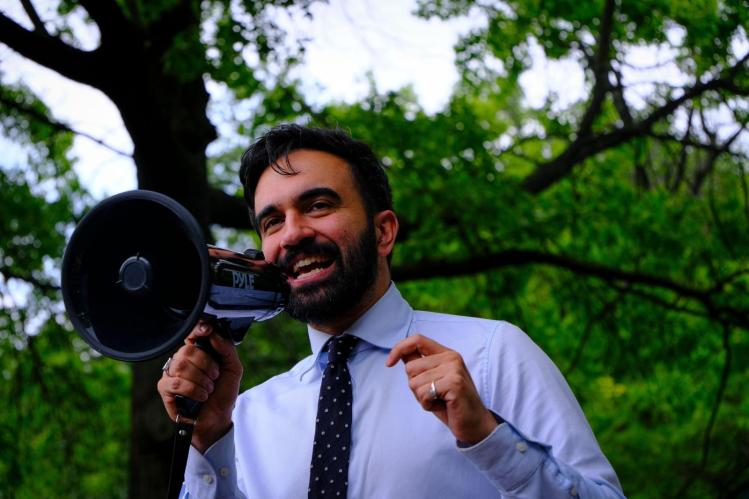
Zohran Mamdani, winner of the 2025 Democratic mayoral primary, stuck to a concise and compelling message throughout his campaign: for far too many people, New York City is far too expensive. It clearly connected with voters. But so did he: Mamdani’s infectious energy, obvious intelligence, and natural ability to communicate—via digital video and “in real life”—were a stark contrast to the dour and detached Andrew Cuomo, the former governor who entered the race the prohibitive favorite. Mamdani mustered fifty thousand campaign volunteers to his cause. He interviewed halal-cart vendors on YouTube, jumped into the ocean at Coney Island, and walked the length of Manhattan two nights before the election, speaking with all kinds of New Yorkers along the way. A decisive victory over the far better funded Cuomo portends well for Mamdani’s chances in the general election this fall.
But is he qualified to govern? It’s not an unfair question. As his critics (they are numerous) and likely opponents point out, his résumé is short and legislative record thin. He is only thirty-three years old, and if elected would be the second-youngest mayor in the city’s history. Difficult nuts-and-bolts issues loom, from how to run the city’s public-school system to the planned closure of Rikers Island, New York’s long-troubled jail complex. Meanwhile, a hostile administration in Washington has already clawed back tens of millions of dollars in funding for New York, while holding its current mayor as something of a political hostage and lobbing threats at the city on a near-daily basis. It has made increasingly ugly personal attacks against Mamdani since his win.
Then, of course, there is Mamdani’s so-called socialist policy agenda, summed up in four signature proposals pegged squarely to the affordability crisis: free buses, five city-run grocery stores (one in each borough), universal daycare, and a rent freeze. His program is contingent on raising taxes on corporations and the wealthy, which he is blunt about. But doing so would require buy-in at the state level, and Gov. Kathy Hochul, as well as some Democrats in the state legislature, have already ruled that out. Many of the city’s wealthiest people and powerful business interests have quickly arrayed against him. Big-name Democrats have offered congratulations but for the most part have stopped short of endorsing him. Were Mamdani to find himself taking office in such an environment come January 1, he could face an uphill climb in seeing his agenda enacted.
To which his supporters—a broad range of New Yorkers across neighborhoods, ethnicities, age groups, religions, and income brackets (as the final tally showed)—generally respond: So what? To them, Mamdani is the long-awaited antidote to the sclerotic, unimaginative, complacent politics overseen by an aging cohort of Democrats too wedded to their own wealthy donors to do anything about the conditions they decry, no matter the hand they had in bringing them on. That’s to say nothing of what seems like helplessness, incompetence, or indifference when it comes to standing up to Donald Trump. Mamdani’s victory over Cuomo strikes many as similar to that of Rep. Alexandria Ocazio-Cortez over longtime Queens congressman Joseph Crowley in 2018, if not Barack Obama’s toppling of Hilary Clinton in 2008: they also were seen as too young, too inexperienced, and too radical to win office—or to govern. Like Mamdani, they were also cast as foreign, alien, un-American—even “dangerous,” which is less a meaningful political critique than an expression of the fear that often accompanies racism and Islamophobia. Mamdani and his supporters are anything but afraid. They are hopeful of making life in the city better and optimistic about the government’s role in doing so. They are willing to try new things that don’t require sign-on by the consulting class and ruling elite, and that, yes, might even weaken the death-grip those elites have on the levers of power in New York. At this point—struggling to afford rent, food, and childcare—what is there for them to lose?
Of course, those who would prefer to see Mamdani lose aren’t attacking him for his ideas as such—ideas that are not really so outlandish. Eugene Debs would be hard-pressed to call them “socialist.” Other cities have introduced free or heavily discounted mass transit. There are states that run stores selling beer and alcohol, if not groceries. New York City has implemented rent freezes in the recent past. Former mayor Bill de Blasio introduced the much-beloved universal pre-K program, which may offer a template for universal daycare. And rich people, once upon a time, were expected to pay their fair share of taxes to make the city better for all by supporting the services that they use themselves (police, for example). What’s more, voters like these ideas.
And so other criticisms arise—such as Mamdani’s alleged antisemitism. Mostly this means his comments on Israel and Gaza. He has called the relentless campaign of the former against the latter a “genocide.” He hasn’t committed to visiting Israel, something previous mayors made a point of doing. He hasn’t satisfactorily condemned use of the term “global intifada” by pro-Palestinian protestors. Never mind that Israel and Gaza have very little to do with the thing critics also say he is too inexperienced to do: run the city on a day-to-day basis. Never mind, either, that his criticism of Israel’s actions in Gaza reflect the opinion of more and more New Yorkers, not just hipsters or Muslims or fellow socialists but older voters and even many Jewish voters. City comptroller Brad Lander, who is Jewish and who was one of Mamdani’s opponents in the primary—the two cross-endorsed each other—is one of his main supporters. Lander has sensibly pointed out that criticizing Israel can’t automatically be conflated with antisemitism, and that even though the conflict in the region is something the world should be focused on, there is very little, after all, that the mayor of New York City can do to directly affect its outcome, especially when things in New York demand attention.
That hasn’t stopped the disgraceful Eric Adams from picking up this line of attack, even going so far as to run on the “EndAntiSemitism” line in the fall after forgoing a run in the Democratic primary. Adams has little else to go with, given the federal corruption charges he was facing until Donald Trump dropped them in what seems to many like a quid pro quo. Many of his former advisers still face charges, while those who weren’t caught up in the investigation have long since jumped ship. Adams is still also on the hook for more than a million dollars in legal fees. He has publicly abased himself, on Fox News and elsewhere, trying to stay on Trump’s good side—that is, by promising to abet ICE raids and mass deportations. His management of the city has been abysmal, and his polling numbers are in the tank. He retains the backing of New York’s Orthodox Jewish community, and the business and real-estate interests that poured millions into Cuomo’s failed campaign seem to see Adams as the only port in the current storm. But now that unions and the city’s Democratic apparatus have come around to Mamdani, Adams is viewed as having little chance. The same goes for the ubiquitous but unserious Republican candidate Curtis Sliwa, who would likely have to compete with Adams for the Trumpish, anti-Mamdani vote; accordingly, he is already spewing his usual line of nonsense about “lefties” and “communists.”
There are eight million people in New York City, which, as a lot of them like to point out, is more than the populations of many states. The election of the city’s mayor always matters, but with Mamdani already having gotten as far as he has, it has taken on national and even global significance. An analog might be London mayor Sadiq Kahn, the first Muslim to lead a major Western city. Like Mamdani, he is also known as a social democrat. He bested a conservative opponent to take office in 2016 and last year won a historic third term. Further, Mamdani may herald the arrival of a new ethnic political coalition, succeeding the previous generations of Irish, Italians, Jews, Puerto Ricans, and African Americans who in their turn flexed political power. New Yorkers with roots in Southeast Asia—in neighborhoods all around the city—came out overwhelmingly in their support for him.
Donald Trump has made no secret of his aims to target cities run by Democrats. He has also started to go directly after Mamdani—a naturalized U.S. citizen he calls a “communist”—suggesting that denaturalization and deportation are in the cards. This is a turbo-boosted reprise of his birtherism smear of Obama. In a press appearance after Mamdani’s win, Trump was the very embodiment of the corpulent tyrant musing aloud on whom next to behead. His slavish courtiers have giddily followed suit, promising to commence investigations and effect Mandani’s arrest. Trump’s new Homeland Security Advisory Council—whose members include a founder of Bikers for Trump and the discredited, disbarred former New York mayor Rudolph Giuliani—also has Mamdani in its crosshairs. In its first meeting on July 2, Giuliani called the candidate an “Islamic extremist and communist”—try to spot the illogic—while Homeland Security director Kristi Noem drummed up fear of Mamdani to call for expansion of her own powers: “The department has authorities that have never been utilized before…and I’m going to need some good minds on how to use those authorities.”
This is all vile stuff, though not surprising. It is also dangerous. But is it as dangerous as the prospect of a mayor with a relatively common progressive vision of governance that puts ordinary New Yorkers first? To those who can’t understand how Mamdani has gotten to the cusp of the mayoralty of America’s largest city, apparently not. Better to distort and demonize than face a two-percent tax increase or lose a chance to jack up the rent again: when it comes to the job of mayor, those who’d help people need not apply. But as of now, the people still get to have their say. And many of them say they like the young Muslim socialist, a lot.