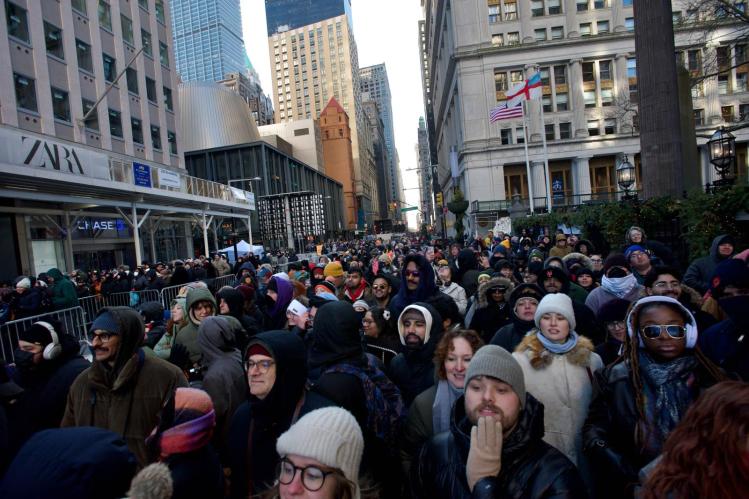
Inaugurations are lofty affairs. At their worst, they can seem stilted and tacky, especially to today’s cynics. But inaugurations are, at their best, artful: they’re performances that capture the moral and aesthetic horizons of a broad political project. At his inauguration as the mayor of New York City, Zohran Mamdani did just that: he offered both a substantive and beautiful glimpse into what local leftist politics can look and feel like.
Mamdani’s inaugural address cited influences and inspiration from around the world, spanning from LaGuardia’s New York to Mandela’s South Africa. He spoke of left politics as a global tradition (rather than a youthful fad, as his critics would have it). But one reference in particular caught my attention, and it wasn’t even from the new mayor’s speech. It was singer-songwriter Lucy Dacus’s rendition of the classic protest song “Bread and Roses,” long associated with the early twentieth-century women’s suffrage and labor movements.
The anthem, born out of women’s organizing at Massachusetts textile mills in the 1910s, simultaneously insists on material redress for poor women (bread) and attention to aesthetics and culture (roses). Intrinsic in the formulation is a connection between material and spiritual aspiration. No project of cold materialism is a true politics of dignity, and the song’s third verse provides a poignant and more holistic vision, once again by invoking stories and people past:
As we come marching, marching, unnumbered women dead
Go crying through our singing their ancient song of Bread;
Small art and love and beauty their trudging spirits knew—
Yes, it is Bread we fight for—but we fight for Roses, too.
What would it mean to have a politics attentive to “small art and love and beauty”? I think the new mayor’s campaign provides an example. Of course, the crowds at then-candidate Mamdani’s rallies could recite from memory his three key campaign promises—freeze the rent, make buses fast and free, and pass universal childcare. But beyond policy planks or slick videos, Mamdani told a convincing story about what New York is and who it belongs to, one that looked more familiar to today’s New Yorkers than the old machine politics (and Andrew Cuomo especially) could imagine. Mamdani’s first State Assembly campaign even offered a new spin on the song: he opted for the campaign slogan “roti and roses” as a way of demanding “that which is necessary to survive, and that which is necessary to thrive…[while] also making sure to highlight the struggles of specific communities that have been left out in the cold for decades,” as Mamdani told Jacobin.
Those specific communities were also at the center of Mamdani’s victory speech, which offered a more modern take on the classic litany of constituents that has become a hallmark of political stump speeches: “Thank you to those so often forgotten by the politics of our city, who made this movement their own,” he said. “I speak of Yemeni bodega owners and Mexican abuelas. Senegalese taxi drivers and Uzbek nurses. Trinidadian line cooks and Ethiopian aunties.” “Yes, aunties,” he added, in a self-aware dig at one of the more desperate attacks on his campaign.
For all his “economic populism,” Mamdani also succeeded by offering an expansive, confident, and joyful cultural vision. He brought the stories of New York’s nearly one million Muslim residents to the forefront of his campaign amid his opponents’ Islamophobic vitriol and defended trans New Yorkers in a moving tribute to Sylvia Rivera. But he also lightheartedly promised to end “halal-flation” (the city’s diverse food culture was something of a recurring cultural motif in Mamdani’s campaign), organized a scavenger hunt across the city for thousands of people, and even spent his Halloween campaigning in the city’s gay clubs.
It has become almost cliché in some Democratic circles to suggest that the party ought to refocus its attention on “kitchen-table issues.” This is often a coded way of saying that Democrats should pay less attention to “cultural” issues, usually trans rights and immigration. Sometimes, these pleas invoke the Mamdani campaign as evidence: the new mayor did not “dwell on cultural issues,” one such analysis explained. “Instead, [he] concentrated on subjects like increasing wages and affording a home.” This just isn’t true, though: Mamdani’s campaign succeeded in part because his politics spoke to the experiences and identities of those who had long been ignored by city leadership.
While one might correctly note that New York City does not reflect the national political environment—the specific policy proposals that win in Brooklyn may not fare well in Bucks County, Pennsylvania—Mamdani did not run away from “cultural” issues that were controversial among New Yorkers, either. The new mayor’s commitment to justice in Palestine is a good example. Rather than ceding ground on a controversial issue for the sake of widening his appeal, Mamdani connected his pro-Palestinian stances to a rhetoric of universal rights. Indeed, had he backed down in the face of attacks over his stance on Israel or retreated into silence, one wonders whether he could have maintained the frenetic energy that mobilized his supporters to knock on three million doors.
It’s time to reimagine the tiresome “kitchen-table issues” conversation. Inconvenient though it may be, politics is about more than “economics” narrowly construed. It is also about culture, belonging, and values. People will continue to talk about transgender rights and immigration (perhaps even at the kitchen table), whether or not Democratic politicians run on those issues. Similarly, reflexively collapsing into the center forfeits the whole task of politics—developing and implementing a positive agenda for society—to respond to attacks that may never subside. Did teaming up with conservative senator James Lankford to propose a draconian border bill save the Biden administration from attacks over immigration? Could anything have saved it—or would the attacks have come anyway? Across the ocean, has the Labour Party in the UK made any progress in turning the tide of far-right politics by adopting a harsher immigration plan than the Tory governments that preceded it? Inauthentic rightward turns are not only lazy; they also stand in the way of a new and energetic cultural politics that might actually meet our perilous moment—one marked by the optimism and expansiveness that made Mamdani’s campaign so refreshing.
If Democrats learn anything from the Mamdani phenomenon, I hope we learn that there is no compelling politics that chops itself in half before even beginning. We need, to borrow a slogan from the interconnected movements for women’s suffrage and decent wages, a politics not just of bread, but roses, too.