Patricia Lockwood is an award-winning American poet, memoirist, and novelist, perhaps best known for her 2017 memoir Priestdaddy, which was named one of the ten best books of the year by The New York Times. She is now also a contributing editor at the London Review of Books. Priestdaddy is about her eccentric Catholic family, ruled over by her larger-than-life father, a cantankerous former Navy submariner. Lockwood writes that when her father was a youthful atheist, he converted to Christianity as a consequence of watching The Exorcist dozens of times while on a submarine. Lockwood often seems to write with a good deal of poetic license, and I suspect it’s best to take that Damascus moment with a large grain of salt.
In any event, after the Navy, her father first became a Lutheran minister and then converted to Catholicism, eventually becoming one of a rare breed, a married Catholic priest and father of five. He is also a gun-brandishing, Rush Limbaugh–loving, electric guitar–playing, raving political reactionary. In fact, too much of the family’s religion, as well as Lockwood’s rejection of it, seems driven by politics. Lockwood’s mother, a cradle Catholic, is an equally memorable personality, but of a very different kind. Nearly everyone Lockwood writes about, including her husband, is more mythological figure than flesh-and-blood character, which I suppose is the point. When not being gnomic, she can be witty and mischievous. Her signature move is to be both judgmental and accepting in nearly the same breath. Alas, I found Priestdaddy impossible to finish. Lockwood is a little too assured in her rhetorical extravagance, and there are just too many sentences that appear to have been designed as stumbling blocks. For example: “Suspecting these speeches are going to continue for a while, I address myself to my catered meal, which is chunks of the lord crucified on a tall Golgotha of green beans.” Or: “How suddenly full you felt of white vapor.” Or: “[He] appeared to be answering that he was the lizard king, who slept in a pyramid every night and meditated by counting the grains of sand in the universe.” In baseball parlance, Lockwood throws a lot of spitballs and junk to set up her fastball. But she has an undeniable voice.
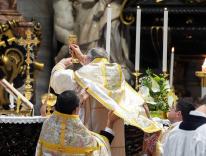
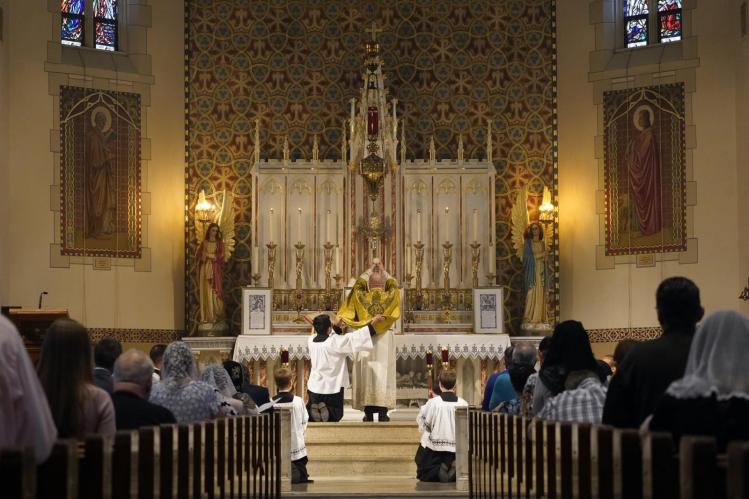
Her most recent piece for the LRB, “A Tradcath Wedding,” revisits the family drama. Lockwood seems to have discarded Catholicism when she was a poetry-obsessed teenager, although she concedes that “belief, or past belief, is a kind of biomarker, like grief or perversion or having studied magic.” Her niece, the daughter of her older sister Christina, is the trad bride. The wedding takes place in St. Louis at the Oratory of the Institute of Christ the King, Sovereign Priest (ICKSP). Lockwood winningly writes that the institute is “a group of guys who are probably as normal as they sound.” Her father is present in his cassock, “perhaps on technical duty.” She is amusingly exasperated by the elaborate ritual actions of the traditional Latin Mass as performed by the ICKSP celebrants. “Now the men on the altar began to mill with excited purpose, like cheerleaders before they climb into a pyramid. There are about twenty of them, and it is nearly impossible to describe the fussiness of their movements, the duration for which they occurred or the pleasure the men seemed to take in producing them,” she writes. “An unseen fog machine pumped the Cadillac of Incense. It was so thick and blue that God, in the rafters, coughed delicately.” She goes on to offer a few wry blasphemies: “If extremity is its own end, why not go the rest of the way and roast an ox up there? Replace communion wine with pruno. Flavour-blast the body of Christ.” As you might suspect, her iconoclasm is the mirror image of her father’s rigid piety. (Pruno, for those who don’t know, is evidently an alcoholic drink surreptitiously concocted in U.S. prisons.)
After the ceremony, Lockwood and her husband spend many hours at the reception in the church basement, where they converse with a number of “trad” Catholics. Her husband, bewildered by the bizarre spectacle of it all, gets drunk. Her sister has seven children, and Lockwood confesses to one couple that she has not been able to have children herself. In response, the woman’s husband reassures Lockwood that she will meet her miscarried fetuses in heaven. “You got to offer a sacrifice that my wife never got the chance to make,” he compliments her. Lockwood takes this in stride and praises the man’s imagination. She moves on to “torture” a cassock-wearing seminarian, who claims that French people can’t be saints. “I asked him what his favorite movie was: Air Force One.” “You used to be able to count on these men for an aesthetic sense, at least,” Lockwood laments. Lockwood is about as prepared as any outsider could be for what she observes at the wedding, but “no matter how often you tell yourself, as the celebrant opens his mouth, that you are in for the ideological ride of a lifetime, you are never really prepared. I have heard my own priest father, at my grandmother’s funeral, describe with relish the way people now roll up their relatives in carpets and bury them in the backyard like pets.”
For some reason, the St. Louis Oratory and the Institute for Christ the King, Sovereign Priest, rang a bell with me. I seemed to remember that Commonweal had published an article about the group that also took place at that church. I managed to hunt it down. It was written by Eric Brende and titled “No One Expects the Inquisition: My Adventures with Cardinal Burke & the ICKSP” (June 2, 2017). When Cardinal Raymond Burke, a Latin Mass advocate, was archbishop of St. Louis, he invited the ICKSP to take over the Oratory in the hopes of promoting the traditional rite. Burke is a champion of the Institute and has presided over the ordination of many of its priests both here and abroad. The ICKSP takes its inspiration from ancien régime France, where the clergy were elevated above both the nobility and the commoners. French is the order’s official language. In his Commonweal article, Brende, an author and urban homesteader, confessed that he thought the implementation of Vatican II’s reforms had gone too far and that many Catholics “would identify me as a conservative.” He and his family were parishioners at the Oratory, “drawn by the desire for beauty and solemnity” and “willing to overlook almost anything to avoid tacky Masses.” He and his wife homeschooled their children, and he helped to organize a homeschooling cooperative at the church. “Although I wasn’t on board with the larger ICKSP agenda, I reasoned that we are all part of the same church, and same Christian family. I’d never been in perfect agreement with the policies of any parish I’d belong to. Life is a trade-off. Aren’t Christians, in particular, called to bear with one another?”
Brende learned, however, that when it came to the ICKSP, rooting out “disloyal” members was a priority. As the result of a convoluted series of events, during which he expressed some “misgivings” about the Institute, he was accused of “undermining a priest in his own domain” and essentially expelled from the congregation. “Privately and unofficially, ICKSP stalwarts scorn the postconciliar church, deny that Vatican II carries doctrinal authority, and are, in essence, following through on these convictions by setting down the infrastructure of a sort of parallel or shadow church with the church,” Brende concluded.
In her piece, Lockwood claims that she is reporting “on the state of American Catholicism,” but her article is a caricature tailored for the misconceptions of LRB readers about Catholicism. She is on an “ideological ride” of her own. To be sure, the ICKSP is one very peculiar corner of the U.S. Church, but it is hardly representative of how the vast majority of American Catholics understand or practice their faith. For most of them, pre-revolutionary France exerts little allure. I have a fair amount of tolerance for the more bizarre manifestations of Catholicism, although I keep my distance. I did not have to endure the sort of eschatology-driven Catholic childhood Lockwood did, but neither do I believe that my own Catholic upbringing exhausts Catholicism’s possibilities. In his house there are many mansions. As Brende wrote, we are called to bear with one another. In fact, as a case in point, in a recent email exchange Brende informed me that he was eventually reconciled with the ICKSP and the Oratory—he objected mostly to the Institute’s clericalism—and can now again appreciate “long, solemn, mystical Masses and liturgies.”
We welcome your comments about this article. Please send your response to [email protected].