On the northbound train from London, I noticed a familiar pattern. I was with my wife and daughter, and after a couple days in the city we were headed for a walking tour of the Lake District. The high-speed train whipped through nondescript industrial territory and thousands of row houses before reaching slightly greener suburbs followed by farmland. It roughly matched what I was used to on trains out of other cities, Chicago especially.
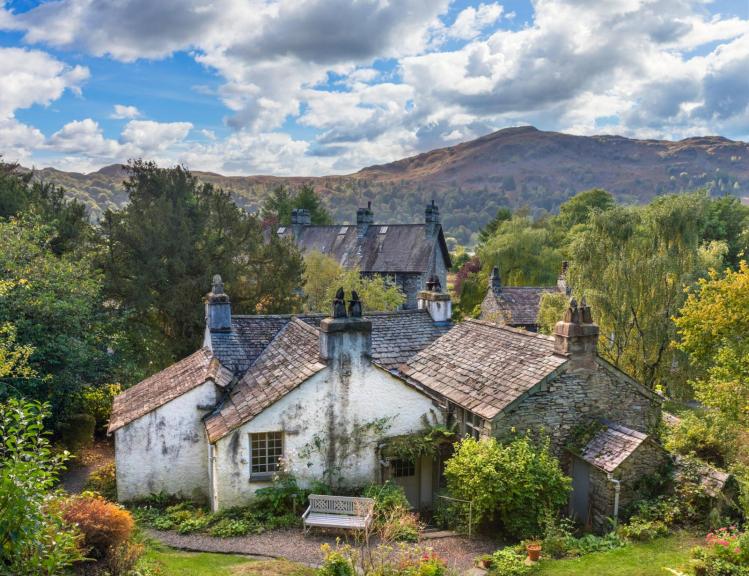
I’m from the middle of Michigan’s Lower Peninsula, near its capital city of Lansing. When you drive north in Michigan, you eventually hit a topographical turning point where deciduous trees shade into evergreens and patches of exposed, beachlike sand crop up in anticipation of Lake Michigan’s dunes. Something like that happens in England just north of Birmingham. The horizon starts to undulate and the sheep population increases sharply. Suddenly there are mountains, and when the train stops at Oxenholme, the topographical line has been breached. You’re in a part of England that has no counterpart in America. We have mountains galore, but these English mountains look cut to human scale. Everything in the Lake District has this vaguely artisanal quality. The blades of grass in the cracks of its parking lots look curated, or at least intentional.
We got off the train at Windermere and took a cab to Ambleside. Unasked, the cabdriver went into tour-guide mode, telling us the number of sheep in the district (around three million), the number of Michelin Star restaurants (“seven or eight”), and explaining that, since farming has become impossible, tourism is now the district’s main industry. As he listed the luxury hotels, vegan yoga retreat centers, and five-star restaurants, I saw Wordsworth reappearing to overturn the tables of the gift shops as Christ had those of the money changers in the temple.
That image, however, would not be quite accurate. Far from hating tourists, Wordsworth wrote a tourist’s guide to the Lake District that went through five editions in his lifetime and might have been his best-known work besides the poem “I Wandered Lonely as a Cloud.” A naïve minister, according to Matthew Arnold, once asked Wordsworth “whether he had written anything else.” Wordsworth’s Guide to the Lakes, which I read before we got on the plane, was popular in spite of the fact that it is animated throughout by Wordsworth’s distinctive brand of nature-mysticism. A chapter of “Directions and Information for the Tourist” is followed by ideas straight from The Prelude, “Ode on Intimations of Immortality,” and his other famous poems. Briefly, he divides nature into two parts. The first he calls “the superficies of the earth,” meaning, obviously, everything we can see. The part we can’t see he calls “Nature,” meaning by this something his detractors (Byron, for example) might regard as a sophisticated version of the Wizard of Oz. When he writes that “sublimity is the result of Nature’s first great dealings with the superficies of the earth; but the general tendency of her subsequent operations is towards the production of beauty,” he uses the language of an art critic. Nature “starts” with a rough draft of giant, unruly shapes such as mountains and works from there down to the level of vegetation and other more easily manipulated details of its landscape. This way of talking about nature is still with us, as when the pilot of our plane out of Chicago twice referred to “Mother Nature” as the author of our weather delays. As anything deeper than this, it is no longer part of anyone’s language, including that of those who with varying degrees of seriousness invoke Gaia or “the planet.”
In Grasmere, my wife and daughter went to a gingerbread shop while I toured Dove Cottage, Wordsworth’s home from 1799 to 1808. The tour opened with a short movie about Wordsworth, his sister Dorothy, and fellow poet Samuel Taylor Coleridge. Besides depicting them walking, conversing, and lying beneath trees looking up at the sky, the movie presents them as precursors of the environmental movement. Yes and no. In his Guide to the Lakes, Wordsworth objects to the practice of planting certain trees (such as larch trees, against which he seems to have a mild grudge) “not merely with a view to profit, but in many instances for the sake of ornament.” He objects to human attempts to rearrange Nature’s artistry. The word “environment,” however, is a somewhat bland successor to what he, Coleridge, and others meant by “Nature.” As the great Wordsworth scholar M. H. Abrams has shown, their response to Nature was not only spontaneous but also philosophically thick.
Wordsworth’s name and likeness are everywhere in the Lakes, while Coleridge is virtually absent. Coleridge lived there only three years, from 1800 to 1803 in Keswick. The movie at Dove Cottage uses actors in their twenties to portray Wordsworth, Dorothy, and Coleridge, and Coleridge is mostly shown reading and looking vaguely distraught. He seems to lack Wordsworth’s comforting relationship to Nature. Wordsworth’s frank pantheism, apparent in most of his early poems, made Coleridge uncomfortable (Coleridge lapsed into pantheism in one of his poems, “The Aeolian Harp,” then nervously backed away from it).
Whatever their philosophical differences (and they were real), conversation between the two men was constant around the time of Lyrical Ballads, the collection of their poetry that first appeared anonymously in 1798. Walking the Lake District around Keswick and Grasmere, one realizes that the area did more than vaguely “inspire” them. One example: a recurrent feature of the landscape is the hidden or partly hidden stream of water flowing downhill or bubbling audibly at the bottom of some ravine. Every fifty yards or so, buried, rushing water flashes in a field or runs across a footpath. The water’s discontinuity is striking. It haunts “the superficies of the earth” for a few yards then abruptly falls out of sight, like the “sacred river” in Coleridge’s poem “Kubla Khan.” These features of the area—starting and stopping water, plunging ravines, giant trees lying dead in a field—seem more aligned with Coleridge’s vision than Wordsworth’s.
Wordsworth dominates the area as perhaps no writer has ever dominated a plot of ground, but the Lake District has managed to clear reputational space for at least one other writer. For many tourists, it is not Wordsworth but Beatrix Potter who matters, and here I may declare a family connection. Before writing The Tale of Peter Rabbit and other children’s books whose characters crowd the shelves of Lake District gift shops, Potter was an aspiring biologist who tangled briefly with the theories of my very distant relative Simon Schwendener, a Swiss botanist. Opinions diverge on how much they had in common, but both were keenly interested in lichens. Schwendener held, and was in fact ridiculed for, his view that lichens were not plants in the usual sense but the symbiotic product of fungi and algae. It was known as the “dual origin” theory and made him a mockery at some scientific conferences. He turned out to be right, and some biographies of Beatrix Potter wrongly portray her as a heroic champion of his then-controversial views. She may have respected him, but unfortunately she rejected his theory, calling herself, in a conversation with another scientist recorded in her journal, “an old-fashioned lichenologist” rather than a “Schwendenerist.”
Potter’s house near Ambleside has been turned into a museum, and probably draws more tourists than either of Wordsworth’s two houses. The rooms of Dove Cottage, Wordsworth’s first house in Grasmere, are small, dark, and starved of direct sunlight, inducing in the visitor a claustral, almost womblike feeling. It stands above ground yet feels like a basement apartment. By extreme contrast, Rydal Mount, Wordsworth’s second house in the Lakes, stands on a hill, is flooded with light and Victorian bric-a-brac, and has a four-acre garden. It is beautiful and has a lofty study commanding a view of the mountains, yet feels stuffy and spiritually inert compared to Dove Cottage. In saying this, I am mirroring the common view of Wordsworth’s decline as a poet. This view has perhaps been overstressed, but tunneling through the dark, grotto-like spaces of Dove Cottage creates a sense of creative fecundity that eludes the light-flooded, picture-lined walls of Rydal Mount, which, we were informed, is now up for sale (around two million pounds, per the lady in its gift shop). According to its website, Rydal Mount can also be rented for weddings.
Wordsworth lived there from 1813 until his death in 1850. On the subject of houses, he writes in Guide to the Lakes that “I have seen a single white house materially impair the majesty of a mountain, cutting away, by a harsh separation, the whole of its base, below the point on which the house stood.” We saw only one mountainside whose visual rhythm was disrupted in this way. Personally, I found mountains the least interesting feature of the Lakes, monotonous in their perfection. When Wordsworth writes about mountains, he often makes them play the Platonic trick of counterfeiting themselves on a smooth body of water. It happens in the fourth book of The Prelude as well as the Guide, where he ascribes to water the ability to etherealize or “give a visionary character” to the objects it reflects, whether birds, humans, clouds, or mountains. I wanted to see this, but it was the rainy season and the lakes were not cooperating. Then one morning a large puddle next to our path took advantage of clear weather to create on its surface a crisply delineated image of a mountain that looked like a Dutch realist painting.
We were briefly in London before and after our week in the Lakes. In The Prelude, Wordsworth accuses London, and by extension all cities, of laying “the whole creative powers of man asleep” by overstimulation, yet the urban parts of that poem suggest that he enjoyed London as much as any normal person would. According to my research (asking my phone), London is the third-most-visited place in the world, yet it seemed calmer, in fact freer of chaos and even haste, than the entertaining madhouse Wordsworth describes. He is not a great city poet, and writes in The Prelude that while in London he survived its “press of self-destroying, transitory things” only by communing inwardly with streams, woods, mountains, and other permanent forms of nature.
The Prelude, Wordsworth’s great autobiographical poem—and the prototype, in many ways, of all modern autobiography—was not given that name by Wordsworth himself but by his wife Mary, who published it under that title after his death. Before that time (1850), it existed only in manuscript and was known as “the poem to Coleridge,” to whom the whole work is in fact addressed as a gigantic verse epistle. Coleridge’s relationship to London was both more intimate and more painful than Wordsworth’s. He went to boarding school there after his father’s death when he was eight years old, and in his poem “Frost at Midnight” describes his only childhood experience of Nature as lying on the school’s roof at night looking at “the sky and stars.” Even if he exaggerates here, it is true that Wordsworth’s simple bond with Nature always eluded him.
Wordsworth’s memory blankets the Lake District and shapes the itinerary of even the most unliterary tourists. Relics or even hints of Coleridge’s presence are virtually extinct, though most of the guidebooks give him a perfunctory nod. The writers were in the habit of writing verse letters to each other, and Coleridge responded to The Prelude by writing “To William Wordsworth.” Coleridge’s most famous verse-letter was “Dejection: An Ode,” addressed in 1802 to Wordsworth’s future sister-in-law Sara Hutchinson with whom he had fallen unhappily in love. (He was married and unwilling to divorce his wife.) Coleridge shared Wordsworth’s belief in Nature as something beyond, or aloof from, “the superficies of the earth.” The vast difference between them was Coleridge’s lifelong feeling, present even when he was most productive as a poet, that he had sinned against Nature or somehow lost “what nature gave me at my birth,” as he puts it in “Dejection.” Severance from nature leading to spiritual dryness and “living death” is arguably the theme of his greatest poem, “The Rime of the Ancient Mariner.”
We visited Wordsworth’s grave in the churchyard of St. Oswald’s in Grasmere. The innate pantheism of his best poetry grated, in some ways, against his eventual embrace of Anglican orthodoxy. After finishing The Prelude in 1805, he subjected it over the next forty-five years to numerous revisions, some intended to make it less offensive to pious readers. The poem exists in both the 1805 and 1850 versions, and most readers, myself included, prefer the first. Some of the revisions, however, are stunning. The vague generality of “the mountain pomp of autumn and its beauty” in the first version eventually becomes “the sunshine of the withering fern.” According to Wordsworth, “September and October (particularly October)” are the best times to visit the Lakes. We were there in midsummer, a season whose coloring, he complains, “is of too unvaried a green.” He would know, though his exacting connoisseurship makes some pages of Guide to the Lakes hard going.
His bifurcated vision of nature, in which the superficies of the earth owe their arrangement to something unseen, haunts the Lake District without threatening anyone’s vacation (ours was delightful). The suppression of Coleridge in favor of Wordsworth makes sense in a tourist economy. “I Wandered Lonely as a Cloud” looks better on T-shirts (available at Rydal Mount) than lines from Coleridge’s “Dejection Ode.” Possibly because I once failed miserably to complete a PhD thesis on Coleridge, I found his muted presence everywhere on our trip. I took pedantic umbrage at seeing his face on a small bulletin board at Rydal Mount listing “Contemporaries of William Wordsworth,” clumsily tossed in with pictures of Keats, Shelley, Sir Walter Scott, and other romantics from central casting. Wordsworth is my favorite poet, yet Coleridge’s personality forms a more solid link between the world we inhabited for a week and the world we returned to in Chicago. Robert Lowell wrote not one, but two poems about him, one titled, simply, “Coleridge.” T. S. Eliot, no great friend of the Romantics, also had a soft spot for Coleridge, once ending a lecture with the words, “The sad ghost of Coleridge beckons to me from the shadows.”
Greta Hall in Keswick, where Coleridge lived, is privately owned and not open to the public. After Coleridge moved out in 1803, it was taken over by his brother-in-law Robert Southey, once a poet laureate but now better-known as the author of Goldilocks and the Three Bears. A rather sad mural of Goldilocks and the bears decorates the wall of Keswick’s main bus stop. On the last day of our trip, we were supposed to climb the local mountain of Cat Bells but instead climbed the balcony of a theater to watch the new Superman movie. The next day found us at the bus stop, where the artist’s rendering of Goldilocks made her look disturbingly middle-aged. Of Robert Southey, her creator, Byron wrote in a letter, “Southey loves nobody but himself,” later adding that “he should have been a parish-clerk, and Wordsworth a man-midwife…. I doubt if either of them ever got drunk, and I am of the old creed of Homer the wine-bibber.” The brilliant, scabrous dedication of Byron’s Don Juan is to Southey, whom he insists on calling “Bob.” He had it in for the Lake Poets and thought their musings about Nature yawn-inducing at best. In the same letter, however, he almost relents with the sentence, “Coleridge is the best of the trio—but bad is the best.”