Democratic challengers are putting Republicans on defense in reliably red territory. In a remarkable shift from election forecasts over the summer, traditional Republican strongholds now seem to be in play. Key contests in Texas, Ohio, Iowa, Alaska, Montana, and even Kansas have stoked hopes for a Democratic comeback in states that Republicans have easily dominated for a decade or more. The most coveted prize is a Senate seat in Texas, where Democratic candidate James Talarico now leads his Republican opponent, Ken Paxton.
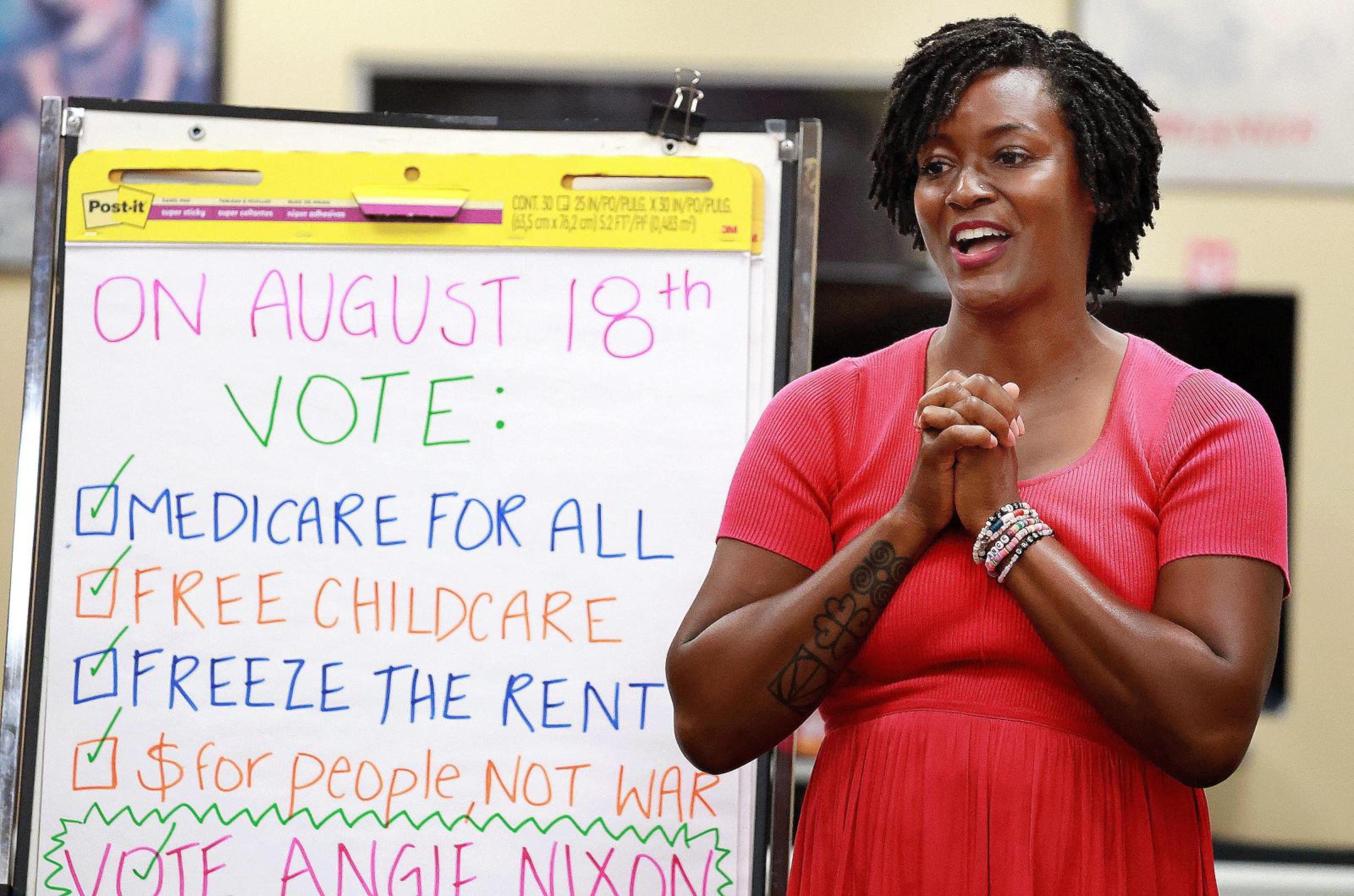
But perhaps the most surprising insurgent this cycle is in Donald Trump’s adopted home state. Angie Nixon is bidding to unseat Florida Republican Ashley Moody, who was appointed by Gov. Ron DeSantis in January 2025 to fill the Senate seat vacated by secretary of state Marco Rubio. A state representative of a district that includes part of Jacksonville, Nixon entered the national conversation overnight in August after a shock primary victory over Alex Vindman, the establishment pick to take on Moody. Although polling averages show Moody with a steady six- to seven-point lead, thanks to Nixon’s retail politics and the mounting backlash against Trump’s record, some observers think she has a plausible path to victory. An upset by Nixon, or even an extremely narrow defeat, would disrupt the narrative about Florida’s rightward trajectory. Either outcome, though, would also resurface pointed questions about what establishment Democrats have—and have not—done to compete effectively in Florida.
If Nixon is successful, it would represent a radical departure from the moderate strategy Democrats have typically deployed in Florida. Her style is also distinct from that of polished orators Raphael Warnock and Jon Ossoff in neighboring Georgia, two of the Sun Belt’s more successful Democratic figures. She is an outspoken underdog in a state commonly considered a case study in how progressive identity politics—along with an ill-fated theory about an emerging demographic-driven Democratic majority—foundered badly. That makes her a risky bet in the eyes of the centrists blindsided by her primary win. But her momentum points to a more robust progressive infrastructure in Florida than national Democrats have long assumed.
Unsurprisingly, Republicans are going all out to depict Nixon as a fringe candidate. As a community organizer mentored by local labor leaders, passionate advocate of Black Lives Matter, nominal member of the Democratic Socialists of America, and unstinting critic of DeSantis (she was once arrested for staging a protest against gerrymandering outside his office), Nixon is, no doubt, well to the left of Florida’s center of gravity.
But Nixon has shrewdly put economic pressures at the center of her campaign while distancing herself from the DSA’s most extreme positions. After her primary victory she discarded the socialist label and restyled herself as an independent-minded populist, affiliated with an array of progressive organizations but not in lockstep with any single one. That effort may neutralize crude attempts by J. D. Vance and Moody’s other surrogates to slander her as un-American. “I’m aligned with what folks have referred to as ‘the FDR Democrats,’” she has said, emphasizing that her motivation, as a café owner and former single mom, is to fight for working families.
Nixon’s challenge, as a Black woman, is greater than simply reducing the size of the standard Democratic deficit with non-college-educated and rural whites. Rather, she must both mobilize politically inactive Democrats among Florida’s sizable Black electorate and court other voters of color, particularly young and working-class Latinos. Many are among the roughly 3.3 million Florida voters with no party affiliation. Other have formally switched from blue to red in recent years but may feel betrayed by the Trump administration’s draconian immigration policies.
Other aspects of the political climate may also help Nixon defy the odds. With the country’s already checkered safety net under renewed assault by the right, everyday purchasing power is eroding. Voters are especially sensitive to inflation in Florida, given the state’s past reputation for an affordable lifestyle. The high price of rent, gas, automobiles and auto parts, and groceries, exacerbated by rising interest rates and the prolonged war against Iran, has begun to puncture Florida’s carefree image while magnifying its vast inequality, among the worst in the nation.
An economic populist message, bolstered by financial support from Sen. Bernie Sanders’s campaign chest, could resonate in crucial battleground precincts in south Florida, where Democrats lost the most ground between 2020 and 2024. Those precincts comprise diverse working-class neighborhoods that, like similar ones in Texas, Georgia, and Nevada, may soon determine presidential elections as much as former manufacturing hubs in the Midwest.
Nevertheless, Nixon will need all the help she can get to increase airtime in Florida’s expensive media market and crisscross the state’s four major metros. And with just weeks to go, Chuck Schumer and fellow party leaders seem unwilling to back her unreservedly. Their caution, however, may prove realistic in light of Florida Democrats’ declining fortunes and disconcerting failure to improve the voter-registration gap.
The party’s track record in Florida is indeed demoralizing. What makes Florida more vexing than Georgia or Texas, similarly challenging environments, is the Democratic Party’s freefall there after Barack Obama won the state in 2008 and 2012. Driven by Obama’s impressive voter-turnout operation, those victories were integral Democrats’ mistaken belief that they had established a clear edge in the Electoral College. But Florida has since become the epicenter of the MAGA movement. Bill Nelson, the state’s last Democratic senator, ran and lost an uninspired reelection campaign in 2018 to multimillionaire Rick Scott, a Tea Party favorite who had steered Florida to the right as governor. In the 2020 election, Donald Trump expanded his 2016 margin of victory in the state while Biden narrowly took Georgia. A year later, the number of registered Republicans finally exceeded that of registered Democrats.
In some quarters, that was proof enough that Democrats should cut their losses in the Sunshine State and shift their strategy in the South. Florida now boasts perhaps the most powerful state Republican party besides Texas. Demographic change and urbanization seem to have only assisted this transformation, leaving the state Democratic Party dumbfounded and directionless.
One explanation for the shift is that Florida has never shown much affinity for the economic and cultural progressivism of northeastern and West Coast Democrats. Economically, Florida voters are seen as broadly libertarian. The state’s political culture blends the outlook of conservative whites concentrated in the Panhandle, older transplants from the Northeast and Midwest, and entrepreneurial Latinos wary of socialism. This is often expressed in a gaudy commercial sensibility that makes its sprawling, tourist-friendly cities “international” but not cosmopolitan. Social policies, too, appear to affirm Floridians’ acceptance of “free-market solutions” and individual responsibility. Long before DeSantis’s crusade against “wokeness” in public education, Florida had been a testing ground under Gov. Jeb Bush for school vouchers and related “school choice” measures favored by movement conservatives.
Yet Florida’s image as a bastion of the Trumpian right and its various subcultures masks a more complex and uncertain pattern of change. Already a boom state, Florida experienced the second-highest rate of population growth during the Covid pandemic, a dynamic some attributed to DeSantis’s hostility to mandates and determination to stay open for business. Not all domestic migrants have necessarily intensified the GOP’s grip on power, though. Since the Great Recession, Florida has been part of the so-called New Great Migration, in which Black college students, young professionals, and middle-class families from the North have relocated in search of more affordable housing and greater job opportunities. Those voters likely make up a good part of the irregular electorate that Nixon needs to excite. As with parts of the Latino electorate, these potential voters are sympathetic to traditional Democratic positions on issues such as health care (Obamacare enrollment surged in Florida in the years prior to Trump’s One Big Beautiful Bill Act), but they either face newly constructed barriers to political participation or aren’t sufficiently engaged by local Democrats.
The labor movement, meanwhile, is not quite as weak as it is in most other parts of the Southeast. Although Florida is a right-to-work state with below-average union density, health-care, teacher, and other service-sector unions, including the SEIU (Service Employees International Union), of which Nixon is a member, have built a stronger presence over the last fifteen years and won important victories. On the political side, those organizing efforts have helped preserve and nurture a strand of grassroots progressivism that the state Democratic Party has largely neglected.
Nixon’s political potential rests, in great part, on her ability to communicate the labor movement’s idea of solidarity in plain, relatable language. Her message is pitched to Floridians tired of feeling powerless, but she has projected strength without the kind of militancy that may dissuade all-important swing voters. While Nixon has not shied away from the demonstrations that first garnered her local media attention, she seems comfortable sounding like a pragmatist in search of common ground, affirming to NBC’s Meet the Press that “the Democratic Party is a big tent.” Despite real intraparty disagreements, that general approach has been embraced by avowed left-populists and pragmatic insurgents alike this election cycle, inspired, undoubtedly, by Zohran Mamdani’s success in New York City.
Still, it remains to be seen whether “big tent” populism can truly gain traction in Sun Belt states where the GOP has relentlessly exploited cultural divisions. It would be naïve to think those divisions, though less salient amid deepening economic fears, couldn’t be inflamed again in a state that overwhelmingly reelected DeSantis. Resigned to the GOP’s massive financial advantage, national Democrats may think it’s a foregone conclusion that Moody will easily paint Nixon as out of step with Florida’s ways.
That self-defeating assumption, however, overlooks that Nixon is tapping into a political legacy much closer to home. In the mid-twentieth century, the South produced a number of liberal populists who challenged the region’s reputation for reactionary rule, and Florida was no exception. Democrat Claude Pepper, first as a New Deal–style senator and then as a U.S. representative following a political setback in the 1950s, was a prominent champion of workers’ rights, universal health care, and Social Security. His advocacy was so threatening that he was effectively red-baited out of his Senate seat by a more conservative Democrat, George Smathers. Though as a young senator Pepper did not entirely break with Democrats’ Southern delegation on Jim Crow, he proved in the 1960s to be a solid ally of Lyndon Johnson’s civil-rights agenda. On key votes, he was as instrumental as his liberal counterparts in the North.
This history may not seem terribly relevant to Nixon’s chances. The political memory of the average voter is thought to be vanishingly brief. But as other insurgent Democrats such as Talarico are beginning to discover, channeling local populist traditions can be a useful weapon against charges that social-democratic ideas are alien. When voters can identify contemporary underdogs with a proud tradition of fighting vested interests, they are arguably more inclined to overturn the status quo.
Nixon’s challenge is to persuade enough uncommitted voters that the vision she shares with Sanders and Mamdani is also homegrown. As exploding health-care costs push millions of Americans into perilous levels of debt, she, like other insurgents, has an opportunity to remind voters that the GOP agenda is not only cruel but also economically unproductive and destabilizing. Nixon’s odds are long, but even if she comes up short, the tenor of her campaign could help set the stage for a different—and far bolder—strategy in a state Democrats otherwise seem to have forfeited.
We welcome your comments about this article. Please send your response to [email protected].