In the spring of 2020, I stopped before the entrance to a corner store in West Philadelphia. On the door were two different signs, one faded and one brand new. The first said “No Masks or Face Concealing Hoodies.” The second, placed next to it, said “Mask Required for Entrance.”
The contradiction is emblematic of the twenty-first century so far, which has seen endless debates over whether we—or those ostensibly hired to protect us—should be covering our faces. These debates have drawn in issues of religion and secularity, health and freedom, protest and law enforcement, anonymity and responsibility. Of course, before it became so controversial in the physical world, concealing faces and identities had become commonplace in the digital world, where we spend more and more of our time.
Masking in both its physical and digital aspects is symptomatic of a culture losing the art of face-to-face encounter and, with it, what it means to be a human person. The prevalence of masking reveals a need to recover the central reality of the human face and thus of the human person, which is very much at risk.
The century of masking started in the years after 9/11, when France instituted a ban on hijabs (and burqas) in schools and eventually, in 2010, all facial coverings. That debate spread to other countries in Europe and beyond and was an admixture of arguments about secularity (and France’s unique tradition of laicité), diversity, the place of Islam in the West, and, as the French also noted, “a certain idea of living together” that fully covered faces seemed to undermine.
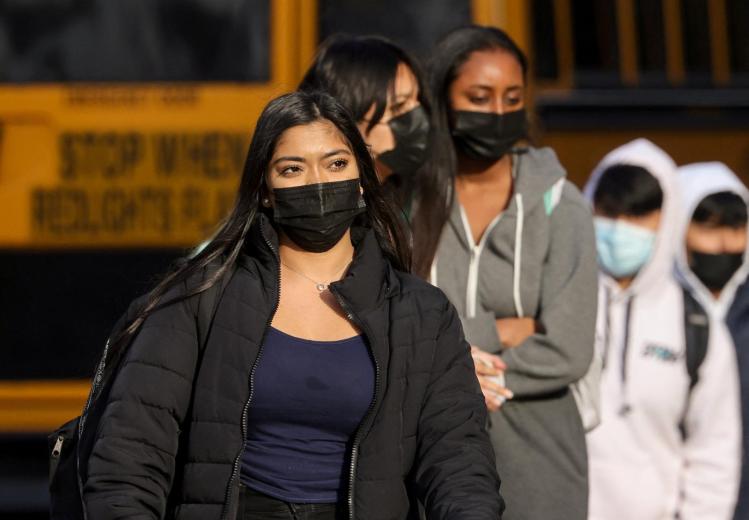
But debates around masking really accelerated with Covid and the CDC’s initial advice not to mask, then to mask, and the confusing and conflicting mandates and policies that persisted for years. In the United States, we masked little kids, put up signs about the right way to mask (cover your nose and mouth, please!), agonized over the right type of masks to buy, and explained that we did not mask for ourselves but for each other.
The mask mandates launched a thousand controversies. My wife and I did not wear masks outdoors but did inside. A man nearly got hit by a car running across the street to avoid our unmasked faces. As the mandates went on, the debates got more vociferous. Opponents of masking cited individual liberty and complained about discomfort. Proponents “followed the science” and “stopped the spread!” Too often lost amid the debates over science and etiquette was what being lost by covering our faces. Masks were necessary, but so was a deeper discussion of the sacrifices of sociality and human contact involved.
By now most of us have thrown our masks away, but masking did not end after Covid; rather, it shifted into the world of protest. The left, which had rallied to masks during Covid, found a new purpose for them at pro-Palestine protests on college campuses. In the first months of Israel’s brutal response to the October 7 attacks, college campuses were filled with masked students, some seeking to conceal their identities, some still holding onto Covid, some a mixture of both. Their masking led to states and universities to pivot from enforcing mask mandates to considering mask bans. Trump’s campaign against universities included pressure for bans. Notably, Columbia student Mahmoud Khalil, who became the face of the protest movement after he was detained by ICE, did not wear a mask while protesting.
While the White House was trying to force masks off protestors, they were simultaneously working to let federal agents keep them on. Minneapolis and St. Paul were roiled by the sudden presence of thousands of masked ICE and Border Patrol agents. In a series of horrifying spectacles, agents of the state anonymized themselves with face coverings while also occluding their names and badge numbers. Masked agents killed Alex Pretti and Renee Good, kidnapped Liam Ramos, and terrorized an entire state for weeks. Courts are currently considering state bans of such masking, and Congress is debating reforms. We cannot long call our country a democratic republic while heavily armed masked government thugs surveil and face off with masked protestors.
Running alongside the battle over physical masking and unmasking is its digital parallel. Masked ICE agents use their phone cameras to subject unmasked protestors to facial recognition software (which, of course, is good motivation for those protestors to mask up). As our digital identities continue to become more important, efforts to maintain some measure of anonymity and privacy may increase. Will more people cover their faces to evade the facial-recognition technology deployed by public and private institutions? As we move more of our lives online, will our avatars become our new masks? AI will allow people to even more seamlessly conceal their identities in digital spaces, modifying or replacing their faces.
Meanwhile, fewer of us are doing the kind of things that even require we show our face: heading out for drinks, having sex, eating at restaurants, attending liturgy. We stay at home watching screens and forgoing the “facial recognition” involved in laughing together at a pub, kissing the person that we love, and kneeling next to each other in worship. Even if physical masking ceases to become a controversial issue, cyber-masking while avoiding face-to-face encounters is not going away.
Why does any of this matter? Why are these debates so fraught? The short answer is because the human face matters. Masking involves deeper issues around what it means to be human and humane. In many ways, we are our faces.
Consider how babies and toddlers gaze attentively at their parents’ faces. You can see them moving their lips and eyes in imitation of their caregivers’ expressions. They do so because our whole face communicates: our foreheads scrunch with worry, the lines of our eyes crinkle with joy, our cheeks tighten with rage, our whole head tilts in perplexity. And then there is that portal to our souls, the human eye. Alone among animals, we have large areas of white that allow others to see that we are seeing and thus look where we are looking. We look with love or hate, with longing or alienation. Our eyes see, but they also reveal. Finally, there’s the mouth itself—where words come from, but also smiles, frowns, gasps, sobs, and laughter. Our voice isn’t just heard, it’s also seen. Long past toddlerhood, most of us still lip-read to augment our often-faulty ears. Amorous words trip over our tongues; angry ones burst forth.
There is a reason figurative language about the human face abounds. We face the truth and face each other. We face down our fears and hope the sun shines warm upon our face. The Irish bury their dead with their feet in the east so when they rise, they will face the rising sun. In John Milton’s Paradise Lost, Satan enters the garden to corrupt Adam and Eve. What nearly stops him is seeing “the human face divine.” In Flannery O’Connor’s “A Good Man is Hard to Find,” the transformative moment comes when a grandmother, kneeling before her murderer, “saw the man’s face, twisted close to her own as if he were going to cry and she murmured, ‘Why you’re one of my babies. You’re one of my own children!’”
To see the face of another is to see oneself as another and so to see that, whether we like it or not, we are in relation. Faces reveal us to others and others to us. They are also revelatory of our fundamental humanity, marked by its social and communicative nature. We are embodied beings; to be with each other, we need to see each other. Emannuel Levinas grounded his ethics—his whole philosophy—on the experience encountering another’s face. For him, it is always the face of the other that demands justice, the face that says “thou shalt not kill.” It is hard to face someone you are hurting directly. That’s why we respond to a shouted or online insult, “Why don’t you say it to my face?” It is easier to speak ill of others behind their backs, behind a screen, from a passing car. Likewise, we cover our faces when we do harm because we seek to be anonymous and unaccountable. In so doing, we also render ourselves inhumane.
Thus, the great command that God speaks in Psalm 27 is “Seek ye my face” and the prayer in response is “Lord, I long to see your face.” This longing to see God’s face is central to Judaism and Christianity. At the heart of Christianity is the face of Jesus, who looks down on Christians in millions of paintings and statues. His is the human-divine face we seek in art, Scripture, the sacraments, and in the poor. It is his face that we long to see in heaven. Of course, the words “I long to see your face” are also the words of any faraway lover or friend. But Christianity reminds us of the vulnerability of that face, human and divine. Part of the power of Flannery O’Connor’s short story “Parker’s Back” is its closing image of the bleeding face of Christ. It shows the depth of inhumanity involved in violating a human (and, in this case, divine) face. But it also shows us that love can overcome this inhumanity if we face up to it.
As someone who worked for several years scraping and sanding lead paint off old houses, I know the value of a facemask, but I also know the unconcealed revelation of the human face is a part of our humanity. There are some who need mask more regularly due to work—firefighters and medical professionals—and others due to health issues that they or their loved ones have. These exceptions are real and deeply human because we see them as sacrifices, as giving up something good. When we give up the good of showing our faces, we should acknowledge what is being lost and seek to reveal our faces as soon as possible.
Our current masking crises point to a declining sense of the human. Anti-maskers during Covid were far more likely to point to individual liberty than the inhumanity of face covering or the loss of sociality and communication. Similarly, masked protesters forget that our democratic republic requires face-to-face discourse to function. We are not anonymous but fellow citizens. Worst of all, the masking of state agents—those who carry the centralized force of the nation—risks inhumane and unaccountable political power.
But the broader masking of our society is our withdrawal from in-person socializing, dating, and community life. We are retreating from a certain idea of living together. Too many of us retreat to avatars, anonymous social-media accounts, and now even AI companionship. As Pope Francis, the pope of encounter, put it: “How I would like for us to look less at screens and look each other in the eyes more!” Alas, our eyes remain glued to those screens.
Paradoxically, anonymity lends itself to both isolation and losing oneself in the crowd, to political pacification and radicalization. The French philosopher Gabriel Marcel described such an anonymous individual as divested “of that substantial reality which was linked to his initial individuality.” To un-face yourself is to disconnect yourself from the heart of personhood. It also disconnects you from “belonging to a small actual group” rather than a large virtual group. It removes us from those small-group structures of belonging that can prevent both anomie and groupthink.
In his novel Till We Have Faces, C. S. Lewis asks, “How can they meet us face to face till we have faces?” We ought to be asking ourselves how we can meet each other again while we hide our faces. We cannot be together without the vulnerability, the risk, and the joy of seeing and being seen together. The recovery of the face and the shelving of our masks is the work of our time, the work of encounter that is “the oxygen of life,” as Pope Francis put it. We cannot have a healthy society, flourishing individuals, and just republican government till we have faces again.
We welcome your comments about this article. Please send your response to [email protected].