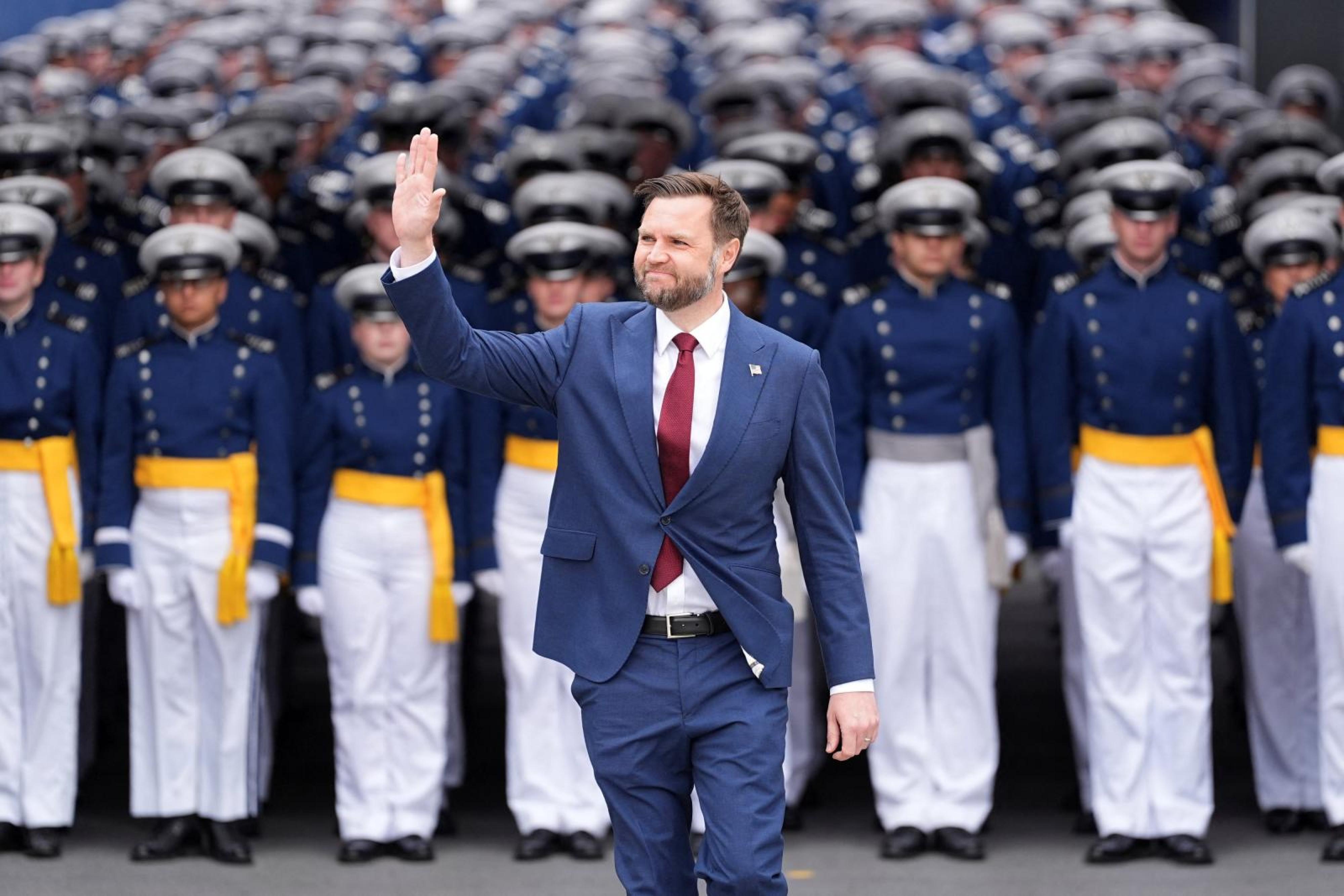
On September 1, the vice president of the United States sat down with an Evangelical podcaster and discussed the end of the world in the tone of a man working through a policy question. The podcaster is Bryce Crawford, a twenty-two-year-old who grew up in Georgia and now preaches on the streets of Los Angeles. He founded the ministry Jesus in the Streets and hosts The Bryce Crawford Podcast, which this spring sat near the top of Spotify’s religion-and-spirituality chart. He has 1.1 million subscribers on YouTube and more than seven million followers across TikTok and Instagram, most of them teenagers and people in their twenties. In the podcast interview, J. D. Vance told him that he had become fascinated by eschatology at the age of ten or eleven. Vance said that he would not be shocked to learn that the Antichrist is already walking among us. He added that, in the meantime, he tries to do as much of God’s work as he can. Then came the sentence that traveled around the world: “If that leads to the end times, okay, and if that leads to…us building a better world that thrives and survives for a very long time after I’m gone, that’s great too.”
The two possibilities were offered as equivalents, and it is the false equivalence that deserves attention. A preoccupation with the last days has accompanied Christianity since its first generation, and has produced letters, mosaics, cathedrals, the Dies Irae; there is nothing unseemly about taking an interest in it. What is startling is the serenity with which the end is set alongside the survival of the world we know, like two line items that cancel each other out.
It may help to go back to the word “apocalypse.” Apokálypsis means revelation, the uncovering of what had been hidden. In the Bible, apocalypse is knowledge that saves, written for persecuted communities so that they would not lose hope. Ordinary usage has reduced it to a synonym for “catastrophe,” and this reduction has very serious consequences. Once the end stops being God’s self-disclosure and becomes instead a calendar to be consulted, theology gives way to a technique of political orientation.
You might like: Massimo Faggioli on Vatican diplomacy and Vance's end times
Nine years ago, the Protestant pastor Marcelo Figueroa and I wrote an essay for La Civiltà Cattolica in which we called this the cult of the apocalypse. We described a simple formula: fight the threats to American Christian values, and await the imminent justice of an Armageddon, a final reckoning between good and evil. We were more interested in the practical consequence than in the doctrine. Faced with the urgency of the end, every process collapses. Negotiation, mediation, and the patient construction of peace become luxuries for people who have time, and there is no time. The community of faith reorganizes itself as a community of fight. We attributed that grammar to Evangelical fundamentalism, which even then seemed to us to be overflowing its banks. Today, it is used without effort by a Catholic vice president: the surprising ecumenism we wrote about has since come to pass.
Anyone who reads disasters as confirmations stops reading them as alarms: ecological crises and wars become signs to be recognized rather than problems to be addressed. The vice president’s “that’s fine” has that shape. It does not deny the catastrophe; it accepts it as an admissible outcome of his own work. And the lever of that rhetoric is fear. Disorder is exaggerated, and religion offers itself as the guarantor of order while one political faction embodies its demands.
In March, Peter Thiel gave four lectures in Rome on the katechon, the Antichrist, and the end times. Thiel financed Vance’s political career, and the similarities between their views of the future are easy to recognize. Here, the apocalypse is not a discourse about God and salvation; it functions instead as a grid for assigning roles in present history: whoever obstructs my projects is preparing the reign of the Antichrist, whoever assists them is holding back the disaster. But there is a difference. Thiel is an architect of the end who declares that he fears it. Vance goes a step further, and more openly: the end does not even need to be feared.
Here, the problem becomes theological. The Gospel says that of that day and hour no one knows (Matthew 24:36), and to the apostles who ask about the timetable, Jesus answers that it is not for them to know (Acts 1:7). That ignorance is not to be filled in with geopolitical analysis: it is a matter of faith, which consigns the fulfillment to God and leaves the work to human beings. Anyone who calculates which week of history we are living in has already traded trust for strategy.
Then there is the weight of the present. In Christianity, the expectation of the end does not lighten what we do; it makes it definitive. In the judgment scene of Matthew 25, no one is questioned about his ability to decipher the signs of the times. The questions are of another kind: Did you feed the hungry? Did you welcome the stranger? Did you visit the prisoner? The poor are the criterion of judgment, and this reverses the sense of what “that’s fine” should mean. To declare oneself at peace with the idea that one’s own work might bring about the end of the world is to use eschatology as an alibi rather than as a measure. A man who believed he was carrying out God’s work is not thereby exempted from answering to human beings for what he has done.
Which leaves the question of what, exactly, God’s work is, and of who decides. In February 2025, Pope Francis wrote to the American bishops that the true ordo amoris is discovered by meditating on the parable of the Good Samaritan, a love that builds fraternity while excluding no one. It was a response to the political use Vance had made of the same expression a few weeks earlier. Cardinal Robert Prevost, now Pope Leo XIV, had publicly circulated an article contesting Vance’s reading. Twice, on the same point, a pastoral correction: the Christian criterion is not to be found in a hierarchy of belonging, nor in the nearness of the end times.
Vance’s position certainly expresses a conviction that history has a direction. So far, so good. And the refusal to fall asleep certainly has an evangelical root: in Gethsemane the disciples slept, and Christe reproached them. The problem arises from what is missing around Vance’s apocalyptic passion. What is missing is the Other—not the enemy, of whom such schemes have plenty—but the neighbor, whose vulnerability is the test of what we do with our vigilance and lucidity.
Francis emptied out the narrative machinery of sectarian millenarianism from within by insisting on mercy as God’s fundamental attribute, since a history governed by mercy does not lend itself to being read as the field of a final battle. In the Gospel of Luke, the blessed servant is the one the master finds at work when he returns (Luke 12:43). He is not awake because he has calculated the hour, and he does not stop working because he fears that the time has run out: he works because something has been entrusted to him. Paul, too, who had described the end to the Thessalonians as a thief in the night, concluded by urging them to build one another up (1 Thessalonians 5:11). When it comes to the two possible futures to which Vance claims to be indifferent—a world that ends and a world that lasts—there is all the difference in the world between an ideology of the end and Christian hope.
We welcome your comments about this article. Please send your response to [email protected].