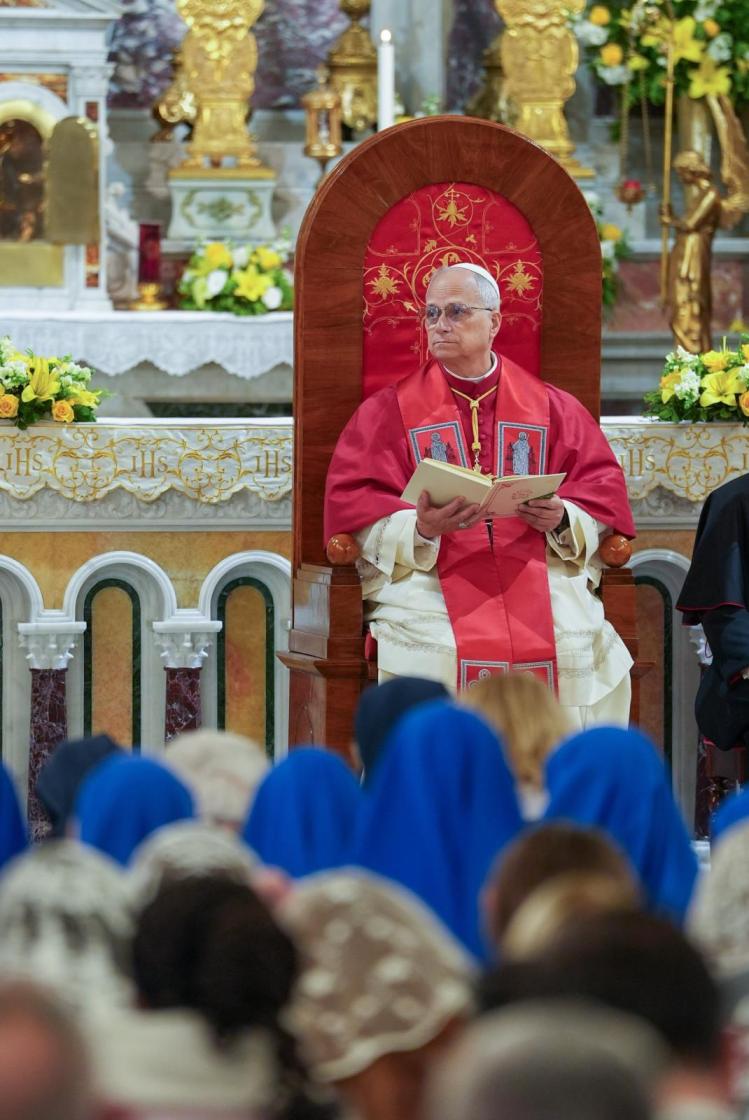
It should come as no surprise that the pontiff who penned the first papal encyclical on artificial intelligence prefers print to screens. When Pope Leo praised reading in his May address to the Vatican Publishing House, he specifically highlighted the material aspect of printed books: “In the digital age, the physicality of the book reminds us of the role of thought, reflection and study.”
The pope did not elaborate further, but had he wanted, he could have bolstered his case by turning to Marshall McLuhan. Indeed, this would have been congenial: McLuhan’s famous quip “the medium is the message” not only sheds light on the digital revolution, but also carries a distinctly Catholic flavor. That is no coincidence, since McLuhan was a devout convert to Catholicism.
To McLuhan, technology is not just a tool we pick up, use for a while, and then put down. Our relationship with it is much more intimate. From the primitive utility of an oar or a knife to the hyperconnectivity of a smartphone, our technologies are extensions of our bodies and minds. As such, they mold us in deep and sometimes unpredictable ways.
In this way, McLuhan’s understanding of the world is profoundly incarnational; mind and matter are as intertwined as body and soul or Spirit and sacrament. When applied to literacy, this connection helps us see why the physical medium is as important as the words themselves. Shift the medium, and you change how we approach the text—and with that, culture is transformed.
The historical record demonstrates this: the rise of Christianity was tethered to the launch of the codex; the Reformation and the scientific revolution to the printing press; the emergence of democracy to the newspaper; and the birth of the great social movements to industrial steam-printing. Today, we sense that the migration from print to screen is reshaping us and our world, though the precise nature of this shift remains elusive. For perspective, we can turn to the past.
When Augustine sat at the feet of his mentor, Bishop Ambrose, he noted something peculiar. As Ambrose read, his eyes moved across the columns of text, “but his voice and his tongue were at rest” (Confessions, book 6). The bishop did not murmur the text but read silently. For most people, the writing conventions of the era made that impossible. Books were written in scriptio continua, a style that eliminated spaces between words. Without the visual breaks, readers typically needed to vocalize the text to discern where individual words began and ended.
This continued into the early Middle Ages, when the monastic scriptoria dominated book production. It might baffle us that it took so long for spacing to be introduced, but the medium carried a message. Monks and nuns were instructed to read slowly, repeat every sentence, and savor each word—and texts written in scriptio continua forced them to do just that. Historian Jean Leclercq describes it vividly: how they chewed each syllable carefully, to release its full flavor. Books were tools for contemplation, and speed-reading would have ruined the spiritual exercise.
Soon, however, a new kind of reader emerged. Scholastics in the nascent universities needed to find specific quotations for their arguments quickly. To those scholars, books were vessels of information. Spaces between words were introduced alongside an array of new organizational tools: tables of contents, chapter headings, and indexes. The philosopher Ivan Illich describes this as a “bookquake”: “Around 1140 a page is turned. In the civilization of the book the monastic page is closed and the scholastic page opens.”
Those textual innovations made it possible to skim and skip through books, and the advent of the printing press made such cursory reading a necessity—at least for intellectuals scrambling to keep pace with the explosion of literature, science, and theology. Yet this was not a simple matter of either–or. Early-modern manuals on reading advised students to shift between rapid scanning and deep reading depending on the text at hand. The technology of the printed book allows for both: it invites focus on a specific page, but it is also possible to flip through it to get an overview.
In recent years, deep reading has been challenged by the digital revolution. At the core of this transformation is the uncoupling of text and medium. A printed book always contains its original text, but in the digital world, texts are no longer bound to any one medium. Instead, they can be opened on different screens, and each screen can, in turn, access countless texts. Any screen is a portal to an infinite library, and when the entire world is just a click away, it is harder to focus on the text at hand.
The digital revolution grants us infinite access at the expense of deep attention. We are distracted by the countless texts we are not reading. This challenge is compounded by the layout of many digital texts. The blue hyperlink, for instance, functions as an invitation to abandon the text we are reading. Studies have shown that even choosing not to click a hyperlink is a cognitive effort that distracts us. Additionally, many web pages are cluttered with distractions—ads, video clips, pop-up windows—all competing for a finite resource: attention.
While monastic texts written in scriptio continua were nearly impossible to skim, screens make deep reading difficult. The medium is generally not designed for focused engagement. Therefore, we instinctively default to a faster, shallower mode of reading—a concession to the inherent logic of the technology. We move with the grain of the medium, just as McLuhan predicted.
If we turn back to Pope Leo’s speech to Vatican publishers, we find that the digital medium impairs the qualities of reading he highlights. A book, the pope argues, is an opportunity to think. But thinking takes time and demands attention. Countless studies show that even comprehending what we read is more difficult when we read on a screen compared to paper. Further, the barrage of digital stimuli compromises our ability to reflect. Reading well, the critic David L. Ulin observed, requires stillness, presence, and the capacity to filter out distractions: “That seems increasingly elusive in our over-networked society.”
The polarization Pope Leo often warns about is, in fact, related to technology. In a public square as crowded as our own, negative emotions—anger, personal vitriol, and moral outrage—are uniquely effective at cutting through the digital noise. This temptation is often too potent for users to resist. As Roosevelt Montás noted in his Commonweal essay “Why Read?,” a digital, postliterate public discourse puts at risk the patience, reflection, and rationality that deep reading cultivates.
The second element Pope Leo highlights in his speech is reading as an avenue for encounter: “A book is a bridge to others,” he notes, “a source of dialogue that enriches us, a stimulus to expand our own perspective.” By cultivating empathy, literature can have profound social and political consequences. When Charles Dickens and Victor Hugo depicted the forsaken children of nineteenth-century London and Paris, they ignited public demand for reform. Similarly, when Harriet Beecher Stowe met Abraham Lincoln during the American Civil War, the president allegedly greeted her with the famous quip: “So you’re the little woman who wrote the book that made this great war!”
Yet that empathetic connection requires a depth of engagement that mere skimming cannot provide. Keith Oatley, a professor of cognitive psychology, has noted that our capacity for empathy expands in direct proportion to how deeply we are emotionally immersed in a narrative. Skimming a story on a screen is, quite simply, less of an encounter.
It is not, of course, impossible to engage in sustained, focused reading on screen—just as it was possible to read ancient books silently. Ambrose’s example shows this, but that the practice shocked as avid a reader as Augustine illustrates how uncommon it was. Most readers moved with the grain of the medium, that is, they murmured the text.
What about spiritual reading: can Lectio divina be conducted on screen? In a study, John Dyer gave two test groups of Evangelicals a biblical text to read and then tested their comprehension. Twice as many digital readers found the text confusing. Next, they were asked to follow a schedule for spiritual reading—half of them using printed Bibles, the other half using apps. The results showed that many of the latter had difficulty approaching the text with a sense of devotion.
The medium does not dictate our relationship to the text, but it matters. The digitalization of the word allows us to access texts from all over the world, which is a great benefit. But if reflection, encounter, and devotion are our aims, then printed books and magazines are better tools than digital screens.
We welcome your comments about this article. Please send your response to [email protected].