Editor’s note: On August 25, the Archdiocese of Chicago reinstated Fr. Michael Pfleger after its Independent Review Board found “no reason” to believe he was guilty of this allegation.
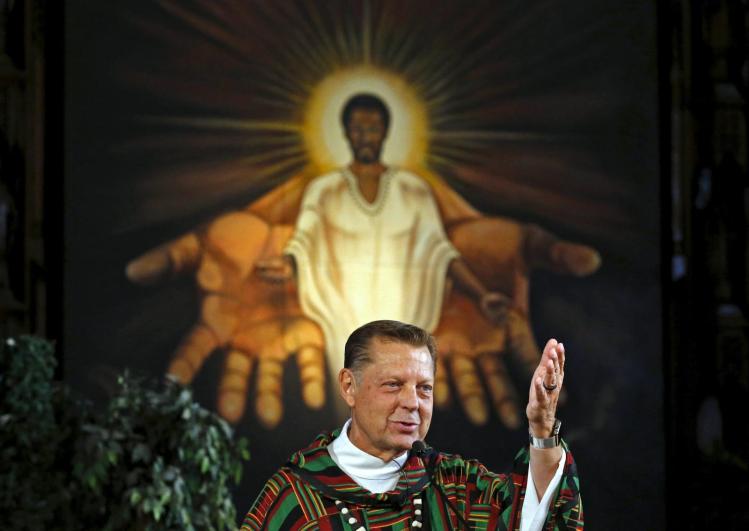
On his last day of radiation treatment for prostate cancer, Fr. Michael Pfleger teared up as he hugged nurses and rang the bell in the hospital hallway, once for himself, once “for all the other people coming out of here.” Then he posted on Facebook that it was “Easier to beat Cancer than get Justice from the Archdiocese.” Earlier this summer, the popular yet controversial priest was temporarily removed from ministry while the Archdiocese of Chicago investigated an allegation that he sexually abused a minor decades ago. It is the fifth time that Pfleger, the senior pastor at St. Sabina Parish on Chicago’s South Side, has been accused; four previous allegations were found by the archdiocese to be unsubstantiated.
Supporters have rallied around Pfleger and called for reform of the archdiocese’s investigative process so that it “preserves the dignity and rights of both the accuser and the accused,” while providing “greater transparency regarding investigative procedures and timelines,” according to a letter released at a July 17 press conference. “We know this balancing needs to be weighted in favor of protecting children, but destroying a priest’s reputation and devastating his congregation requires more consideration by the Archdiocese of the impact on an unjustly accused priest,” the letter said.
The Pfleger allegations have once again put the Catholic Church’s procedures around sexual abuse of minors in the spotlight and raised the issue of priests’ rights to due process. A 2022 survey of U.S. priests found that 82 percent regularly fear being falsely accused. Yet most criticism in the past has pointed to the Church’s failure to prevent and to respond to abuse; in many cases, Church authorities not only ignored but covered up abuse. Survivors and their advocates insist that the Church’s processes are still flawed, but against victims, not priests—and that parishes that rally around priests during investigations make it more difficult for victims to come forward. “Having gone through this trauma, and then not being believed and being attacked, is a horrible thing,” said Angela Walker, executive director of the Survivors Network of those Abused by Priests (SNAP).
Noting the Church’s history of “sweeping accusations under the rug,” Walker urged victims to report their allegations to law enforcement and said she hoped the pattern of allegations against Pfleger would convince the community to act. “We’re talking about two decades of accusations. And rather than taking this at face value and investigating it and removing him, he’s been reinstated” in the past, Walker said.
Pfleger maintains he is innocent and subject to allegations because of his sometimes controversial social-justice work. “I believe this is another attempt and another attack by those who have sought to destroy me for years and another attempt by someone to get money from the Archdiocese and to silence me,” he said in a statement, adding that he receives weekly hate calls and emails because of his advocacy. During the seventy-seven-year-old priest’s five decades at St. Sabina, he has spoken out against gun violence, racial injustice, and many policies of the Trump administration—positions that have made him a lightning rod for critics. His support of Nation of Islam leader Louis Farrakhan has been particularly controversial. In 2019, Cardinal Blase Cupich apologized to the Jewish community after Farrakhan made antisemitic comments at St. Sabina.
While acknowledging the seriousness of clergy sex abuse, Pfleger said he believes current archdiocesan policies treat accused priests unfairly. “Before an investigation or even a conversation has taken place a priest is removed and told to remain silent during their process,” he said in his statement. “The presumption of innocence does not exist for priests.”
Actually, language about “presumption of innocence” for accused priests was just added to the national document that governs sexual-abuse policies when the U.S. bishops met in June, about a month before the latest allegation against Pfleger. That proposed change, in addition to a decision not to include adult victims as part of the document—called the Charter for the Protection of Children and Young People—led some bishops to call for a delay in the vote on the revisions. Among them was Bishop Shawn McKnight of Kansas City, Kansas, who said during the public discussion, “I am worried how the language presently in the draft will impact our known victims as well as our unknown victims.” But Bishop Robert Barron of Winona-Rochester, Minnesota, founder of the Word on Fire media ministry, raised concerns about whether the document sufficiently protected accused priests against false accusations. The revisions eventually passed.
The so-called “Dallas Charter,” created in 2002 by the U.S. bishops, is the basis for the Chicago archdiocese’s policies, which are overseen by its Office for the Protection of Children and Youth. Because of its “no tolerance” policy, all allegations of sexual abuse, whether coming from victims, through law enforcement, or other reports, are investigated by the archdiocese’s Office for Child Abuse Investigations and Review (CAIR). After gathering basic information, the office’s director meets with the victim to get a formal, written accusation, then meets with the accused priest, if he is still living. Working with the archdiocesan Independent Review Board, the director reviews the priest’s file, interviews people, and prepares a report about the allegation. The board makes a determination and presents it to the archbishop. The archdiocese also encourages victims to contact civil authorities and says it cooperates with civil investigations.
During the investigation, the priest is temporarily removed from ministry, especially if he works in a parish or a school, to protect both children and the accused, the policy says. A priest has the right to retain civil and canonical counsel and continues to receive his salary and benefits during the investigation. The investigation should try to protect the priest’s privacy and not illegitimately harm his reputation, but the allegation and investigation are made public through letters to parishes and the broader community, usually resulting in media reports. The policy mentions timelines for various parts of the process, but depending on circumstances, it can take longer. The first allegations against Pfleger, which included three alleged victims, took about six months; the second investigation, with one alleged victim, about two months. The policy states that priests’ guilt should not be assumed, and that if an accusation is proved to be unfounded, their good name should be restored. The archdiocese releases public letters with an investigation’s findings, which again usually results in media coverage.
Pfleger is not the only priest raising concerns about accused priests’ rights to due process. The Association of U.S. Catholic Priests (AUSCP) created a working group to study and inform clergy about their canonical and civil rights when accused of misconduct. Its 2025 report, “Moving Toward Restoring Justice for Priests,” called for Church authorities to protect the rights of victims and the accused. The report argues that priests’ rights are undermined when penalties are imposed prematurely, when priests are removed from ministry for long periods of time without credible evidence, and when their names are published before the verifiable evidence has been gathered and the investigation completed. It is worth noting that when a bishop (as opposed to a priest) is accused of abuse or coverup, that investigative process, which is governed under the Vatican document Vos estis lux mundi, is not automatically made public. Some have called for greater transparency in those investigations.
Citing the “right to a good reputation” in canon law for all the baptized, the AUSCP report urged removing priests from active ministry only when “substantial, verifiable evidence is gathered,” and not publishing accused priests’ names before investigations. “Such practice puts the ‘right to a good reputation’ at risk” and damages “the morale of hard-working priests,” the report said. “By ensuring that a competent and honest investigation is conducted and completed before a priest is publicly accused or punished, we protect the reputations of all involved.”
We welcome your comments about this article. Please send your response to [email protected].