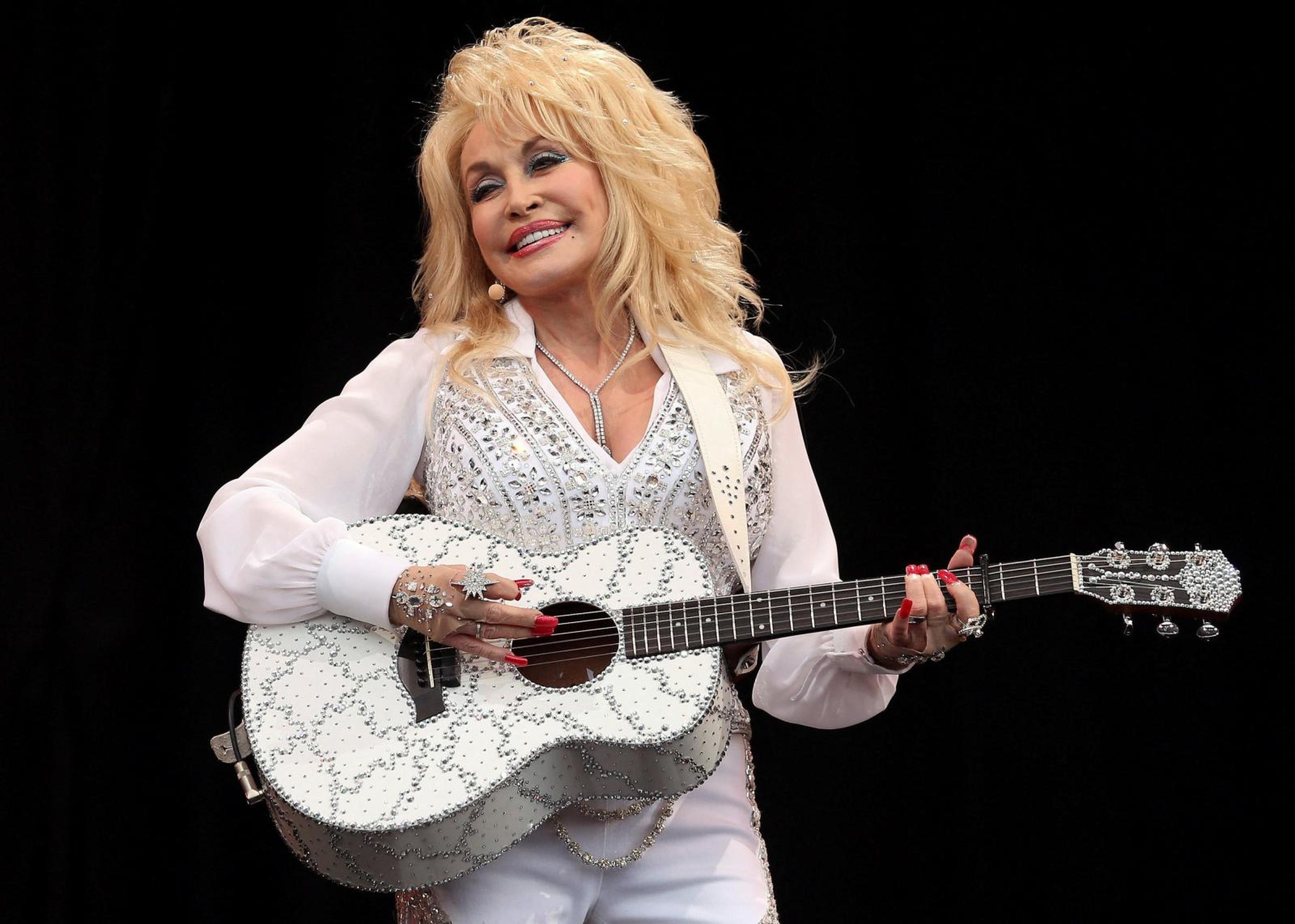
When a celebrity dies, a few days of public grieving and tributes are to be expected. But it’s been more than a week now, and my social-media feeds are still full of quotes set to “I Will Always Love You” and news reports about a proposed airport renaming and an upcoming Dollyfest. Even the subsequent deaths of actor Tim Curry and poet and environmentalist Wendell Berry haven’t slowed the public adulation for the late singer, songwriter, and philanthropist Dolly Parton.
I have to be honest: I’m not a fan of country music, and earlier in life I unfairly misjudged Dolly Parton to be a vacuous bimbo, based on her public persona. So I came late to respecting her extensive charitable work and cultural significance, which I learned about through the 2019 podcast series Dolly Parton’s America. The podcast traces how she achieved American-icon status not only through her music and performances, but also through her carefully constructed yet subversive identities as an Appalachian woman with working-class roots. Her greatest achievement may be, the podcast argues, how she bridged the country’s deep divisions and became a rare unifying figure. But is she the last celebrity who will be able to accomplish such a feat?
The extensiveness of her popularity was evident after the announcement of her death on August 25 at the age of eighty. Praise for the late star poured in from across the country from musicians, actors, and even religious figures. She was praised by librarians and parents for her literacy efforts with the Imagination Library project, by the queer community for her supportive words about LGBTQ folks, and by medical professionals for her financial contribution that made the Covid vaccine possible. Praise for her legacy even crossed the political aisle. House Speaker Mike Johnson called her a “true national treasure,” while New York Mayor Zohran Mamdani labeled her an “irreplaceable champion of the working class.” President Donald Trump ordered flags be flown at half-staff in her memory; so did California governor Gavin Newsom.
This broad affection is even documented by data. In a 2026 poll asking Americans to rate their feelings about twenty-three public figures, Dolly Parton received the highest approval numbers of all of them (even Taylor Swift!)—and her 70-percent positive rating was consistent across most demographics, including both liberals and conservatives. When the only thing most Americans seem to agree on is the fact that we don’t agree on much of anything, it’s worth asking how a country singer known as much for her bust size as for her ballads came to exemplify a unity that otherwise escapes us. What was her secret?
You might like: Rand Richards Cooper on Linda Ronstadt
Some suggest she was only able to accomplish this bipartisan support by cautiously avoiding anything political. It’s true she shunned party politics, but “cautious” is not a word I would use to describe her enthusiasm for supporting causes and issues she believed in. In fact, one of the things fans loved about Dolly was that she was thoroughly herself, with little concern for what others thought. These days, the word “authenticity” is overused and paradoxically overcultivated by marketers, but Dolly Parton was as authentic as it gets. I don’t think the lesson we need to take from her life is to avoid important political or cultural issues. She certainly didn’t when she said in 2020, “Of course Black lives matter.”
I think what made Dolly Parton special was how she stood up for what she believed in: with grace, humor, and respect for those who believed differently than she did. In all my research, I was unable to find any time that she badmouthed the opposition. Yes, she supported same-sex marriage, but she never disparaged those who oppose it. Yes, she helped fund the Covid vaccine, but she never trashed vaccine deniers. And while the boss in the movie 9 to 5 was portrayed as a sexist tyrant, in real life, Dolly never lifted up the working class by denigrating the one percent. In fact, my guess is that she never saw anyone as “the opposition.” Judging was not part of her MO.
That she carried that lack of judgment into how she practiced and spoke about her faith could be a lesson for many of today’s Christians. Although she was authentic about her own spiritual journey, Dolly never sought to proselytize it to others. “Spirituality is the most intimate part of a person’s makeup, and it’s strictly up to the individual to choose how to express it,” she wrote in her memoir, My Life and Other Unfinished Business. Some have called her a saint, and religious idolization has intensified since her death. But I surmise that Dolly (like Catholic Worker cofounder Dorothy Day) would not want to be called a saint so as not to be “dismissed so easily.”
I think we can best honor Dolly Parton’s legacy by learning from her example. The consensus seems to be that she was literally exceptional—that no one else has the ability to transcend the country’s political and cultural polarization, especially given how social-media algorithms and echo chambers exacerbate tensions. But Pope Leo XIV’s popularity—which also, at least for now, spans ideological divisions—is evidence that our leaders can become models of civility, not only without eschewing their values but precisely because of them. And one of those values has to be respect for diversity of people and opinions. It’s what Dolly would do.
We welcome your comments about this article. Please send your response to [email protected].