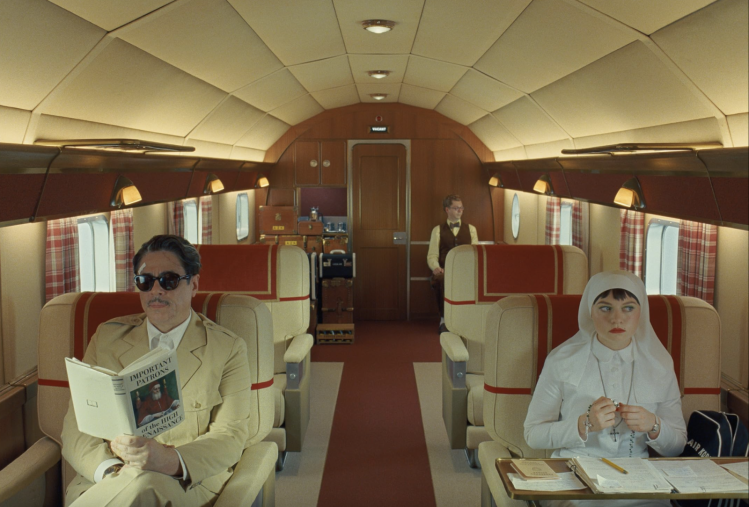
The Phoenician Scheme opens on a moment of obvious distress: a bomb explodes inside a jet airliner, and the craft plummets to earth. Yet because this is the latest from Wes Anderson, the moment is not only comic but a little cute. The arms dealer and industrialist Anatole “Zsa Zsa” Korda (Benicio Del Toro) is a man of refined taste, and his jet is art-designed to the nines. Even with a hole blown in the back, Korda doesn’t seem particularly worried. He crawls his way up to the cockpit, ejects the pilot, and crash lands the plane in a cornfield, because it seems softest.
The episode is a fitting introduction not only to the movie but to most of Anderson’s work: a corpus of gleaming, minutely mapped surfaces and ostensibly soft landings. His films’ symmetrical art design can transform even the realest of real-world distress into a cozy illustration, a movie set, a doll house. It is typical to knock Anderson for retreating into a self-contained world of models and miniatures, repressing the vivid reality of his earliest films in favor of structurally complex and emotionally arid expressions of authorial control. The latter half of his career has been dominated by stop-motion animated features, zany capers, Roald Dahl adaptations, stories nested within stories nested within stories. Yet all this work draws attention to how much of it is, well, work: in drawing attention to the creation, the design, he draws the viewer’s attention to the artifice of what we’re watching, and to what that artificial surface might be obscuring.
His typical protagonist is attempting to manage some unbearable inner experience—parental abandonment, professional decline, grief—by adopting an elaborate system of outward control. The Royal Tenenbaums have their color-coded personas; Steve Zissou his Cousteauean celebrity costume. Faced with the loss of his father and his own near death in a motorcycle accident, Francis Whitman (Owen Wilson) plans a trip across India for himself and his brothers, micromanaging every stop made by the Darjeeling Limited along the way, and arriving finally at the Catholic convent where the Whitmans’ mother has disappeared. There are touches of yuppie self-actualization here, some eating and praying and bit of loving. But rippling beneath it all is their father’s violent death, their mother’s perpetual absence, and a family now bonded by little more than the squabble over an inheritance—a void without love or understanding, which Francis’s twee travel arrangements cannot conceal. The background grief punctures Anderson’s perfectly prepared surface; it always does.
The Darjeeling Limited is an explicitly spiritual film; it addresses the questions of life, death, and rebirth that animate all human culture. Though often criticized for its hyper-stylized appropriation of Indian religion and culture, the film is up to something much cannier than its detractors recognize. The Whitman brothers find themselves in a nation where they do not speak the language and cannot interpret the symbols and rituals that have facilitated relations between humanity and the divine for thousands of years. Yet, however uncomprehending, they do encounter these symbols and rituals. What, if anything, can they do with them? That is the question.
This is also the wealthy Korda’s predicament in The Phoenician Scheme. He has equipped himself to survive assassination attempts and international industrial sabotage. He is much less prepared to deal with his daughter Liesl (Mia Threapleton), a pious young nun in formation who wants nothing to do with the empire she will inherit. And then there are Korda’s visions of the afterlife, a black-and-white stage set full of fluffy clouds and robed personages and the figure of Liesl during the years when he abandoned her. He has the first of these visions after the opening assassination attempt, and they pop up throughout the film, rupturing the pastel-colored hijinks with their visions of death, abandonment, and celestial justice. These visions of a world to come are in keeping with Liesl’s beliefs, and yet it is Korda, an atheist, who receives them, and only he can transform their ambiguous meaning into actions.
These actions make up the plot of the film, a set of comic set-pieces that rope in the various financial interests—American industrialists, royalists, organized crime, kibbutzim—involved in the fictional Phoenicia’s “scheme,” a money pit that Korda hopes will establish his reputation (and his wealth) for good. The mystery of the scheme is not particularly important, and neither are the particulars of the plot. Your mileage may vary from section to section of the story; I know mine did. In terms of pure narrative, the plot resembles the caper structure of Anderson’s superior Grand Budapest Hotel, but without as much clarity, hilarity, or excitement. But then, Budapest is a masterwork of authorial control, while Scheme is about an artist learning to let go.
Korda is based on a number of mid-century tycoons, but with his picture-perfect villa decorated with real classics of European art, he resembles no one more than Wes Anderson himself—and in the slow disintegration of his business empire, we watch as the director dishevels his typically natty affect. Anderson’s early work took the perspective of a bereft child forced to reckon with wounded or absent parents. The tone of the later films is no less grief-stricken, but they have shifted to the parent’s perspective, constructing systems to nurture children they cannot really protect. Whatever Korda’s reasons for shipping Liesl off to a convent when she was still a child, he has, in effect, abandoned her, just as his father abandoned him, and as he now feels abandoned by the heaven of his visions. Korda might be the sovereign of his own little universe, the commander of byzantine industrial arrangements, but he is not the only god on the scene, and his are not the only commandments that count. The scenes set in heaven are powerful precisely because they feel spliced in from the work of a drastically different filmmaker. Yet without the scenes set in this world—or Anderson’s idiosyncratic version of it, anyway—they wouldn’t have their transcendent power.
It is precisely the continuity of Anderson’s fastidious visual style that has allowed him to take thematic risks. Over time, his films have become more explicitly existential, blowing the spiritual theatrics of Darjeeling up to cosmic scale. The complex metafictional structure of 2023’s Asteroid City cashes out in a bracingly simple question: How are we to live when we don’t know what life is for? No answer is forthcoming, yet we must act on it all the same. Toward the end of The Phoenician Scheme, Liesl confesses to her father that when she prays, no one answers. “So what do you do?” he asks. “What I was going to do anyway,” she responds. The line may not be as cynical as it sounds. Trapped in vast artificial structures of capital and law, Liesl trusts in herself and her knowledge of God. Sometimes, that’s all that faith requires. Her religious faith, like Anderson’s faith in his material, opens the film up. His characters leave the world of wealth as the director leaves his familiar jewel-box world, and the film’s vision and style expand along with them. The control sets the stage for a vital chaos. The result is not perfect, but it moved me.