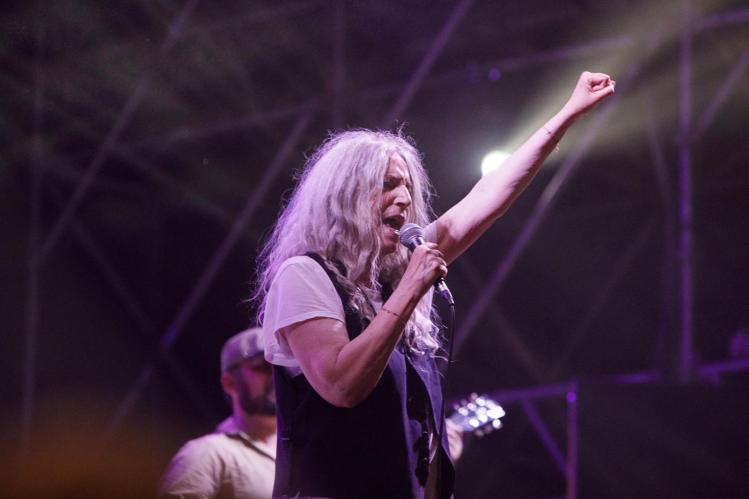
Poet and rock icon Patti Smith opens her new memoir, Bread of Angels, with an epigraph from Ukraine-born novelist Nikolai Gogol: “Obstacles are our wings.” That line launches a narrative arrow whose trajectory describes how Smith integrated (rather than overcame) lifelong trials and losses into the fletchings that guided the ascent toward her heart’s desires—and includes one unexpected and luminous revelation. This startling information likewise reveals how, despite poverty and struggle, the bow that set her in motion came into being: through the sacrifices and devotion of two particular angels.
Aside from the feathered entities that serve as the book’s metaphorical underpinnings, Smith threads the odd, evocative (and very Smithian) phrase “rebel hump” throughout the book. It is introduced in present tense in the first sentence of the prelude, and the poet herself wonders what it might point to: “The pen scratches across the page rebel hump rebel hump rebel hump. What do these words mean, asks the pen. I don’t know, replies the wrist.”
This untamable outgrowth serves as another of the book’s recurring motifs and refers to, as Smith conceptualizes it, “the miniature Quasimodo trapped inside an awkward child’s body,” unbecoming yet somehow necessary. As with the other initially mysterious images, its utility and importance are revealed incrementally until, by the memoir’s end, the awkward child, now matured into an artist of global stature, accepts the rebel hump as the source of her art and as a connection to her child-self. She announces with confidence: “Welcome, rebel hump…. I am you.”
To show how she arrived at acceptance, Smith brings us along on her path from working-class Chicago, Philadelphia, and South Jersey—daughter of a factory worker who never graduated from high school and a former nightclub singer who raised the poet and her three younger siblings on department-store wages—to her storied musical career. It’s from her mother, the former singer Beverly, that Smith inherits her love for poetry. Mrs. Smith gives her daughter a cherished remnant of her own difficult childhood: a copy of a poetry collection, Silver Pennies, that her mother had given her. “I was certain,” Smith writes, “that within this little book I would find the entrance into the mystical world I most desired.” She reckons that the pennies are physical objects that require devotion and discipline to find. But with time she realizes that, like grace, she already possessed them: “The small volume was the storehouse, and the poems were the pennies.” Later, for her seventh birthday, her mother drops her off at Philly’s Leary’s Bookstore, whose policy it was to let a child celebrating a birthday fill a shopping bag with books (birth certificate required). Supervised by the owner, Patti makes her selections. On her lunch break from Strawbridge’s department store, Beverly collects her daughter. As an adult woman reflecting on a complicated relationship, Smith writes: “Despite any conflicts with my mother, that day a new ritual unique to us was born…. For the rest of my life, she gave me books for my birthday, from the Bobbsey Twins to William Blake to Baudelaire.”
Smith’s evolving relationship with her parents—especially her mother—gives the book, as well as Smith’s life, the wings mentioned early on. As a young wife and mother, Beverly took in ironing and, accompanied by her children, went on “coal missions,” collecting the bits that fell from traincars for the kitchen stove, the house’s sole source of heat. The family’s privations are not recognized as such by the poet; the excitement of the expedition colors the memory. Still, the poet and her mother butt heads:
My mother called me in the house and told me to put a shirt on…. [She] said I had to wear one as I was becoming a young lady. This sudden information shocked and repelled me…. I put on my shirt and went to the woods alone and read Peter Pan…. I did not want to choose between Peter the boy or Wendy the girl. It was better to contain both.
Well-known to Smith’s longtime fans is her youthful embrace of gender fluidity. But there was no such term in 1967 when Smith penned the poem “Female,” included in her first collection, Seventh Heaven:
female. feel male. Ever since I felt the need to
choose I’d choose male
. . . . . . . . . . . . . . . . . .Every feminine gesture I affected from my mother
humiliated me.
In the section on her career, we see her moving purposely further and further away from those gestures. But by memoir’s end, the once-rebellious girl accepts her once-repudiated mother as a source of her art. And when she and her sister take a DNA test to determine if the father who raised them was their biological father, the results reveal another link in the arc of her creative flight. What Smith uncovers (with the help of the daughter she once put up for adoption, but with whom she has reunited) is the “youthful restlessness” of her mother, so like her own, and how her nonbiological father’s devotion, sacrifices, and support allowed her to become the artist she desired and aimed to be.
That poignant conclusion reminded me of the part my own parents played, along with Smith, on my path as a poet. In 1977, when I was sixteen, I received a letter:
Dear Sharon,
Thank you for your sweet card. I’m getting stronger every day. It may take a while, but I’ll be back.
Patti
It took me a minute to understand that I was holding a handwritten note from my literary idol. I’d heard that she’d fallen off a stage during a concert and seriously injured herself, and my mother—who also worked in a department store, and with whom I similarly had a fraught relationship—suggested I send her a get-well card, which I did, in care of her fan club. At a South Side Chicago department store, I picked out a card with cartoon horses (for obvious reasons) while never expecting a reply. To show my gratitude, I again wrote to her fan club, this time directly to her mother, who helped with the mail, and asked if she remembered the address of their home in Chicago; I wanted to take pictures and send them to Patti for her birthday. Mrs. Smith wrote back, and I prevailed upon my dad—who also never graduated from high school, and with whom I had a similarly closer relationship—to make the long drive to the Northwest Side. I put the photos I took together with a drawing of Patti and Bob Dylan and sent it on. A few months later, a package arrived, with a note:
Dear Sharon,
Thank you for the photographs. I was very touched…. I also love the Dylan drawing. I’m sending you my book and my energy.
xx, Patti
There’s a wonderful vignette in Bread of Angels about the benevolent yet often resisted influence of parents—specifically mothers. Smith describes leaving a concert during her 1976 Radio Ethiopia tour with her mother in tow. Avid fans clamor for autographs, but “it was cold, and I felt wired and exhausted and wanted to keep going. My mother was incensed that I would walk away from them. You sign every album, she demanded, don’t forget who put you here.”
Smith has not forgotten.
Bread of Angels
Patti Smith
Random House
$30 | 288 pp.