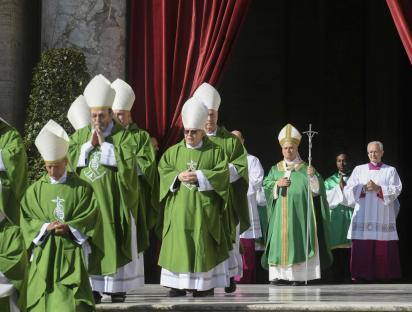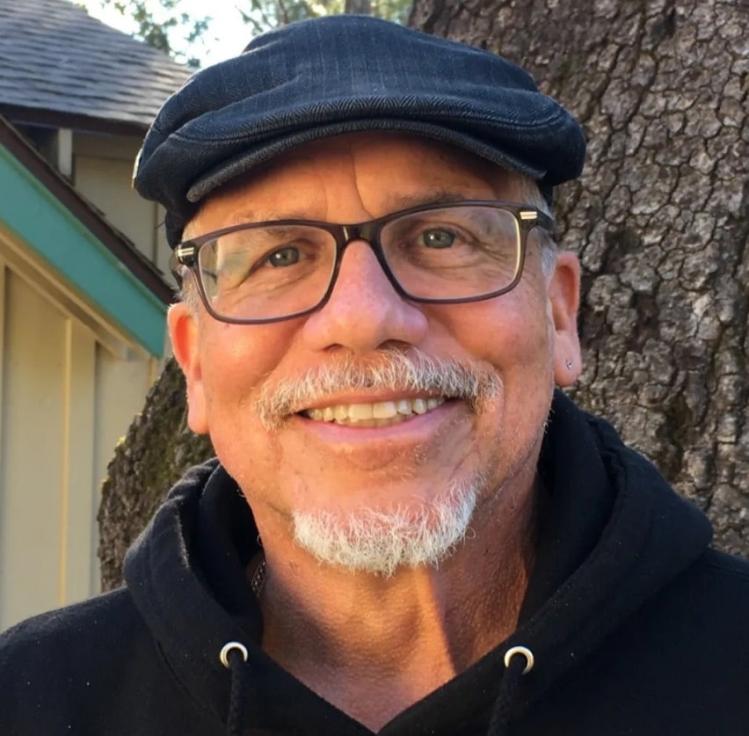
This past October, at a papal Mass in St. Peter’s Square, I had the good fortune of being seated next to Daryl Grigsby, a Black Catholic author from California. “Can you believe this?” he kept saying as we waited for the opening Mass of the synod to begin. I could not. The early morning light bathed St. Peter’s in an ethereal glow. We looked around as people from all over the world were taking their seats. What other institution with members in every country on earth has endured and remained unified for thousands of years? Grigsby’s joy at receiving the Eucharist at a Mass with Pope Francis was palpable (as was mine).
Grigsby is what used to be called a “peace and justice Catholic.” He is interested in service, but like most such Catholics, his devotion to the sacraments also runs deep. He has a tattoo of the Eucharist on his forearm: a chalice with a round host suspended above it. When I asked him about the tattoo he lit up. “It’s all there.” Grigsby said, “The Eucharistic prayers are so beautiful.” He quoted St. Augustine, “Be what you see. Receive what you are.” He continued, “The Church becomes the offering. Our lives become an offering for the sake of the world.” I pointed to his ink and asked him, “Do nonreligious people know what that is?” He said, “Oh yeah. People talk to me about it all the time.”
Grigsby’s evangelism runs more than skin deep. His latest book, Catholics for the Common Good: An Eternal Offering includes profiles of thirty-six Catholics (lay, consecrated religious, and clergy) who have inspired him in his ongoing conversion. Grigsby was raised Southern Baptist and converted to Catholicism twenty-five years ago when he began attending St. Therese parish in Seattle.
Catholics for the Common Good is firmly rooted in scripture, tradition, and the Black Catholic experience in America. In it, I discovered figures whose stories have seldom been told, like Sr. Anne Marie Becraft, OSP (also known as Sr. Aloysius). Born a free Black woman in Washington D.C. in 1805, she eventually became a nun and committed her life to teaching Black girls to read. Sr. Anne lived in a time, Grigsby writes, when “all free Black people were required to possess a certificate signed by three reputable white people that they are of ‘good character.’ Failure to produce such a document resulted in the auction block and enslavement.” (Recent events show that we are not as far away from these dark days as we like to imagine.)
Grigsby also tells the story of Sr. Maria Antona Ebo, FSM, who participated, in full habit, in the 1965 Selma Montgomery March for voting rights. She was prominently featured in press coverage of the event. The image of a Black nun marching for civil rights so unnerved some white Catholics that they claimed she must just be wearing a costume. In fact, Sr. Maria’s own order practiced the segregated profession of vows and enforced segregated dining facilities. Grigsby quotes Hans Küng here: “The church is not a community of the perfect but is on pilgrimage…towards the ultimate truth.”
Grigsby also writes of heroic lay Catholics like Marguerite Barankitse of Burundi. During the Rwandan genocide, she was stripped, bound, and made to watch as seventy people were murdered in front of her. She adopted seven children, from both Hutu and Tutsi backgrounds, and went on to work for reconciliation after the war.
Some of the figures Grigsby writes about are well known, like Dr. Paul Farmer, who created Partners in Health to address global poverty and health inequality. Farmer lived in Haiti and, inspired by his faith, built a school and hospital there with his own money. Or there’s Cardinal Paulo Evaristo Arns of Brazil, who, in a time of brutal military dictatorship, set up a radio station next to his home and used it to expose the excesses of the secret police and their use of torture. He became a journalist because that’s what was needed.
Others, like Sr. Laura Vicuna Pereira Manso, CF, may be less well known. Sr. Laura serves her fellow Indigenous people of the Amazon region as a Franciscan nun. She ministers to them and works to save their ancestral home, the rainforest—the “lungs of the world.” Sr. Laura was invited by Pope Francis to attend the Synod of Bishops for the Amazonian region, where she explained the Amazon’s need for women deacons. Seventy percent of the bishops voted in favor of ordaining women deacons that day.
One of Grigsby’s most compelling stories is about Mary Lou Williams, a jazz pianist and composer who walked off the stage after a 1954 performance, heartsick about the addiction and darkness consuming her fellow Harlem musicians. She spent the next three years “seeking her spiritual center.” During that time, Williams would drop into Catholic churches to pray, and in 1957, she became a Catholic alongside Dizzy Gillespie’s wife, Lorraine. Afterwards, she began a ministry serving musicians in Harlem dealing with addiction and despair, caring for them out of her own apartment. She also composed music for worship and contemplation, including “Black Christ of the Andes” about St. Martin de Porres.
The evil and suffering in the world can feel overwhelming, especially now. Christian nationalists have invoked the word “courage” in refusing to call someone by their preferred pronouns or in signing up to terrorize mostly innocent brown Catholic immigrants as ICE agents. It is tempting in times like these to give in to despair. But Grigsby’s book, about what real courage looks like, reminds readers of the people who try to make of the world a garden.
I’m surprised the book hasn’t received more attention in Church circles. Perhaps it’s because some of the Catholics profiled have faced criticism from the institutional Church, for example, for supporting liberation theology or questioning priestly celibacy. A few—including Swiss priest Hans Küng and Brazilian bishop Pedro Casaldáliga—have even been investigated by the Congregation for the Doctrine of the Faith. But that doesn’t make their stories any less worthwhile. Anyone who knows the lives of the saints knows that many holy Catholics, like St. Teresa of Ávila, now a Doctor of the Church, were in their own time investigated or brought before the Inquisition.
What’s more, dozens of high-profile conservative American Catholic authors and clergy are in open disagreement with the Church on issues spelled out in the Catechism: from immigration and the death penalty to care for creation and respect for LGBTQ people. Indeed, many prominent Catholic authors, New York Times columnist Ross Douthat among them, have written entire books criticizing Pope Francis. I once worked with a priest who called the former pope “evil.” Anyone who has moved in Catholic circles can name folks on the right who dismiss encyclicals and entire pontificates, question if they should actually follow the U.S. bishops on immigration, or wonder aloud if Pope Benedict XVI “really wrote that stuff on economics.”
These folks are rarely made to feel that they are not actually Catholic—even when they want the Church to change. In fact, we often call them “trads,” and they are frequently considered the American Church’s most important benefactors. Meanwhile, Black social-justice Catholics like Grigsby are often made to feel that they aren’t really Catholic—even when they believe it all and, like Pope Francis, want a Church that is more welcoming to gay people, women in leadership positions, and others on the margins.
This is not to say that anyone in the Church has a monopoly on the truth or always gets it right. But we need the Padre Pios and the Dorothy Days, and we need to resist the impulse to exclude some of the most devout Catholics from what is supposed to be a big tent.
This impulse to exclude is the source of some of the Church’s most painful history. Take another of Grigsby’s courageous figures: Fr. Augustus Tolton, the first African American priest. Tolton’s parents fled slavery to live in the North and raise a devout little boy, who, once he discerned his obvious vocation, was rejected by U.S. seminaries for years because of his race. Tolton was finally ordained in Rome. He wanted to serve in Africa, hoping it would be less racist, but he was sent back to the United States, where he ministered as a priest to the end of his life, helping everyone he came across, including those who denied his basic human dignity.
Grigsby’s book reminds us both that evil is real—indeed, the Church has sometimes participated in it—and that the only solution is to love all the more fiercely. As it says in Romans 12, we must “present our bodies as a holy and living sacrifice.” We are, each of us, called to use our gifts in the service of others. The least we can do is retell—and heed—the stories of those who have.
Catholics for the Common Good
An Eternal Offering
Daryl Russell Grigsby
Paulist Press
216 pp. | $29.95