Capitalist economics has a problem. It wants to be a science. There’s nothing wrong with that, of course, if “science” means “a rational, disciplined, systematically self-critical group attempt to understand the world.” We need those. I love understanding the world better, and I also enjoy it when my coffeemaker works. No doubt you feel the same way.
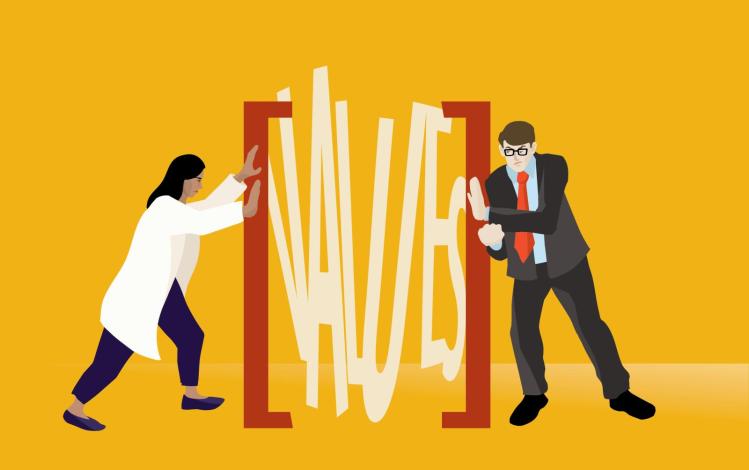
But the kind of “science” that some economists want their discipline to be is something a lot narrower than that—something where the rules and definitions are crisp rather than fuzzy, where every law operates with the mechanical predictability of an imaginary ideal machine rather than a faltering human organism, and where, most of all, “values” are cleanly bracketed off from “facts.” This idea—that science operates above values and is the only real way to understand things—is often called “scientism.”
Economics, which is a necessary discipline, often falls prey to scientism: to bracketing values from facts and treating living things as machines. We can see this tendency most clearly, I think, when we look at what capitalism proposes—in contradistinction to Christian anthropology—as the paradigmatic human being. And we can get at that, I think, by looking at two of the finest minds capitalism has to offer: F. A. Hayek and John Stuart Mill.
Hayek was one of the most influential economists in the Anglo-American world during the past eighty years and one of the intellectual godfathers of the free-market paradigm that has so influenced the entirety of my lifetime. Margaret Thatcher loved Hayek, and he was as influential on the Reagan White House as anyone else. He is one of the shapers of the world we live in. And he was a particularly big fan of the first item in my definition of scientism—bracketing “values” from “facts.”
In The Road to Serfdom—a popular, nontechnical presentation of his ideas published in 1945—he argues that any economic system that isn’t free-market, with at most small, temporary programs for emergencies, is bad because it imposes a set of values held by one person or group (those in charge of the government) on everyone else. The free market, he argues, doesn’t do this—it allows people to make all the choices through their buying and selling and working. If what The People want is to cut down all the trees in the Amazon in pursuit of profit, then it’s undemocratic and unfree to overrule The People on this point.
In contrast, socialists, and some other flavors of leftists, believe that the market is not a perfect representation of what people want or need. They turn to law, government, and other institutions, at least in the short term, to keep economic activity from trumping other concerns, like, oh, environmental collapse. (Many leftists hope for something beyond even this strategy in the medium or long term—the abolition of these institutions in their turn. Anarchists seek to get rid of them all more or less simultaneously.) Socialists vary widely among themselves on the questions of how much planning the government should do and how that planning should be done. There is, for example, a strain of socialism called “market socialism,” where we still let supply and demand decide what gets produced and how much, just as in capitalist or free-market economies; it’s just that the people own the means of production.
To Hayek, none of these nuances matter. To regulate the economy for moral or political reasons is both unscientific and undemocratic, he argues, because it’s done for the sake of values. And regulating business in the name of values other than profit is unscientific and irrational because such regulation forces the values of the planners and regulators onto everybody.
Hayek’s project is one version of something that’s common in modernity: the attempt to do an end run around those questions that are simply too big for science to answer. Questions like “Is there a God?,” “Why are we here?,” “What is goodness?,” “Is it better to be successful or to be kind?” These sorts of questions never go away, but you can’t really do an experiment or write a proof that will answer them. Scientists in various disciplines differ about how to cope with them. So, for example, in evolutionary biology, you might have a Stephen Jay Gould or Joan Roughgarden on the one hand, someone who understands that every biologist brings a whole philosophy of life—some of which is unprovable, unfalsifiable, and extrabiological in some of its assumptions—into the lab with them, and that while this may compromise their objectivity, it doesn’t have to compromise their honesty. You can still admit when the evidence is against you; you can still allow yourself to be proved wrong. And then on the other hand, you have, say, Richard Dawkins, who pretends (in my view, anyway) to be capable of objectivity, far above all these grubby human things.
Among physicists, similarly, you have a confessing Christian like John Polkinghorne or Owen Gingerich, on the one hand, and on the other hand, Richard Feynman, who once dismissed the entire discipline of philosophy (and by extension, theology) by saying, “Shut up and calculate.” The problem for someone like Feynman is this: you can’t calculate an answer to the questions “Why calculate?” or “Calculate for the sake of what?” or “Which problems are the most important ones to be calculating about?” or “What do we do with the information we figure out by calculating?”
In mainstream economics, the Feynman types have tended to win out, although economics is a big field that includes many people with more nuanced views than these. Let the market allocate resources efficiently, many economists often say—without any of our irrational human assumptions about how resources ought to be allocated. Libertarians often take this logic to extremes, arguing for, say, a free market in human organs or the abolition of the age of consent. (If a nine-year-old wishes to fetch herself a high brideprice…the thought is too nauseating to finish.)
A world that ran this way would descend into a kind of high-tech warlordism rather quickly. The guys who were already positioned to hire the best security forces—that is, the rich—would simply rule everything, and we would soon be living in a Mad Max scenario, except that the leaders of the gangs would be golf-shirted guys named Jeff and Ethan rather than cool-looking-if-evil motorcycle weirdos named Toecutter. This is one reason why, in the real world, there are so few libertarians, compared to many other political tendencies.
Just on the conceptual level, though—before we even start to think about implementation—there’s an obvious problem with this scientism, in economics as anywhere else. It also imposes a set of values, and thus doesn’t escape the very critique it’s trying to make. In practice, it says that because I can look at the economic activity going on around me, and abstract from that to an idea of a “market,” and then assume certain simplifying conditions, and eventually arrive at the intellectual construction of a “perfectly efficient market”—simply because I can do all that, that means there is somehow some reason why actual people should let this construct I made up rule over their lives.
It’s similar to the arguments that social Darwinists make: I can, with a certain amount of editing and ignoring, model the world of animal behavior with the saying “survival of the fittest,” so therefore it’s now everybody’s job to make sure the fittest survive. Why, though? Why is that our job? In clearing away my supposed irrational, unscientific assumptions about how to live, this kind of argument merely imposes upon me another irrational, unscientific assumption about how to live. After all, there’s no reason why “this thing arguably exists” means “this is the way everything ought to be.”
We live in a moral universe. This is one of the points that Christians of all stripes ought to agree about: we think that both morality and existence itself emanate from God’s nature, which is love. We can’t describe the world more accurately or make better laws by denying the relevance of morality in any domain. People who do so are not being “more realistic” or “clear-eyed” or “unsentimental.” They are being obtuse.
So what do we do, as Christians, instead? Well, we do the same thing everyone else is doing—we try to make sure our values are the right ones. Simple, right? For Christians, as for everyone else, the question of “making sure our values are the right ones” is irreducibly complex. We look to the Bible, and we impose our various schemas and templates on it—we can’t help but impose these either, the Bible being at first glance irreconcilable with itself on all sorts of issues. The Bible in turn judges our schemas and templates, even when we have derived these from reading it. We use reason too, although we know that our reason is fallen. We muddle through and make mistakes. This is also what other people do, as far as I can tell. Nobody has “solved” ethics in the way that Einstein solved the relation of mass and energy, and my suspicion is that nobody ever will. But that doesn’t mean we can avoid ethics. Morality, at least for Christians, is not an add-on to the universe; it’s part of the fabric.
You might wonder what the heck knowledge even is, if our process for arriving at it is characterized by words like “muddle” and “irreducibly complex.” I’m wondering too, and here’s where I’m at: I think that Christians basically have to treat knowledge as a hope rather than an accomplishment. We believe that truth is a person, and people are harder to know than sets of principles; we also take it as axiomatic that we are, at this moment, seeing “through a glass darkly” as the King James Version puts it. So we start with what little light we have, and we do the best we can, using everything we’ve got—the Bible, the theological tradition, reason, experience, science, philosophy, the insights of people in other religious traditions, sudden ecstatic visions, art, everything. All these things comment on and critique each other. An organic mass of error and insight results.
But happily, if Christianity is true, then Jesus, when he wants to, directs the formation of this mass and keeps it from becoming too damnably big of a muddle. In the same way that we work hard to avoid sin and do well and know it’s not enough and thus hope for salvation, we also work hard to learn things and hope to be delivered from the stupidity that inevitably besets us at every step. One of our less flawed methods is to judge something by its fruits. Another is Augustine’s rule for the interpretation of Scripture: if an interpretation tends toward the increase of charity, then it’s an okay interpretation, even if it’s not exactly right.
In some of his work, Hayek gives up the game, and admits that he is, like everyone else, arguing for his preferred set of values. He’s right. He should have admitted this in the first place. Values are inescapable. We are going to impose them on each other just in the process of living—including the process of asking scientific questions and answering them. We’re going to do it badly, and we’re going to keep working to do it better, but the idea that you can just skip values entirely is silly.
When it comes to planning or regulating our economy—deciding what it’s going to make, or simply letting the market decide but placing certain restrictions, carve-outs, and don’t-go-heres upon it—we can’t avoid values, either. We can only try to make sure our values are the right ones, and we can make the process by which those values are imposed as open, honest, transparent, and democratic as possible. Because “open, honest, transparent, and democratic” are ultimately just other ways of saying: “Love thy neighbor.”
If scientism—in economics as in other branches of study—misleads us as to the moral-all-the-way-down quality of the universe, it also tells us harmful lies about ourselves. One way or another, it tends to reduce us to selfish survival machines.
In college, I had a roommate who could spend whole evenings arguing that he, the first-person being we knew and (sometimes) loved, did not exist. What he called himself, what he experienced as a unified being with agency and will, was just the firing of neurons in a predictable response to random stimuli—a soulless program. Evolution—cheery, rapacious, amoral—was the programmer. He had gotten heavily into very reductionistic, scientistic versions of biology, and now he wanted to get me excited about them too. Although, strictly speaking, according to him, neither of us really existed, so who cared whether we were excited or not? We were just bundles of impulses and nodes of survival advantage.
One evening, he needled me for having cleaned the kitchen without calling attention to the fact that I had done so. This, he informed me, was poor strategy from an evolutionary-psychology perspective. I had gotten tired of the subject, and snapped back—with unpardonable self-righteousness—“Don’t let your left hand know what your right hand is doing.” I think this was the wrong move, obviously, but I also think his response is nevertheless revealing.
He shook his head and muttered, “I just can’t quite trust that over science.” Even in my irritation, I was struck that he found the relatively new and extremely controversial subfield of evolutionary psychology—a subfield that is constantly subject to withering criticism by evolutionary biologists, among others—more trustworthy than the words of a guy who, Son of God or not, was surely a successful organism, having bent billions at least partially to his will over a period of two thousand years.
But that bending of the will was, of course, precisely the issue. By denying his own personality, agency, and personhood—his own existence as a human being, properly so-called—my friend, who had been raised in a strict and sometimes inhumane fundamentalist environment, was actually displaying all three qualities. He was willfully seizing on bad arguments in order to throw off a religion that, for very good reasons, he associated not with love—the thing that makes Jesus’ claims on our own wills something other than mere tyranny—but with masochism and repression. Unfortunately, his new set of beliefs understood human beings even more narrowly, even less humanely. He had fallen in with the kinds of Darwinists who are more Darwinian than Darwin himself was.
In its attempt to make sense of economic activity in a thoroughly scientistic way, a way that avoids pesky questions about morality and value, mainstream economics can make the same mistake that the ultra-Darwinists make. It can reduce human beings to single-motivation machines.
For example, let’s take John Stuart Mill’s definition of economics (what he calls “political economy”) itself:
Political Economy considers mankind as occupied solely in acquiring and consuming wealth; and aims at showing what is the course of action into which mankind, living in a state of society, would be impelled, if that motive, except in the degree in which it is checked by the two perpetual counter-motives above adverted to, were absolute ruler of all their actions.
Mill wants economics to be the study, simply, of human beings in their wealth-wanting aspects: humans insofar as they’re greedy. A person who has only one motivation, of course, is not really a person. That’s a machine. Because Mill was not an idiot, he goes on to write, “Not that any political economist was ever so absurd as to suppose that mankind are really thus constituted, but because this is the mode in which science must necessarily proceed.”
Must it necessarily, though? Why not start from actual human behavior, in its generosity and its pettiness, its magnificence and its abjectness, when we try to formulate hypotheses about the things people do and why they do them? Why not assume that human motivations are as fallen and ridiculous and messy and magnificent as they actually are, rather than reducing us to one of our most boring dimensions? Do any of us actually know anybody who actually acts from wealth-seeking motivations all the time? Even the most rapacious person occasionally displays hints of other motivations: the need to be understood, the need to justify themselves, the need for connection. Successful mobsters spill their secrets, late at night, to favorite mistresses; billionaires with ketamine problems make emotional and incoherent late-night posts on social-media sites; capitalists who have no ear for music endow an opera house so that they can show up to it and appear smart. At our worst, we’re still social beings.
Though we can pretty clearly see the influence of the globetrotting, Africa-stealing, Irish-starving, worker-exploiting Victorian intellectual milieu that Mill proceeded from in the way he defines human beings (for, he stresses, just methodological purposes), that definition is still broadly the one that “neoclassical” and “neoliberal”—a.k.a. capitalist—economics uses. Is this economics, or is it a branch of abnormal psychology?
An economist who has one foot in this tradition, Amartya Sen, has written very clearly about its limits. Criticizing the idea that a person always only acts in “his interests,” he writes:
It is possible to define a person’s interests in such a way that no matter what he does he can be seen to be furthering his own interests in every isolated act of choice…. The reduction of man to a self-seeking animal depends in this approach on careful definition. If you are observed to choose x rejecting y, you are declared to have “revealed” a preference for x over y. Your personal utility is then defined as simply a numerical representation of this “preference,” assigning a higher utility to a “preferred” alternative. With this set of definitions you can hardly escape maximizing your own utility, except through inconsistency…. But if you are consistent, then no matter whether you are a single-minded egoist or a raving altruist or a class conscious militant, you will appear to be maximizing your own utility in this enchanted world of definitions.
Sen goes on to call this whole approach to talking about human motives “a robust piece of evasion.” He’s right. The way neoclassical economists talk about our motives and preferences is empty. They in effect look at, say, Harvey Weinstein on the one hand and Greta Thunberg on the other and say: “Economically, they’re basically doing the same thing with their lives. Greta Thunberg wants to force rich countries to stop cooking the world; Harvey Weinstein wants to get rich, rape women, and boss people around. But they are both choosing to do things. So they’re both acting in self-interest.”
This is an intellectually vacuous way to proceed. It’s also spiritually disastrous. As Christians, we should reject it not, as some might, because we think humankind is inherently good and prosocial in its motivations. We don’t think that. We think we’re all sinners, and our motives are mixed, and precisely because they are mixed, we can’t understand ourselves better by saying, “Imagine that we were purely selfish machines all the time. What then?” and making the science that proceeds from this assumption the whole basis of how we run our economy. Whatever we are, we are more complex than that.
Moreover, one of the things we are is imitative. When we tell ourselves that we are nothing more than (as some economists phrase it) “rational utility maximizers,” we tend to behave as though that were true. As the left economist Herbert Gintis puts it:
The culture of the business world is determined in part by the values transmitted by [the] training of its leaders. For four decades neoclassical economic theory has dominated business school teaching…. The theory thus fosters a corporate culture that ignores the ethical standards associated with influential positions in the modern enterprise, and considers honesty, decency, and integrity to be mere social facades. This means that business education is deeply complicit in the high level of corporate misconduct witnessed in recent years because it has failed to provide a plausible alternative to the Homo economicus model and its corporate culture of greedy materialism.
If the students that Gintis describes—taught to behave like Mill’s Homo economicus—gravely misunderstand themselves, the way they misunderstand their employees is likely to be still graver.
The newspapers that still exist are full of horror stories about employees made to act like machines: Amazon workers wearing diapers because their automated schedule permits no bathroom breaks; truck drivers dying because they couldn’t afford to sleep; and a Supreme Court justice, Neil Gorsuch, arguing that the trucking companies are not responsible for creating this state of affairs. The newspaper you pass by as you stop for fuel and coffee tomorrow morning, if read attentively, will no doubt disclose similar incidents.
But we don’t even have to go to the most Gothic examples. No matter how cushy your job, you can probably think of a time when you were expected to perform like a machine. Maybe you didn’t have to wear diapers at work, but you were never allowed to focus on your newborn child—to turn off the notifications on your phone, for example—or to refuse a middle-of-the-night phone call, or to generate meaningless make-work “documentation” proving, ironically, that you were being productive. The condition is general. Silicon Valley’s obsessive overhyping of “artificial intelligence”—by which they mean jumped-up large language models fueled by venture capital and systematic plagiarism—probably has far more to do with the Homo economicus boss’s fantasies of the robotic ideal worker than it does with the likely actual benefits, to most people, of such technologies. We have built a society that needs us to be machines!
We are, the psalmist says, worms. We are also, the same psalmist says, a little lower than the angels. It’s hard to make a science out of that, but that’s the reality. Both angels and worms, we should note, are living creatures and not machines.
When Jesus, in the Beatitudes, blesses the least machine-like people—the people who fail so absolutely at calculating that they try to make peace, thirst for righteousness, mourn, and practice all sorts of traits that are likely to place a person at a disadvantage—he reinforced this point. We are, like worms and angels, creatures. We need an economics that has realized it.