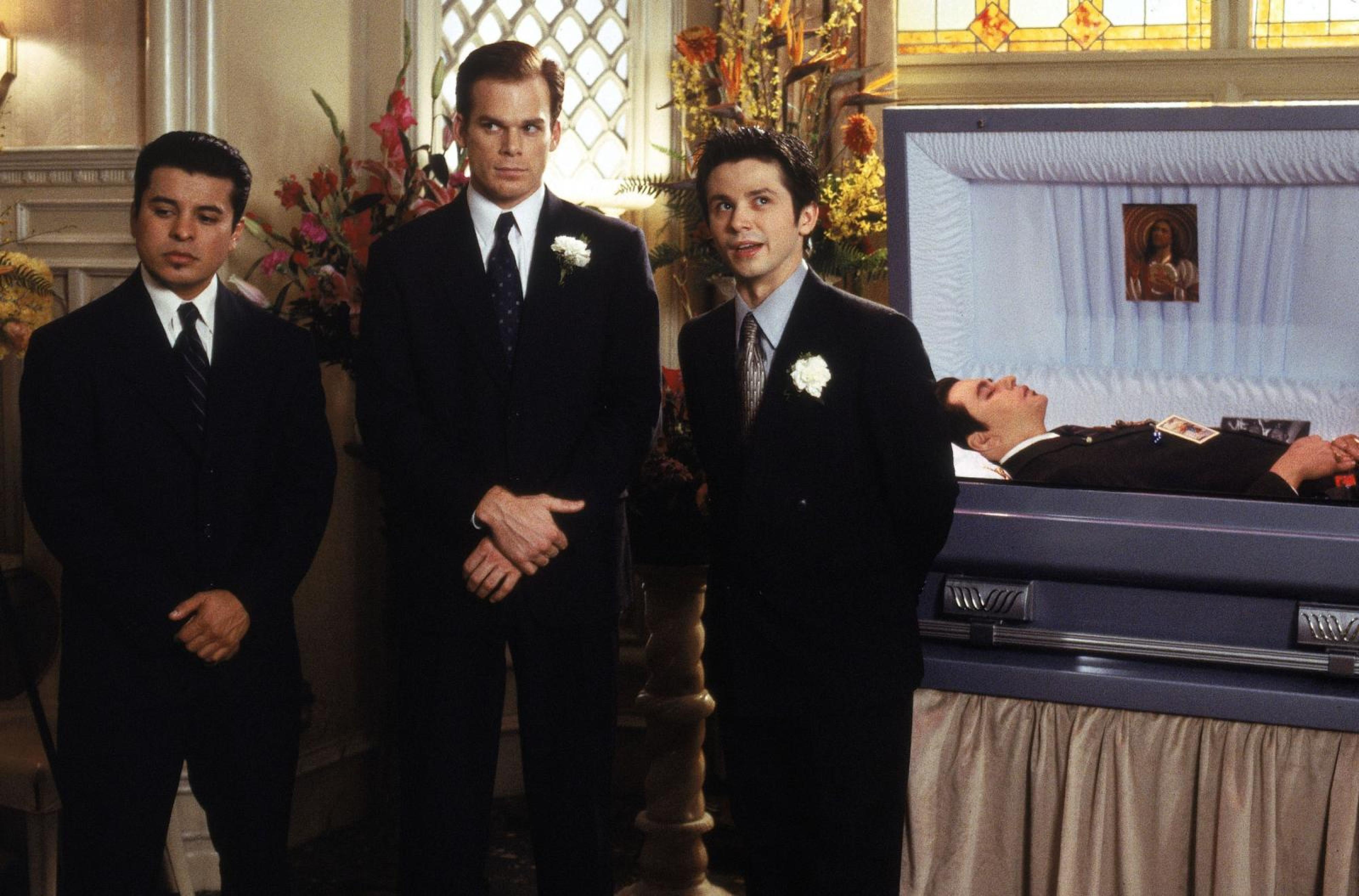
If television series came with Latin epigraphs, HBO would own the rights to “Et in Arcadia ego.” What maxim could better sum up the themes of Six Feet Under, the cable channel’s seductive, award-winning drama centered on a Los Angeles funeral parlor? Luxurious cinematography and an enticingly melodramatic narrative (which has dabbled in sex addiction, drug addiction, police violence, and Russian mobsters, among other sensational topics) give the show, which just entered its third season, the contours of an entertainment Eden. Its cast of stunningly good-looking actors, representing the appealing, emotionally vulnerable proprietors of the Fisher & Sons Funeral Home and assorted significant others, could be poster children for the myth of California as the land of beauty and perpetual youth. Still, the character who deserves top billing—the Master of Ceremonies over all the action—is death.
Granted, it would be hard for a series about a funeral parlor to shut out the Grim Reaper entirely, although given our society’s obsession with nymphet models and antiwrinkle creams, one might expect the show’s creators to try. Nevertheless, Six Feet Under can dwell so deliberately and lovingly on death as to recall those memento mori skulls that artists used to paint into piously inclined still-life canvases. Take, in particular, the credit sequence, which evokes death, morgue work, and burial with a hallucinatory chain of exquisitely macabre imagery: clasped hands reluctantly breaking apart in a tilled field that’s obviously pining to be a graveyard; a toe-tag flagging a foot on a gurney; a bottle of embalming fluid; a hearse; a tombstone wittily bearing the name of series creator Alan Ball.
Or consider the sly prelude to each episode, introducing the person who will become the latest subject of funeral preparations at Fisher & Sons. Since mortality takes many of these victims by surprise, the initial moments of these preludes (a pyramid-scheme kingpin conning a new group of suckers before diving into a swimming pool and hitting his head; an inebriated businessman gossiping on a shipboard party, just prior to falling overboard) are irony-packed reminders that in the midst of life we are in death.
That’s not to say that Six Feet Under devotes all its scope to the shuffling off of mortal coils. There is also a lot of sex. Last season alone offered a death by auto-erotic asphyxiation; a threesome with a prostitute; conversation about the deflowering of Nate Fisher (Peter Krause) back when he was a teenager; a frank discussion about a high-tech Japanese vibrator; several sordid episodes in which Nate’s psychologically unstable fiancee Brenda (Rachel Griffiths) has sex with complete strangers; a massage session in which—well, let’s stop there and point out that the first season of the series is available on DVD and video from HBO, and the second season presumably will be forthcoming.
Because its funereal concerns provide a sobering balance, Six Feet Under can brazen its way through this NC-17 territory without appearing to be downright smutty. After all, very little of the sex the characters are having actually makes them happier. Loneliness haunts their relationships: Nate and Brenda deceive each other; Nate’s buttoned-down homosexual brother David (Michael C. Hall) and his policeman lover Keith (Mathew St. Patrick) can’t seem to get along; the plaintive Fisher family matron, Ruth (Frances Conroy), frets about the lack of intimacy in her romance with a flower shop owner; the sulky teenage daughter Claire (Lauren Ambrose) falls for ne’er-do-wells. And given the gruesome details about death and decay that invade these Californians’ lives (“We’ll try to bring the swelling down, but we may get some skin slipping and then we’re screwed,” Fisher & Sons’ em-baker Federico, played by Freddy Rodriguez, brightly remarked about one particularly tricky corpse last season), the sex scenes can carry a hint of desperation, as if the lovers are seizing a brief, longed-for distraction from the corpses that arrive and decompose, as regularly as clockwork.
Conversely, though, the scriptwriters occasionally point out the affinity between sex and death. In the early moments of the first season’s pilot, for example, Ruth remarked of her soon-to-be deceased husband, “I’d much rather have him buy a fancy new hearse than leave me for another woman,” and later in the episode, the sight of her husband’s corpse prompted her to tell her sons about a longstanding extramarital affair. Similar allusions to a death/sex link have surfaced in subsequent episodes—Fed-erico’s joking reference to a corpse’s erection as “angel lust”; a soundtrack quotation from “Don’t Fear the Reaper,” the classic death-seduction song by the heavy metal band Blue Oyster Cult; the album of corpse photographs that prompts a friend of Claire’s to say, during a moment in a darkroom, “It’s like each one is someone who’s lying in bed with you.”
If its emphasis on the eros/Thanatos connection puts Six Feet Under in a distinguished mythological and literary tradition—along with the Persephone/Hades legend and all those Shakespeare speeches exploiting the correlation Elizabethans saw between death and sexual climax—it’s also a concept that suits the show’s medium. Simply by appearing on HBO, a channel that has only grown more hip and glamorous since the debut of The Sopranos, the Fisher family saga makes death sexy. Is there not even a certain orgasmic quality to the spasm of intensifying whiteness that separates scenes, a substitute for the hackneyed fade-to-black that’s standard in television and films? This clever and telling brighten-to-white technique, of course, carries another connotation: the sensation of zooming toward bright light so often reported by survivors of near-death experiences. It’s a recurring intimation of a supernatural reality, like the Fisher children’s occasional visions of their late father and other departed souls.
These hints of mysticism can coexist with the more materialistic Fisher family soap opera because Six Feet Under is a show that plays with shifting viewpoints. Episodes to date have contemplated Buddhism, liberal Judaism, fruit-loopy hippie beliefs (represented by Ruth’s sister), the biker lifestyle, animal rights/radical vegetarianism, Christian homophobia, and a self-actualization cult (in which Ruth briefly became ensnared), among other worldviews. To a certain extent, this sampling of beliefs reflects the search for novelty amidst constancy that might tempt the scriptwriters of any long-running series, but the existential smorgasbord seems particularly natural in a saga centered on a funeral home, since death forces us all to fall back on, and reexamine, our beliefs.
It would be foolish to make too much of the show’s philosophical provocations: Six Feet Under was designed as entertainment, and its sex-and-death themes are calculated to elicit from its audience a ratings-friendly frisson. But in a culture that generally prefers to ignore mortality, it’s remarkable—and heartening—that this stylish, intelligent drama has fared as well as it has. One can’t sit through that credit sequence without at least a passing, sober thought about the way of all flesh.
Having spent several weeks immersed in contemplation of this series about the mortuary arts, I would just like to say (for the record): When the time comes, I’d prefer to be cremated.