Every year, when Christmas decorations went up after Thanksgiving break at the Jesuit university where I did my doctorate, a liturgically minded friend would begin to grumble. All this red and green was premature; the Christmas season—“Christmastide,” liturgically speaking—doesn’t begin until December 25. This is Advent. Put up trees and wreaths and garlands if you must, but at least deck them in purple, please. We’re not celebrating yet; we’re waiting. We started calling it “Timothy’s War on Christmas.”
But his holiday bellicosity rubbed off on us. We were theology graduate students, already fussy and well-churched, and so susceptible to his agitations. We got conscripted in differing degrees. I resigned myself to tending my own holiday garden by inaugurating a dubious household tradition. My wife and I already had a fake plastic Tannenbaum in the garage, but I returned from Home Depot with two different strings of lights: one in classic multi-color, but another in a regal purple. I declared that during Advent the tree could go up, but until Christmas Day—Christmas Eve at the absolute earliest—it would be our “Advent bush” and lit in purple. Only with the turning of Christmastide would we swap out the lights and add ornaments. The tree would stay up until Epiphany at the earliest, ideally until Candlemas. My wife tolerated all this for several years with preternatural patience.
My colleagues and I were, many of us, in various stages of recovery from what I’ve taken to calling “postliberalism 2.0” (arguably a far cry from the postliberalism 3.0 that plagues us today). Painting with a broad brush, according to this schema, postliberalism 1.0 was mainly theological. On one side, it saw seemingly insoluble doctrinal conflicts between Christian denominations; on the other, an increasingly unquestionable secular, liberal “orthodoxy” dominating the wider culture. Postliberalism 1.0 tried to dodge both the Scylla of fundamentalist pretensions to doctrinal objectivity—which it saw as an insurmountable obstacle to progress in ecumenism—and the Charybdis of mainline capitulation to secular liberalism.
That first generation of Christian postliberals, including theologians George Lindbeck and David Burrell, adopted and adapted the linguistic philosophy of Ludwig Wittgenstein to derive Christian doctrinal claims neither from a supposedly direct intuition of objective reality à la the fundamentalists, nor some naturalistic, de-mythologized secular reality “behind” the tradition, à la the mainline liberals. Instead, they argued that the distinctiveness of Christian teaching was rooted in the distinctiveness of the Christian common way of life—that is to say, the life of the Church.
This project swiftly transformed from a theology of doctrine into a political theology in postliberalism 2.0. Figures like Stanley Hauerwas, William Cavanaugh, and our teacher D. Stephen Long claimed that Christian doctrine could have its autonomy as a counterrationality, independent from the rationality of secular liberalism, because it emerged from the way of life embodied by the countercommunity that is the Church. Discerning and enacting the counterpractices constituting that way of life became a major preoccupation, including getting persnickety about the liturgical calendar. Putting our foot down about the difference between Advent and Christmastide was a way to resist the “Constantinian temporality” expressed in the commercial holiday merchandising calendar.
But there was also, I must admit, something scolding, even bullying about our liturgical correctness. Sometimes, in the process, we became blustering ecclesial versions of Walter Sobchak, John Goodman’s unyielding character in 1998’s The Big Lebowski. We were bellowing, “This is not ’Nam. This is the Church. There are rules.” On one hand, we weren’t wrong. But on the other, we’d gotten ourselves cross-wise with what I’ve called “The Walter Sobchak Principle”: to adapt the Dude’s admonition, we weren’t wrong—we were just assholes. In the unspoken demand that reality conform itself to our Advent counterpractices, you can smell the fertilizer where the authoritarian postliberalism 3.0 of Patrick Deneen and Rod Dreher would take root.
In recent years, a new liturgically minded tradition has popped up in my household. The night before Ash Wednesday, we throw a little Mardi Gras party at my house. We mostly invite the kids’ classmates from school and their parents. I make New Orleans cocktails for the grown-ups and a mountain of buttermilk pancakes for kids and parents alike. It’s a school night, but we wring a family-friendly modicum of irresponsibility out of the few hours before Lent begins. Then we all settle into the slow, ascetic thaw that leads to Easter in New Jersey.
Last year, inspiration struck. While waiting in line to receive my ashes, maybe a smidge hungover, an analogy occurred to me: Thanksgiving is to Advent as Fat Tuesday is to Lent. As an analogy, it is distinctively American—only our Thanksgiving falls on roughly the appropriate date each year. But then again, national distinctiveness is hardly disqualifying when it comes to Catholic folkways. Mardi Gras came to the United States with French settlers, after all. I was less inspired by liturgical correctness than by an analogy or the extension of a rhythm: we feast, then we fast, then we feast. In the ongoing improvisation that is Christian enculturation—that endlessly renegotiated Christianization of every way of life lived by God’s pilgrim people—this rhythm ties together the myriad variations.
Theology aside, my Thanksgiving–Mardi Gras analogy is also a matter of facing some practical holiday-season realities. Speaking for myself, the stretch from Thanksgiving to Christmas has become exhausting, and Christmastide feels hollowed out. The expectation that we wrap up the calendar year and at the same time both prepare for and celebrate Christmas is, frankly, inhumane. The end of the school term is packed with exams, papers, grading. Cards have to go out. The kids’ end-of-the-year performances must be attended. There’s the work party, the friends’ party, all the traveling and/or hosting. There’s shopping, mailing, planning, cooking, and cleaning—all on the list. It can feel like we’re all packed in a car that’s hurtling through December, stomping on the gas and the brakes at the same time, while also cranking up the volume on the holiday radio station. By the time we stagger back to school and work in January, it’s no wonder we’re a little numb and deaf, unable to hear the good news that God has come to us, poor and meek and helpless.
Some people have argued for recovering the penitential character of Advent. The idea is that, as we wait each year on the arrival of our Savior, we stay in touch with the deep “reason for the season”: our sins and the desire to be liberated from them. On this vision, Advent would be an ascetic season very much like Lent for the discipline of fasting and training in repentance.
What I’m suggesting is a little different. To play on the athletic roots of the word “ascetic” (the Greek “askesis”), what if the image of athletic discipline for Advent wasn’t physical exertion, but purposeful recovery? What if the metaphor for Advent askesis wasn’t a punishing run or lifting weights or hewing to a restrictive diet, but hitting the sauna, drinking more water, or—even better—taking a nap? What if American Catholics geared up for one last harvest-season hurrah with Thanksgiving, then turned our attention to a calm, controlled descent to the end of the year? What if we adopted a certain Advent minimalism—a December discipline of politely declining Outlook calendar invitations on religious grounds? What if, for a few weeks, we were largely devoted to no more than the annual tying up of loose ends and carving out some stretches of expectant silence? What if, with the sun setting so early anyway, Catholics enacted the distinctive counterpractice of getting eight to nine hours of sleep a night?
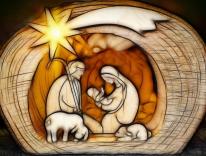
I suspect that might make Advent look different for many of us. But more importantly, I suspect it might free us up to celebrate Christmas differently as well. The past few years, I’ve found myself grieving the way in which Christmas Day feels like a conclusion, rather than a beginning. It feels some years like we shuffle away from it through the turning of the New Year and then collapse exhausted onto a pile of discarded wrapping paper, just as life starts getting back to normal in January. Or, worse, after only the briefest reprieve, we get gripped again with the anxiety and dread of New Year’s goals, tasks, obligations, and ambitions. We resolve once more to tackle our messy garages, neglected projects, vices, or health. We hastily tuck away the infant Christ from our nativity sets. We’ll see him again in a few months, grown and nigh-crucified.
An earlier “War on Christmas” was waged by those fussiest American ancestors, the English Puritans. The decorations, the scheduled gluttony, and the days away from productive labor all smacked of Popery and, anyway, were surely too much fun to be morally licit. While the Puritans were briefly ascendant during the English Civil War, they simply forbade it. My pitch that we dial things down between Thanksgiving and Christmas is not meant to be puritanical in that sense. If it makes you feel cozy and festive, then put out the decorations and bake the cookies. Put up the tree and play the music while eating leftover turkey and stuffing on Black Friday. I’m not here to take that from you. Heck, kick it off on All Saints for all I care.
But if trying to keep the Christmas magic aloft while also spinning all those other December plates has become punishing, what I really want to offer is permission. Advent can offer a few weeks of mindful stillness if you need it. This Thanksgiving, you can let it rip—get thirds, have two desserts, stay up until 2 a.m. playing board games with your cousins. But then, if you want it, Advent could be a time to refill your tank. We wait on Christ expectantly, yes, but that doesn’t have to mean anxiously or frantically. Like one of the five wise virgins in Jesus’ parable, you’re invited to top up your oil lamp precisely so that, when the bridegroom arrives, you aren’t caught running errands. More importantly, you’re offered this chance at disciplined restfulness so that, when the time comes and you’re taken into the wedding, you are free and ready to joyfully let loose. On Thanksgiving, as Americans, we can remember the Puritan pilgrims in whatever light might be appropriate, but from Christmas to Epiphany, I do think there’s a certain Catholic obligation to make them blush.
We welcome your comments about this article. Please send your response to [email protected].