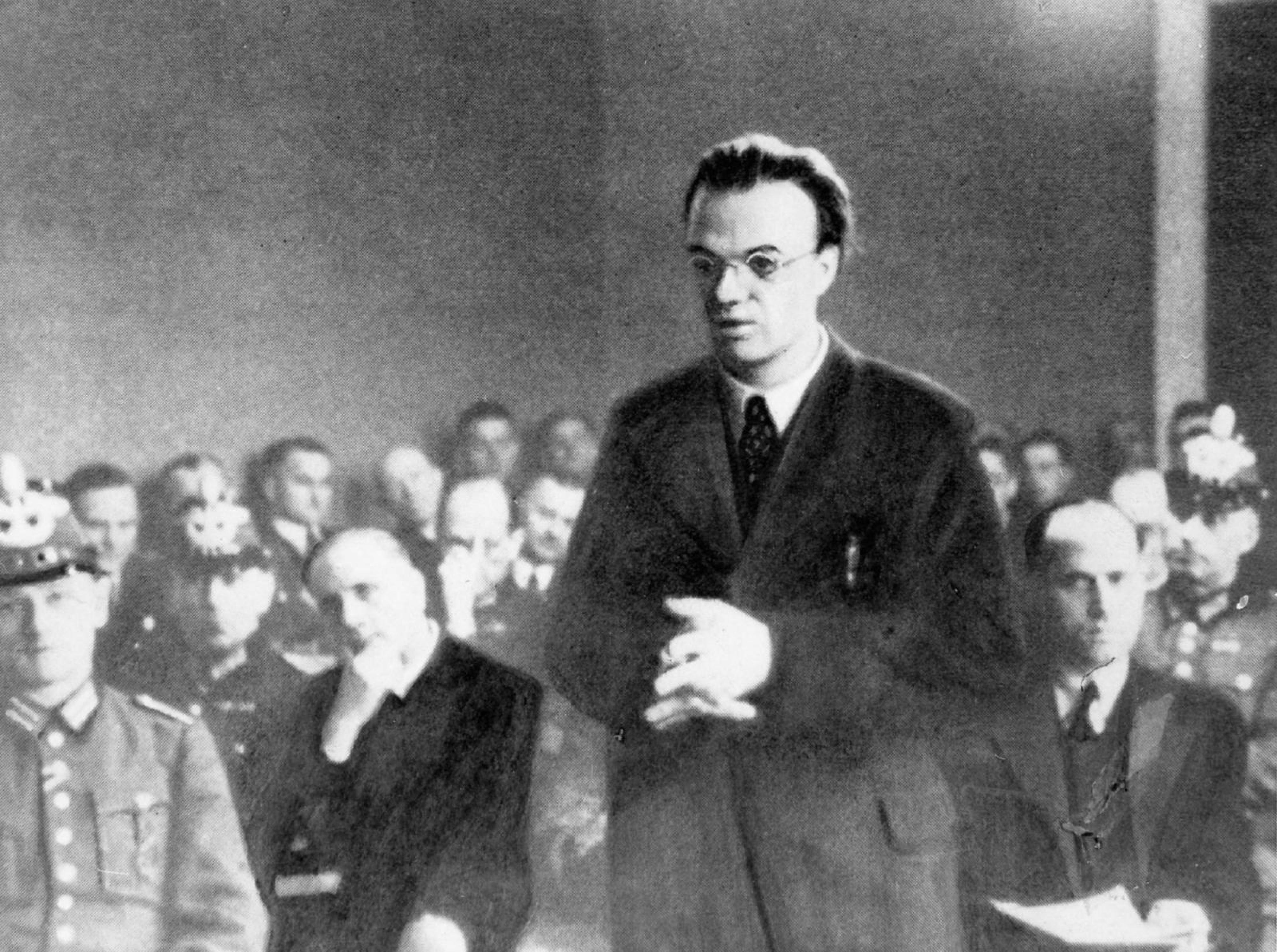
In 1944, the first Sunday of Advent fell on December 3. Inside Tegel Prison in northeastern Berlin, Allied bombs could be heard nightly as the city exploded into ruin. Elsewhere in Germany, the murderous Nazi regime raged on. The Jesuit prisoner Alfred Delp, stripped of any illusions he might once have had, picked up a small pencil with manacled hands and wrote: “Unless a man has been shocked to his depths at himself and the things he is capable of, as well as the failings of humanity as a whole, he cannot possibly understand the full import of Advent.”
Delp had been in Gestapo custody for nineteen weeks, having been arrested in the crackdown after Claus von Stauffenberg’s failed attempt on July 20, 1944, to assassinate Hitler as part of Operation Valkyrie. Delp was thirty-seven years old, brilliant and opinionated, and had tussled at times with the strictures demanded by the vow of obedience. An expert on the 1931 papal encyclical Quadragesimo anno, which dealt with questions of social and economic order, he had been invited by his immediate superior, Augustin Rösch, to join a secret group of resisters who were planning a post-Nazi German government based on Christian principles. Rösch and another Jesuit involved in the group, Lothar König, had gone into hiding after the assassination attempt, but nearly all the others in the group had been captured. Those who had not already been executed were awaiting trial in Tegel Prison. Delp had decided not to go into hiding because his final vows—already deferred once for unknown reasons that may have had to do with matters related to obedience—had been set for August 15. Instead, on that day, he was undergoing the Gestapo’s enhanced interrogations.
“He was a sinner who became a martyr,” two of Delp’s Jesuit contemporaries told me when I met with them one day in 2001 at Peter-Faber-Haus, a Jesuit retirement home in Berlin. One of them, Richard Wagner, a youthful ninety-year-old, hastened to clarify the stark statement they had just made: Delp was a sinner “like all of us,” he said, and his months in prison had prepared him for martyrdom. The other Jesuit, eighty-nine-year-old Otto Ogiermann, an early biographer of Delp, was recovering from hip surgery and still frail. Delp himself would have been ninety-four. His two confreres reminisced about the pre-prison Delp: his joie de vivre, his big and easy laugh, the philosophical writing he had accomplished before his arrest, the cigarettes he enjoyed, his relish for a good argument with a worthy opponent. When his two confreres looked at photographs of him before his arrest, they marveled that he was so young and that they, too, had once been that age, and that he had surrendered his life at the peak of his abilities. After the war, the two of them had moved on to postwar lives, Fr. Wagner to work as a chaplain to the American forces in Berlin and Fr. Ogiermann to minister in East Germany. When I pressed for more reminiscence of Delp, Fr. Wagner, who had lived a year in community with him, considered a moment and then replied: “Enfant terrible.”
Two days before the beginning of Advent, 1944, Delp wrote to another Jesuit, Franz von Tattenbach, who had been deputized as a messenger between him and his superiors: “During these nineteen weeks, life has become immensely complex and multidimensional. God and death and freedom and miracle and guidance and surrender and trust: these all belong naturally to it. In the past a lot was masked…” The original has asterisks: the thought is unfinished.
From the time he was a theology student, Delp had regarded Advent as a sign of God’s response to human longing. In 1933, as a young Jesuit scholastic teaching in a boys’ school in Austria, he had written a play called The Eternal Advent; its central theme was “that God touches us…that God comes to us and makes us free.” In prison, with grim days ahead of him, the captivity of humankind before the coming of Christ was laid bare literally in his own life. The barred window, the cell door without a keyhole, the fettered wrists: to him these became a metaphor for “the hunger and thirst and wandering in the wilderness” that afflicts all humanity. And then: “If we are terrified by the dawning realization of our true condition, that terror is completely calmed by the certain knowledge that God is on the way and actually approaching.” He ends his reflection on the first Sunday of Advent with the quiet admonition to all those on the outside, sunk beneath the weight on their own shoulders: “Light the candles quietly, such candles as you possess, wherever you are. They are the appropriate symbol for all that must happen in Advent if we are to live.”
On December 8, the feast of the Immaculate Conception and a Jesuit feast day, Delp received a surprise visit from Franz von Tattenbach, who had been given extraordinary permission to receive his imprisoned comrade’s final vows. Under the watchful eye of a prison guard, Delp, whose emotional defenses had nearly abandoned him, stumbled through the Latin vow formula, sobbing. He later wrote that his final vows lifted him from a feeling of isolation and gave him a new spirit of freedom despite the bars and locks and chains. “A shadow was cast when it seemed that God didn’t want me to make my vows on August 15,” he wrote to Tattenbach. “He was only allowing me to prepare further.”
Delp’s two-day show trial took place on January 8 and 9, 1945, and he was sentenced to death for treason. He was executed by hanging on February 2, 1945. On the same date this year, Cardinal Reinhard Marx, archbishop of Munich and Freising, formally opened Alfred Delp’s beatification process in the Cathedral of Our Lady in Munich.
We welcome your comments about this article. Please send your response to [email protected].