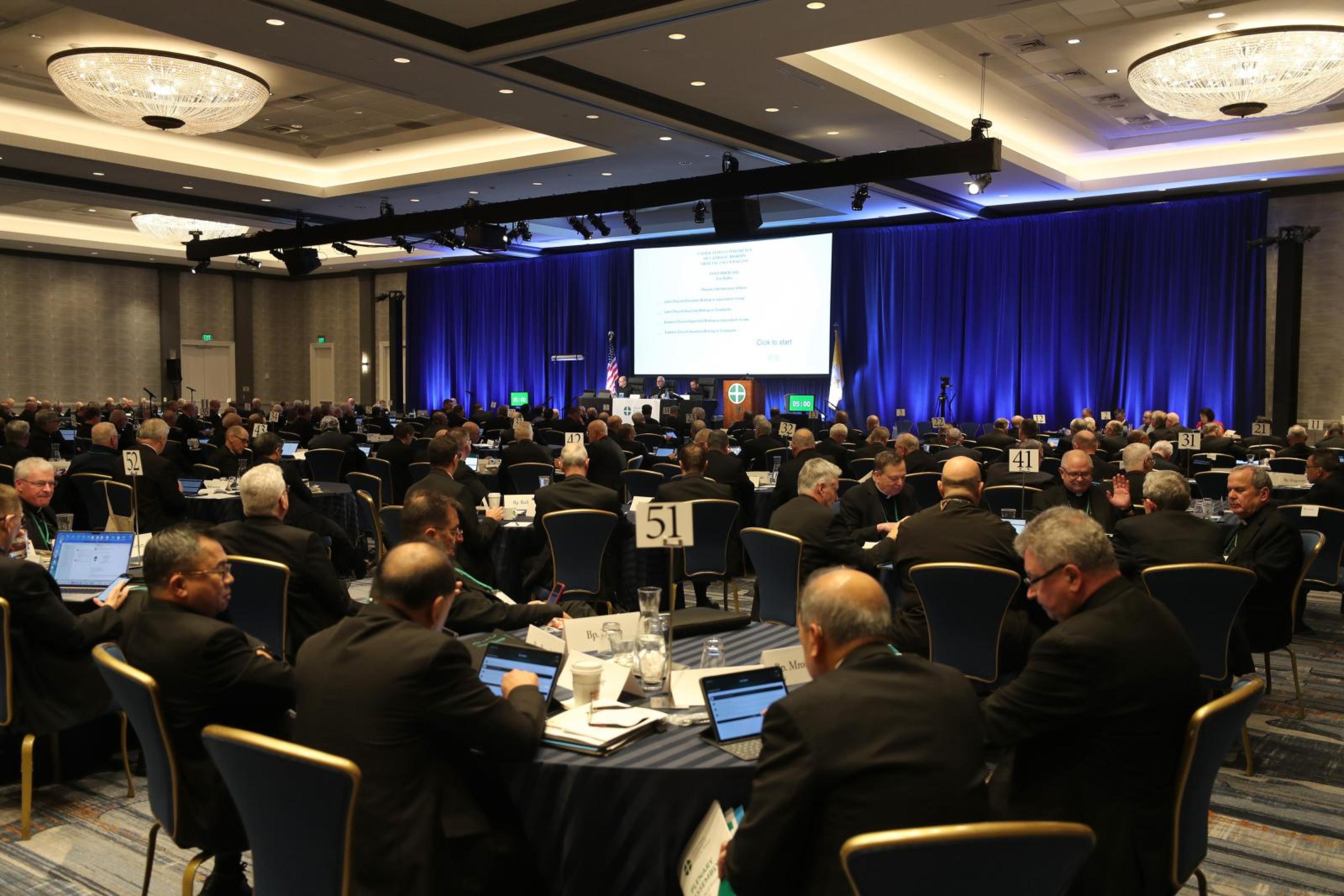
In national-election years, the annual mid-November plenary meeting of the U.S. bishops has the added function of discerning how, or if, the body of Church leaders will react to the election results. In 2020, they formed a working group to consider their reaction to a pro-choice Catholic president, which led to a year of debate about whether to deny Joe Biden Communion. After the 2024 election, they expressed alarm about Donald Trump’s campaign rhetoric about immigrants, and the following year they released a special statement opposing the administration’s mass-deportation tactics. This year, after the massive Democratic wins in the midterm elections, one commentator wondered in his pre-meeting column whether the Catholic bishops would “learn how to surf the blue wave” or “continue to build sandcastles on the beach.”
If the two days of the public portion of the meeting were any indication, the bishops seemed mostly unaware that the political weather had changed. Their action items were primarily internal: They voted to advance the cause of a potential saint, passed the budget, and approved a new version of the lectionary. They authorized new investment guidelines that call for divesting from private prisons, detention centers, and companies that make autonomous weapons, and approved a day of prayer for racial justice at the end of October. They also heard a report from the newly formed ad hoc committee on artificial intelligence, which promised to advocate for guardrails on AI, something Pope Leo XIV urged in his encyclical Magnifica humanitas.
The longest agenda item of the two days was a workshop about renewed interest in the Church among some young people, although at least one presenter was careful to note that any celebration of a “revival” is premature. That topic prompted the most response from bishops from the floor. Otherwise, nearly all agenda items passed without amendments or public discussion. The only action item that intersected directly with politics involved abortion—a virtual non-issue in the midterms. The bishops voted to begin the process to finally update their twenty-five-year-old pro-life pastoral strategy, in light of the overturning of Roe v. Wade four years ago.
It wasn’t until the lunchtime press conference that conference leaders were forced to address the donkey in the room. Asked how they foresee working with a now Democratic-majority Congress, conference leadership expressed openness. “We’re committed to working with whoever is in office, whoever is in the White House, whoever has the majority on Capitol Hill,” said conference president Archbishop Paul Coakley of Oklahoma City. “We’re here to help shape public policy according to our Catholic social teaching, seeking the common good and respecting the human dignity of every person. We can find something in common with virtually anybody on the hill that is willing to work with us. We’re willing to work with them.”
Conference vice president Bishop Daniel Flores of Brownsville, Texas, acknowledged the historic flip in his state, where voters elected the first Democratic U.S. senator and governor in three decades, and where Dems took twenty state House seats and all four state supreme court seats. “The bishops in Texas have a long history of working with whoever happens to be in the legislature and the governor’s mansion,” Flores said at the press conference. “There are things in the previous administration we could support and there were things we didn’t…. That’s because the Catholic perspective on human dignity and life doesn’t fit neatly into either party.”
Earlier that morning, in Coakley’s presidential address, he had also tried to downplay the Church’s connection to politics. He acknowledged that it had been a “blessing” to vote—“as Pope Leo did”—and that the “difficult and often contentious election” had yielded “if not surprising, undeniably consequential results.” But he pushed back on the tendency to analyze the Church with concepts like secularism, individualism, and polarization that apply to politics rather than the Church. “This is even true among many within the Church, whether among ourselves, or in Catholic media, on social media or among influencers and pundits whose default position is to interpret events and happenings in the life of the Church through political or ideological lenses,” he said. “That is a problem, for the world thinks in terms of power. The world sees things through a false binary logic, a world of yes or no, of left or right, of either/or. But, as you and I know, the Church thinks in terms of mission.”
Last year’s special statement on immigration and its accompanying social-media video were widely praised and effective in portraying the Church as concerned with more than its “preeminent” priority of abortion. But this year, the bishops had no new plans beyond “continuing” what they had already done—even as Stephen Miller, the architect of the violent immigration enforcement tactics, has been elevated as Trump’s chief of staff. “One year later, much of what we addressed at that time continues to be relevant today,” Bishop Brendan Cahill of Joliet, Illinois, the chair of the Committee on Migration, said in his presentation to the public meeting. “Monitoring and responding to conditions in immigration detention remain priorities for the Migration Committee as well, with more people detained today than any other time in our nation’s history.”
The migration report was cautious and mostly self-congratulatory, praising movement on the religious worker visa program and noting that Church leaders have long supported immigration reform. “Taking all of this, and considering the desires of the American people, the question of meaningful reforms to our immigration system should not be discussed in terms of ‘if’ but ‘when,’” Cahill said. “We know neither the day nor the hour, but the Migration Committee is working closely with our staff at the conference and our partners to remain vigilant and engaged.”
In an interview with me, Bishop Michael Pham of San Diego, who came to the U.S. from Vietnam as a refugee, said the Church needs to be “a voice for the vulnerable,” including immigrants such as the eight-year-old Haitian boy recently detained by ICE in his diocese. “In moments like that, we can’t sit still,” he said. “We’ve got to be that voice, not just speaking in the church environment, but to be out in public.”
Notably, Coakley didn’t even mention immigration or migrants in his presidential address, and he echoed the business-as-usual language in his response to a press-conference question about specific strategies on immigration, given the new Congress. “Many of our concerns will remain the same,” Coakley said. “We will try to advocate as we have been.” Flores said he hoped for a political conversation about immigration reform, something “the U.S. bishops have been asking for for decades.” But he, too, suggested more of the same: “We continue to have the concerns that we raised, I think quite articulately, in the bishops’ letter last year,” he said. “Those concerns continue to be real.”
In fact, what struck me about the meeting was how muted was any mention of the social issues that motivated American voters to turn out in record-breaking numbers and deliver a “blue tsunami”: inflation and the widening gap between rich and poor, the senseless and illegal war in Iran, skyrocketing healthcare costs, and corruption in the Trump administration. Although Coakley has issued several statements echoing Pope Leo’s condemnation of the U.S. war in Iran, there was no mention of it at the meeting and no public response to a letter from nearly a hundred theologians and educators who urged the body of bishops to take a stand against the war.
Flores is not wrong that the Church’s teaching does not fit neatly into either political party in this country, and the bishops’ conference does need to avoid partisanship. Of course, they have not always been shy about partisan alliances when it comes to certain issues. Witness the recent controversial photo-op of twelve bishops praying over Trump in the Oval Office just days before the midterm elections. (Nothing was said about that at the meeting either, at least not in the public sessions. Increasingly, larger portions of the meeting are being held behind closed doors in executive session.)
While their leader, Pope Leo, was traveling to South America, raising concerns about global warming, the need for universal healthcare, and economic justice, the bishops in his home country held a perfunctory meeting that gave minimal encouragement or guidance to the people in the pews facing multiple crises and momentous change. If the Church wants to be relevant in the lives of U.S. Catholics, it cannot remain silent on the urgent social issues on which Catholic teaching has so much to say.
We welcome your comments about this article. Please send your response to [email protected].