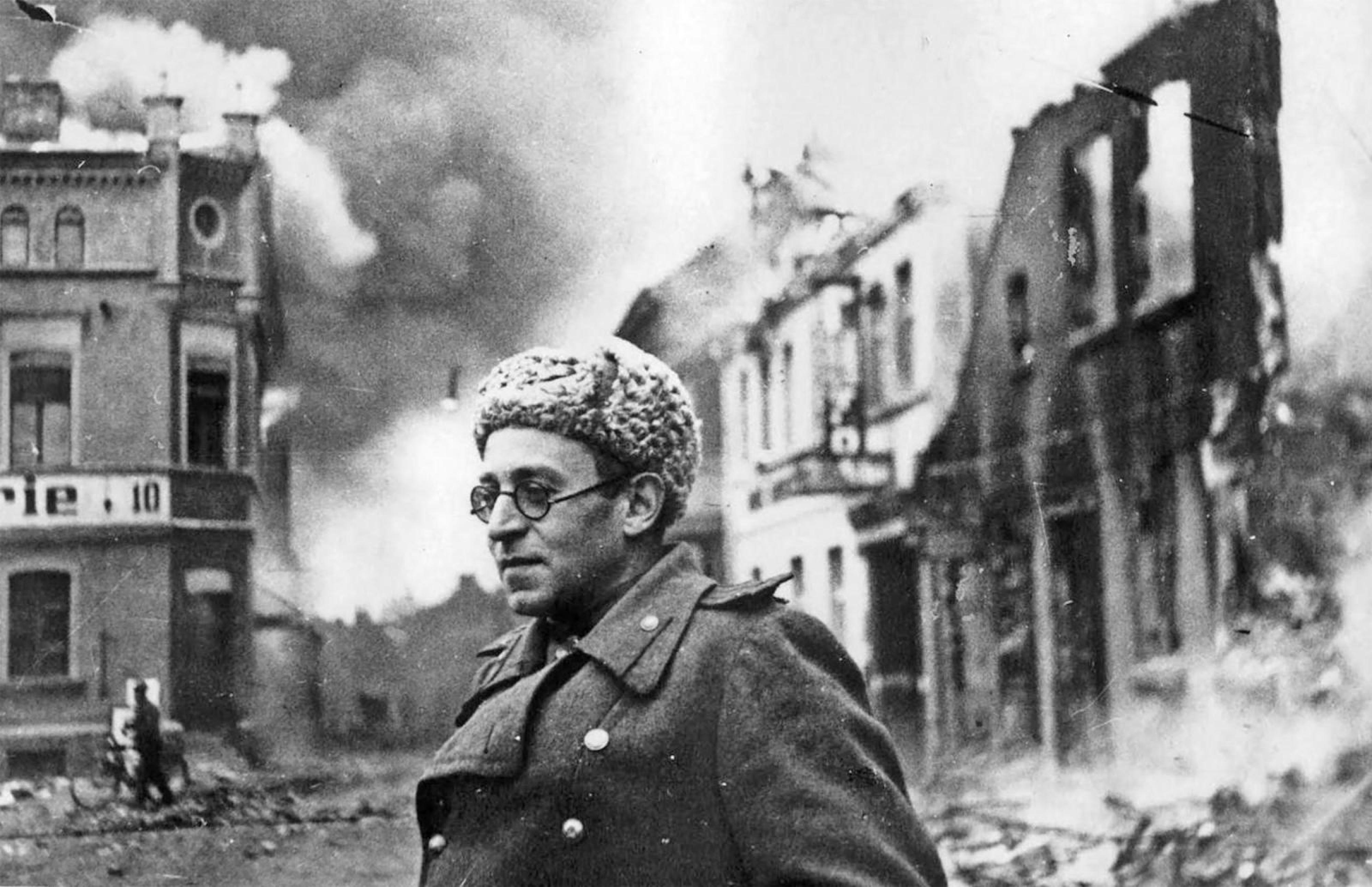
In April 1945, with the Red Army already battling its way into the outskirts of Berlin, the Soviet writer Vasily Grossman set off from Moscow for a final journey to the front. Behind him lay nearly four years of brutal combat, much of it witnessed firsthand as a correspondent for the Red Army’s newspaper, the Krasnaya Zvezda (or Red Star). Ahead lay Germany’s inevitable capitulation.
Yet along the journey, the Soviet landscape seemed exhausted by the conflict. An unseasonable wind rattled the tin roofs of ruined houses and whipped the flames of grass fires burning in abandoned fields. The smoke mixed with the drizzle across mile upon mile of highway nearly all the way to Warsaw. Along the roadside were the mounds of mass graves for Red Army soldiers who fell by the millions.
“It might have seemed impossible to paint a grimmer, sadder picture,” Grossman wrote in a dispatch for the newspaper—headlined “Victory”—that went unpublished for decades. It is a startling line. By that point, Grossman had spent more than a thousand days at the front line with the Red Army. He’d walked the shattered, deserted remains of the Warsaw Ghetto and the undulating ruins of the Treblinka death camp. His own mother, and scores of other relatives, had been among the Jews massacred in Ukraine.
But Grossman, who has posthumously earned a colossal literary reputation primarily on the strength of his epic masterpiece Life and Fate, was above all a brilliant observer with a habit of casting his eye in surprising but revealing directions. Those instincts animated the best of his work as a correspondent, which has been gathered in a new, meticulously edited collection of his wartime reportage, From the Front Line: Stalingrad-Treblinka-Berlin, 1941–45. The book is translated by the husband-and-wife team of Robert and Elizabeth Chandler with an introduction by Robert Chandler and the Russian scholar Julia Volohova.
A nearly suicidal compulsion to bear witness seems to have gripped Grossman throughout the conflict. Not long after Nazi Germany invaded the Soviet Union in 1941, Grossman—already a modestly successful novelist—tried to enlist in the army. Overweight, asthmatic, afflicted with poor eyesight, and already walking with a cane, he was turned away. A position as a war correspondent for the Red Army’s house newspaper, which enjoyed a massive readership inside and outside its ranks, proved more attainable. After being assigned the rank of quartermaster and provided with the most rudimentary training, Grossman struck out for the front lines.
Grossman had remarkable access to Soviet commanders and military plans, and the pieces in From the Front Line reveal a sharp sense for strategy. Grossman grasped almost immediately the pivotal importance of the desperate Soviet effort to halt the German advance at Stalingrad, the battle that sits at the heart of his two great wartime novels.
His devotion to capturing the fighting firsthand evidently won him the respect of frontline troops, and fellow journalists described his preternatural ability to get even the most taciturn veterans to speak openly. Poet and fellow Red Star correspondent Ilya Ehrenburg wrote that the “soldiers of Stalingrad did not look on Grossman as a journalist, but rather as one of their comrades in arms.” Two long, grim profiles of Red Army soldiers—a sniper named Chekhov and an antitank rifleman named Vlasov—are highlights of the new collection, along with a group profile of the Siberian regiments given the ghastly task of holding out against the relentless German assaults. “As long as I live, I will never forget these stern and magnificent days,” Grossman wrote to his wife in a letter from Stalingrad. “Never, I believe, have I experienced anything so intensely as I do now.”
All the while, Grossman clearly harbored immense literary ambitions. In 1942, before the German advance had even been halted, he published his first wartime novel, about a Red Army battalion threatened with encirclement and annihilation. (New York Review Books released a new translation by the Chandlers in 2022, with the title The People Immortal.) He began working on his first epic account of Stalingrad—published as For a Just Cause in 1952, and in a new NYRB edition from the Chandlers as Stalingrad in 2019—even as the war was still raging.
As the nonfiction precursor to those great novels, From the Front Line is a treasure. Here is one of the century’s great writers grappling on deadline with how to capture events that seem to exceed the limits of ordinary language. There are passages laced with Soviet rhetoric and clichés, where Grossman’s accounts fall into the bombastic socialist formulations expected of a Red Army newspaper under Stalin. But there are also captivating and startling observations. They rely most of all on what Grossman saw: the chatter among soldiers in the Stalingrad trenches waiting for supper; shellshocked Romanian prisoners of war emptying their pockets of women’s silk clothing looted during the campaign; the nervous habits of Red Army generals; tugboat captains navigating ice floes and German mortar fire to shift barges across the Volga.
Censorship always hangs over wartime journalism, and even in the democracies there was more than a whiff of propaganda to much of the World War II coverage. But the paranoid repression of Stalinism, the haunting specter of the ongoing purges, and the fanatic rigidity of Stalinist ideology created a vortex of self-censorship and terrified editing that even a writer of Grossman’s talent and integrity could not escape. The collection contains very few of his early frontline reports for Red Star, when Soviet troops suffered a string of catastrophic defeats—Chandler and Volohova write that these reports are shot through with “much false optimism and many Soviet clichés.”
From the Front Line reveals how Grossman tried to navigate the strictures of the Stalinist system—where any deviation from the acceptable Soviet line risked denunciation—without betraying the essence of events. Chandler and Volohova have reconstructed pieces from published articles, notebooks, drafts, and typescripts, often restoring sections excised by editors or Grossman himself as they tried to negotiate the shifting boundaries of what was acceptable to print.
Some subjects were entirely taboo. Grossman’s accounts of the Red Army’s advance into eastern Poland conspicuously avoid mentioning that the Soviets had invaded the same territory just a few years earlier in 1939, when they were Hitler’s ally. A 1944 entry from Grossman’s journal quoted in the collection recounts listening to the destruction of Warsaw as Nazi forces crushed the Polish uprising while Red Army troops waited idly near the western suburbs. That Stalin preferred to let the Germans destroy an independent anti-Soviet Poland was obvious even then, but neither Grossman nor his fellow journalists dared to broach the topic.
We heard the roar of guns on the far side of the Vistula, and sometimes the crackle of machine guns. The insurgents were evidently fighting to the death, resisting stubbornly, hoping no doubt for support from Soviet forces. And no one could understand why our army was staying in position and not offering help. A kind of heavy, inexpressible bewilderment hung in the air, yet no one showed any particular wish to discuss aloud the strategic, tactical or political thinking behind our army’s inaction. Any such words would have been fraught with unpleasant consequences.
Bearing witness to the Holocaust was obviously of huge importance to Grossman, himself a Jew from Ukraine—also overrun by the Nazis—who was tormented by grief and despair over the annihilation. But it was also a fraught and dangerous task, as virulent antisemitism in the Soviet Union, and Stalin’s own hostility to the Jews, increasingly shaped official ideology. To emphasize the singularly horrific fate of the Jews under the Nazis, according to the Kremlin line, was to minimize the common suffering of all Soviet citizens. It also risked showing, however obliquely, how some of their fellow Soviet citizens had collaborated in their torment and murder.
Grossman’s reporting on the Holocaust forms the dark emotional core of From the Front Line, and the invaluable annotations from Chandler and Volohova make clear how he made painful compromises to get the pieces published. Along with other Soviet Jewish writers, Grossman contributed to a vast eyewitness account of the Holocaust dubbed The Black Book, which initially won approval for publication in the Soviet Union but was ultimately suppressed. His experience at Treblinka—where the earth itself was still turning up bits of clothing, scraps of letters, and other belongings of those murdered there—clearly haunted him. According to Grossman’s daughter, he kept a child’s worn building block that he had plucked from the soil at Treblinka on his writing desk for the rest of his life. In a famous passage from his remarkable report from Treblinka, one of the first detailed pieces published in any language about the Nazi death camps, Grossman wrote that “it is the writer’s duty to tell the terrible truth, and it is the reader’s civic duty to learn this truth. To turn away, to close one’s eyes and walk past is to insult the memory of those who have perished.”
After many revisions, Grossman managed to publish his detailed account of the Treblinka death camp—not in Red Star, but in the smaller monthly Znamya. In describing Grossman’s work, Chandler and Volohova turn to a line from the memoirs of another chronicler of Stalinism, Nadezhda Mandelstam, who vowed to tell “the truth, nothing but the truth—but not the whole truth.”
What is striking in From the Front Line is not only the censorship, but both what survives it now and what Grossman pointedly left unsaid. The official Soviet line often sits uneasily beside his observations, but so do simplistic readings of Grossman’s work that might suggest the Soviet Union and Nazi Germany were equally totalitarian forces. Whatever the crimes of Stalinism, Grossman knew far better than most what the Red Army was fighting against. In another dispatch from liberated Ukraine, he wrote: “I have walked and driven about this land from the Northern Donets to the Dnieper, from Voroshilovgrad in the Donbas to Chernigov on the Desna; I have looked at Kiev from the east bank of the Dnieper. During all this time, I have met only a single Jew.”
The suppression of Life and Fate—the manuscripts were seized by the Soviet police and first published abroad only after Grossman’s death—has resulted in most readers understanding Grossman primarily as a victim of Soviet repression. As Chandler and Volohova write in their introduction, the “Soviet authorities effectively split Grossman in two: the patriotic voice of Stalingrad could be celebrated, while the Jewish witness and future dissident could be suppressed.” From the Front Line helps reunite those two Grossmans, showing a writer of convictions constantly pressing the boundaries of the system while still accommodating himself enough to operate—and thrive—from within it.
Grossman spent the war carefully tracing where private lives and epic world-historical events intersected. Like Tolstoy, he had a masterful sense for how those events play out at a human level. This is what makes Life and Fate the great literary masterpiece of World War II. But From the Front Line displays an uncanny brilliance for capturing those world-historical events as they were happening. Tolstoy was only born a decade after Napoleon’s disintegrating armies fled Russia. Grossman, meanwhile, began grappling with how a novel could capture the immensity of the Soviet Union’s wartime experience even as Stalingrad was still burning.
At the decisive moment, when the initiative passed irrevocably from the savage German invaders to the Red Army, Grossman’s dispatch in Red Star, included in From the Front Line, captured it not at a general’s headquarters nor even among the attacking troops. Instead, he described a crowded barge frozen into the Volga ice, a scene that would later reappear in Life and Fate but whose significance is already immediately recognizable here.
Six hundred workingmen, along with their wives, mothers, and children were living in the hold, waiting to be evacuated to the Transvolga steppe. One cold, dark evening, a man climbed down into this hold. He walked past elderly workers plunged in gloomy thoughts; he walked past sad, silent old women; he walked past a worn-out young woman who had given birth to a son only the previous day, on the damp, dirty floor of the hold; he walked past children asleep on piles of bundles. This man then began to read aloud, by the light of an oil lamp: ‘Recently, our troops positioned on the approaches to Stalingrad launched an offensive against the German Fascist forces…’
From the Front Line
Stalingrad-Treblinka-Berlin, 1941–45
Vasily Grossman
translated by Robert and Elizabeth Chandler
New York Review Books
$24.95 | 512 pp.
We welcome your comments about this article. Please send your response to [email protected].