Since the civil-rights movement in the 1960s, there’s been an on-again, off-again dispute in political circles over whether the United States is a democracy or a republic. Opponents of expanded civil rights downplayed democracy and amplified “states’ rights,” which was coded language. Unsurprisingly perhaps, it’s now a MAGA article of faith that the United States is a republic and emphatically not a democracy. The Heritage Foundation, of “Project 2025” fame, published a report in 2020 titled “America Is a Republic, Not a Democracy.” Also in 2020, Utah senator Mike Lee provocatively tweeted during the vice-presidential debate that “we’re not a democracy,” but “a constitutional republic.” He followed up with a brief essay, “Of Course We’re Not a Democracy,” conceding that the United States has “a political system in which government derives its powers from the consent of the governed,” but claiming that the term democracy “conjures far more than that” and “is often used to describe rule by majority,” which the U.S. Constitution was designed to curb. Bizarrely, the website of the U.S. Embassy in Argentina currently explains that, “while often categorized as a democracy, the United States is more accurately defined as a constitutional federal republic.” The power of government is distributed between the federal government and the states, and citizens “elect representatives to exercise that power” rather than regularly exercising it directly through referenda and the like.
It’s not hard to imagine the MAGA right’s motivations for that talking point. For example, the electoral college disproportionately empowers rural voters in states that now reliably vote Republican. If the United States isn’t a democracy but is instead a republic, the charge that the electoral college is antidemocratic loses much of its sting. More egregiously, Senator Lee was involved in efforts to overturn the results of the 2020 presidential election by making states won by Joe Biden but controlled by Republican legislatures (such as Arizona, Georgia, and Wisconsin) appoint pro-Trump electoral-college delegates, on the grounds that voting in those states had been riddled with fraud. Then there are President Trump’s ongoing voter-suppression schemes. Perhaps the only way to defend them as anything other than tyrannical and unhinged is to insist that the United States isn’t a democracy to begin with.
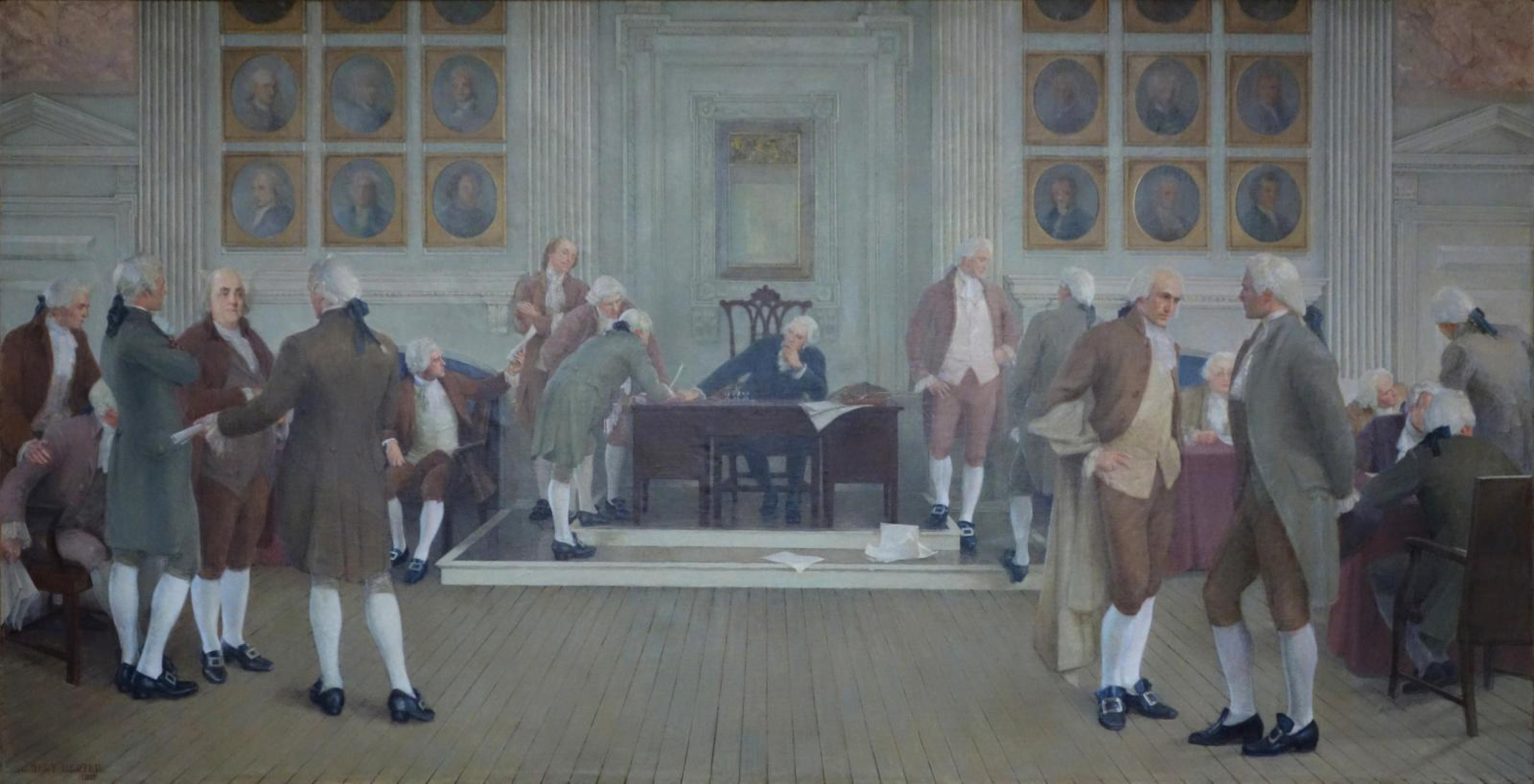
A famous exchange between Benjamin Franklin and the Philadelphia socialite Elizabeth Willing Powel, however, suggests that arguments about whether the United States is a democracy or a republic are barking up the wrong tree. “Well, Doctor,” Powel is said to have asked Franklin on September 17, 1787, the day the Constitution was signed, “have we got a republic or a monarchy?” James McHenry, a delegate from Maryland to the constitutional convention, recorded the elderly but still sharp Franklin replying: “A republic if you can keep it.” Note that Powel didn’t ask whether the signers of the Constitution had given us a democracy or a republic, and Franklin didn’t correct her question but answered with her terms. The lesson from Franklin and Powel’s exchange is that the key contrast in the eighteenth century wasn’t between a democracy and a republic, but between a republic and a monarchy.
It’s true that James Madison contrasted a republic with a democracy in the tenth and fourteenth Federalist Papers. But there are two reasons to resist the conclusion that he agreed with Mike Lee and the U.S. Embassy in Argentina. First, Madison focuses his discussion on what he calls “a pure democracy, by which I mean, a society consisting of a small number of citizens, who assemble and administer the government in person.” The distinction he draws is that, in a republic, the people “assemble and administer [the government] by their representatives and agents,” which allows a republic to be “extended over a large region,” as the United States would be. Second, the term “democracy” in Madison’s time wasn’t always pegged to pure democracies like the one in ancient Athens; it had a wider meaning. As the political philosopher Danielle Allen has noted, Alexander Hamilton, one of Madison’s collaborators in the Federalist Papers, described the system formed by the Constitution as a “representative democracy.” What’s more, James Wilson, a signer of both the Declaration of Independence and the Constitution, distinguished three “species of government”: monarchy, aristocracy, and “a republick or democracy, where the people at large retain the supreme power, and act either collectively or by representation.” Wilson’s classifying “a republick or democracy” as a single species makes the point clear that the concepts were not mutually exclusive.
The upshot is that we should stop squabbling over whether the United States is a democracy or a republic. It’s both! Instead, we’d do much better to ask: What is it to be “republican” in the sense intended not by President Trump or Senator Lee but by the framers of the Constitution?
There are two reasons to ask that question. First, it might help the saner remnants of the party of Lincoln begin to take back the term from MAGA. Second, as a political philosophy, republicanism is an attractive alternative not only to the cult of Trump but also to the excesses of wokeness and cancel culture on the progressive left. It’s therefore worth rediscovering.
At its origins, republicanism is Roman or, more precisely, neo-Roman, and a discovery and invention of the Renaissance and early modern period. Etymologically, a republic (res + publica) is a public thing or thing belonging to the people. Renaissance and early modern republicans, including the so-called commonwealthmen in England who influenced the American founders, took inspiration from Cicero and other defenders of the Roman Republic over and against Caesar Augustus and subsequent emperors. They weren’t primarily advocates of what came to be called the “freedom of the moderns”—the freedom to be let alone, or to do as you will. Nor were they interested in restoring the “freedom of the ancients”—that is, the freedom to participate actively in government, as the citizens of Athens did when it was a democracy. Instead, as the political philosopher Philip Pettit has explained in a number of books and articles, modern republicans were animated by a third conception of freedom: what they prized above all else was freedom from domination.
You lack freedom from domination when someone can arbitrarily direct or redirect the course of your life without your being able to do much about it. Subjection to such domination comes in degrees. An extreme example is a slave who is entirely subject to his or her master’s will, without any way to challenge the master’s orders. Someone who can be fired “at will” from her job, without cause and without protection, doesn’t have it as bad as a slave, but such a person still must be careful to please her boss and might even need to resort to the “bowings and cringings” that the poet John Milton—a prominent early modern republican—so despised. Importantly, you lack freedom from domination even if someone with the power to lord it over you chooses not to exercise it. From this point of view, the slave lacks freedom from domination even if his or her master is a paragon of benevolence.
“The representation of the people in the legislature, by deputies of their own election”—a.k.a. representative democracy—was, according to Alexander Hamilton, one of the means “by which the excellencies of republican government may be retained.” But republicans like him and Madison were also worried about the risk of domination through democratic rule, and that’s why they looked to other structures that Renaissance and early modern republicans discovered in the example of ancient Rome. These included, to quote Hamilton again, “the regular distribution of power into distinct departments” and “the introduction of legislative balances and checks.” Yet more basic was the rule of law, governing political elites as much as common citizens, and it was also crucial that people have mechanisms to contest policies and decisions bearing on their interests—not only through regular elections but also by such means as “the institution of courts composed of judges, holding their offices during good behaviour.”
As a political philosophy, republicanism might seem adequate for framing a system of government but not for galvanizing a political movement or formulating a policy program. There’s some truth to that view: the slogan “No Kings” expresses a refusal but no particular aspiration beyond that. Still, there was at least one other event in U.S. history, after the founding, when republicanism led to real change. That event was the founding of the Republican Party in the 1850s, in opposition to the expansion of slavery into new states and territories, which the Kansas-Nebraska Act of 1854 allowed. Not all early Republicans opposed slavery as such, but they feared that allowing slavery to expand into new states and territories would undermine the ability of white men to support themselves through free, independent labor, without depending on wages to make ends meet. The Civil War led Republicans to become more radical and to seek to dismantle slavery throughout the United States. A commitment to freedom from domination saved and eventually transformed the nation.
There’s obviously a lot more to say about that history, and perhaps there are other historical moments that illustrate the point just as well (for example, the women’s-rights movement that led to the Nineteenth Amendment in 1920, or the civil-rights movement that led to the Civil Rights Act of 1964). What’s important here is that republicanism has become relevant again. The Trump administration is obsessed with dominance: dominance in trade, dominance over allies and enemies alike, perpetual military dominance, dominance in AI, dominance over political foes, dominance over the Republican Party, dominance over the institutions of government, dominance over universities, and dominance over undocumented immigrants, who lack the standing to fight back and thus make for an especially attractive target. A movement committed to freedom from domination is urgently needed to push back against President Trump’s Caesarist pretentions and ambitions. It’s also needed to push back against the increasingly alarming AI arms race, which, as Pope Leo XIV remarked in his encyclical Magnifica humanitas, is “driven by the desire to secure geopolitical or commercial dominance” without regard for the common good. Further, republicanism undergirds arguments for greater workers’ rights against domination in the workplace. Finally, republicanism is no friend of cancel culture or the excesses of wokeness. Freedom from domination is freedom from having to bow, cringe, scrape, and fawn. It’s freedom to stand up for yourself. No one should glory in rudeness and invective, but everyone should be free to speak his or her mind.
In sum, republicanism is ripe for revival. As the end of President Trump’s time in office finally rounds into view, we must look for leaders who can help us keep the republic that the founders gave us. In the meantime, it’s republican in the original sense of the word to resist all domination, large or small. The difference that matters most now is not between lowercase-d democrats and lowercase-r republicans, but between a republic and a monarchy in disguise.
We welcome your comments about this article. Please send your response to [email protected].


