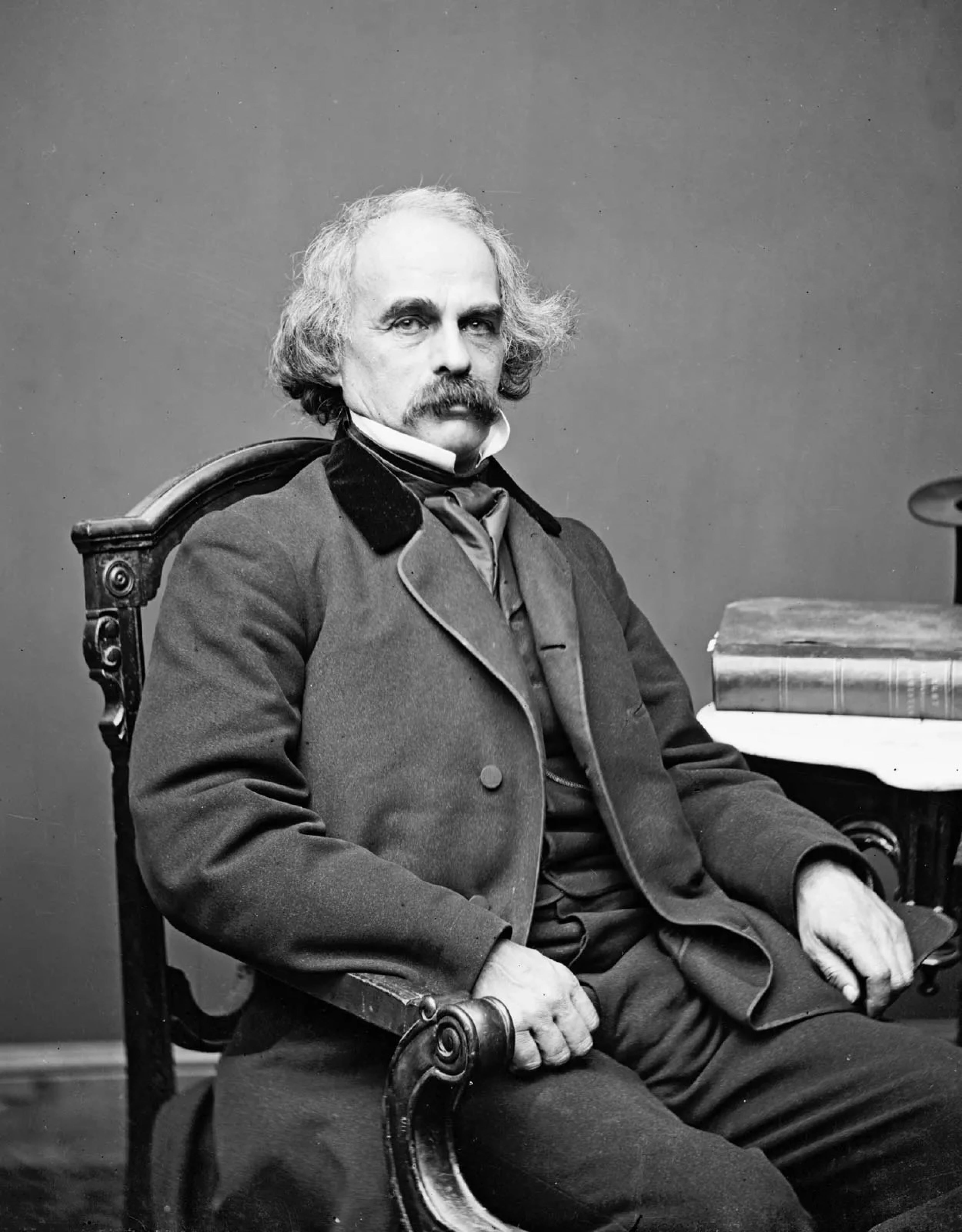
I don’t believe we read The Scarlet Letter in high school. At least I don’t remember reading it. When it came to morality tales, we did read John Knowles’s A Separate Peace, Hemingway’s The Old Man and the Sea, Twain’s The Adventures of Huckleberry Finn, John Hersey’s A Bell of Adano, and perhaps The Catcher in the Rye. If The Scarlet Letter had been assigned, I’m sure Nathaniel Hawthorne’s archaic style, with its endless subordinate clauses and ornate dialogue, would have defeated me. And I’m equally sure its allegorical intent would have escaped me. I needed symbolism to be as straightforward as Knowles’s fatal Tree of the Knowledge of Good and Evil, where the protagonist of A Separate Peace must finally confront his own sin. In a brief review of a newly published selection of Hawthorne’s Parables, Fantasies, Fragments (Library of America) in the October Harper’s, Dan Piepenbring warms to a youthful Hawthorne’s “gleaming strangeness, a morbidity, even a goofiness at odds with Hawthorne’s stuffed-shirt reputation.” He notes that Borges thought Hawthorne was “Kafka’s forerunner.” Hawthorne was not wrong, Piepenbring writes, “to see hell everywhere—to believe that, even in moments of redemption, we can find ways to cast our tortured shadows over the Godhead.”
I recently read The Scarlet Letter, and while I didn’t find it easy going, it is affecting and strangely powerful, especially the scenes between the adulterous couple, Hester Prynne and her tormented lover, the Reverend Arthur Dimmesdale. Hawthorne brings both the physical and spiritual Puritan world of Boston vividly to life. The wilderness looms both just beyond the town as well as in human hearts. Today’s novels are rarely filled with the kind of religious vocabulary Hawthorne uses to describe human nature and moral life—words such as “sin,” “penance,” “sanctity,” “consecration,” “soul,” “the judgment of Providence,” “spirit,” and “reverence.” Yes, there is even an element of “morbidity” in the way Hawthorne depicts how our spiritual health weighs heavily on our physical well-being. It is a world whose fixed morality and religious confidence exerts a powerful attraction, even though it seems far beyond the reach of contemporary American culture, which often scoffs at the notion of moral judgment, let alone damnation.
I have also recently read The Blithedale Romance, based on Hawthorne’s brief flirtation with utopian socialism, and parts of his “Notes on Travel,” regarding time spent in Italy in 1854. Visiting Siena, he is enchanted. “The life of today, within the shell of a time past, is wonderfully fascinating,” he writes. Siena’s cathedral, with its stunning black and white marble, mesmerized him, as it did my wife and me when we spent a few days there many years ago. “The architecture is generally of the pointed Gothic style, but there are likewise carved arches over the doors and windows, and a variety which does not produce the effect of confusion—a magnificent eccentricity, and exuberant imagination flowering out of stone,” Hawthorne writes. “A majesty and a minuteness, neither interfering with the other, each assisting the other; this is what I love in Gothic architecture.”
Hawthorne and his family also visited Siena’s Institute of the Fine Arts, where they came across a fresco by Il Sodoma of Christ bound to a pillar after being scourged. Hawthorne wrote,
I do believe that painting has never done anything better, so far as expression is concerned, than this figure. In all these generations since it was painted it must have softened thousands of hearts, drawn down rivers of tears, been more effectual than a million sermons. Really it is a thing to stand and weep at.
Hawthorne returns to the cathedral every day and watches a steady stream of penitents going to confession. He speculates that it must be tedious for the priests to listen to the “commonplace iniquities of the multitude,” but he has “nothing to say against the sincerity of this people’s devotion. They give all the proof of it that a mere spectator can estimate.” Here, Hawthorne seems less Kafka and more American egalitarian.
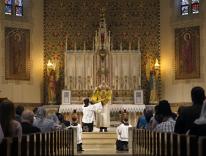
Hawthorne’s youngest daughter, Rose, was on the family sojourn to Italy, and the “magnificent eccentricity” of Italy’s Catholicism presumably made a lasting impression on her. I first heard of Rose Hawthorne in connection with my late colleague Pat Jordan, the longtime managing editor of Commonweal. Pat was a dedicated Catholic Worker, but he also spent a year working with the Hawthorne Dominicans, an order founded by Rose to care for indigent cancer patients. How did the daughter of America’s foremost novelist of New England Puritanism end up as Mother Mary Alphonsa? A difficult and ultimately failed marriage had much to do with it. Rose married the aspiring poet George Parsons Lathrop in 1871. During the marriage, she herself became a novelist. Their only child, Francis, died of diphtheria when he was five. Lathrop was depressive and alcoholic. The couple initially lived in New York City but built a house near the shore in New London, Connecticut, in hopes of improving Lathrop’s health. By some accounts, it was there in 1891 that the couple were received into the Catholic Church at St. Mary Star of the Sea Church—an impressive Gothic revival structure built in the 1870s but no Siena Cathedral. Lathrop founded the Catholic Summer School of America in New London the year after his conversion. But his health only worsened, as did his behavior toward Rose, and she separated from him in 1896. Returning to New York and taking inspiration from the death from cancer of a dear friend, Rose established what was essentially the first hospice in the United States. Lathrop died in 1898 at the age of forty-six, and in 1909 Rose made her final vows as a Dominican. She died in 1926, and in 2024 Pope Francis declared her Venerable. According to the Nathaniel Hawthorne biographer Brenda Wineapple, Rose believed “it was her father’s fine-grained appreciation of suffering that motivated her. ‘He was as earnest as a priest,’ she said, ‘for he cared that the world was full of sorrow & sin.’”
And so it is. In 1989, when I was a reporter at The Day, New London’s daily newspaper, I had occasion to visit St. Mary Star of the Sea for a funeral. I was covering the death of a young man, a graduate of St. Mary’s elementary school as well as the local diocesan high school where I had taught for a year. He had been a student at the high school when I was there, but I did not know him. He died when he was twenty-three years old of a drug overdose in the Plaza Hotel in New York City on New Year’s Day, which raised a host of questions. The previous night, he and a group of friends had attended a concert of the fabled blues-rock guitarist Stevie Ray Vaughan. The young man’s death was news because he had allegedly been a minor drug dealer in the New London area and charges were pending against him. At the Mass, the priest preached a tough sermon about the dangers of drugs. U2’s song “Bad,” about heroin addiction, was played for the distraught congregation at the end of the service. “If I could, through myself, set your spirit free / I’d lead your heart away, see you break, break away / Into the light and to the day,” U2’s lead singer Bono exclaims somewhat cryptically. As if in reply, Bono goes on: “If I could, you know I would / If I could, I would let it go.”
That young man’s terrible fate seems emblematic of Hawthorne’s conviction that we “find ways to cast our tortured shadows over the Godhead.” Facing such tragedies, Hawthorne’s archaic language seems more honest and consoling than any rock lyric. Traditional Christian prayer, forged in centuries of loss and hope, speaks to us in ways contemporary laments rarely can. In his final confession and moment of redemption, Dimmesdale earnestly beseeches Hester “in the name of Him, so terrible and so merciful, who gives me grace, at this moment, to do what—for my own heavy sin and miserable agony—I withheld myself from doing seven years ago, come hither now, and twine thy strength around me! Thy strength, Hester; but let it be guided by the will which God has granted me.”
For better and worse, Hawthorne’s language is a thing of the past. But it might be useful to recover the notion that God can indeed guide our will if we are open to such promptings. There is still a magnificent eccentricity and exuberant imagination at work in that spiritual world, whether in Salem, Siena, or even New London.
We welcome your comments about this article. Please send your response to [email protected].