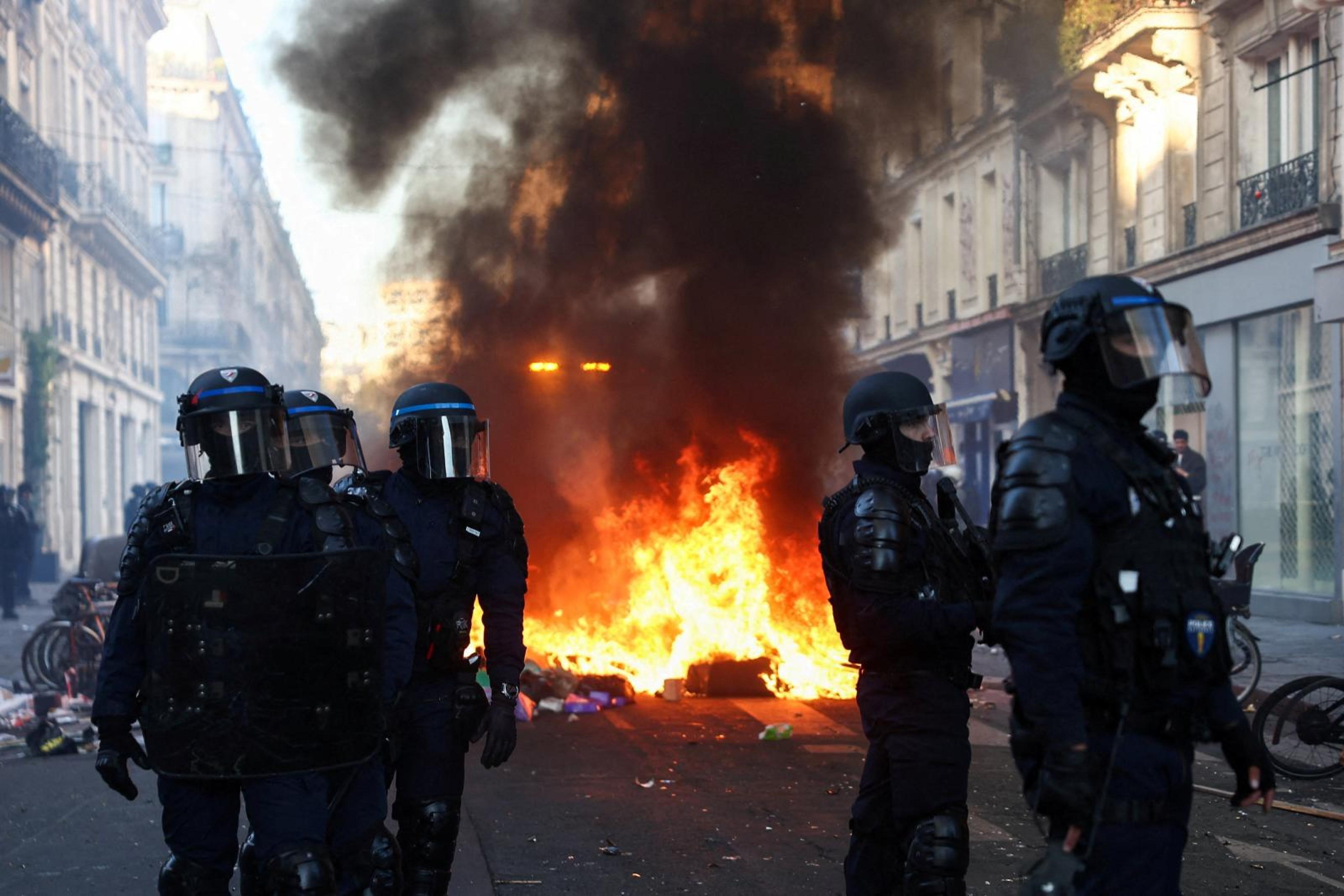
Extraordinary scenes of social unrest and urban violence in France have been interpreted in ways that are exasperatingly predictable. Progressives denounce the repressive tactics employed by the French state and police brutality, including the use of foam-round launchers and sound grenades. Conservatives express outrage at attacks on private and public property, which they blame on mass immigration, elite wokeness, and leftist nihilism. Yet underlying the partisan concerns is a deeper problem, which, at least in principle, should be coded neither “left” nor “right.” France is undergoing a crisis not only of the state but of authority as such—both things that have been central to France’s democratic identity.
The claim that the country is undergoing a crisis of the state has been proposed by many of France’s political actors in the wake of the recent unrest. France’s prime minister, Sébastien Lecornu, responded to the scenes of devastation from across the country by saying: “France needs to be commanded.” Raphaël Glucksmann, the candidate of the Socialist Party in next year’s presidential election, denounced the “impotence of the state,” adding: “It is not possible that a great power like France be brought down to the level of what we saw on Saturday and Sunday evening across our territory.” Marine Le Pen, the leader of the right-wing National Rally, who is comfortably ahead of the other presidential candidates in the polls, declared: “We are faced with a collapsing state.” After the French police’s failure to plan for the widespread vandalism and looting that occurred on October 17 and 18, some have warned that shopkeepers and small-business owners may start taking matters into their own hands during demonstrations expected in the next few weeks.
Talk of a “crisis of the state” and of declining respect for authority might seem inherently conservative, but it shouldn’t: modern democracy is inseparable from a robust conception of the state. Historically, France has been the Western country most committed to the connection between democracy and a strong state. The 1789 Declaration of the Rights of Man and the Citizen declared: “The principle of all sovereignty resides essentially in the nation,” adding that “no body nor individual may exercise any authority which does not proceed directly from the nation.” France’s current constitution, which went into effect in 1958, states: “National sovereignty shall vest in the people, who shall exercise it through their representatives and by means of referendum,” emphasizing that “no section of the people nor any individual may arrogate to itself, or to himself, the exercise thereof.”
When we think of liberal democracies, we tend to think of personal freedoms enshrined in constitutions and the right to vote. But as those French documents remind us, democracy also defines a source of authority: popular sovereignty, which means a state conceived as a vehicle through which the people can act. This may explain why, for much of its history, France has been accused of prioritizing state authority at the expense of civil liberties. But at present, in France the authority of the democratic state seems severely wounded. For those concerned for the health of liberal democracy, this is bad news indeed.
The crisis of the state is apparent, in the first place, on the French left, particularly in the political party that stands accused of fomenting the high-school students movement and creating the conditions for the mass vandalism that occurred on October 17 and 18. That party, La France Insoumise (“Unbowed France,” or LFI), is difficult to classify, as it blends economic populism with a strong emphasis on culturally progressive attitudes, most evident in the way it claims to prioritize the struggle of racial minorities and immigrants. But while advancing those causes, it has increasingly veered toward questioning the current French state as a framework within which grievances can be settled. The party’s leader, Jean-Luc Mélenchon, once declared “il faut tout conflictualiser”—“everything must be conflictualized.” His strategy has consisted in identifying the fault lines in French society—between the people and elites, the haves and have-nots, the white majority and “racialized” minorities—and accentuating them to provoke political contestation.
Other members of his party have followed suit. Raphaël Arnault, an LFI member of parliament, is the founder of an antifa group, the Jeune Garde antifasciste (the Antifascist Young Guard), that was implicated in the murder of a far-right student in Lyon earlier this year. Some LFI members have explicitly denounced the nature of the French state. Rima Hassan, an LFI member of the European Parliament, has referred to France as a “racist state that downplays or even glorifies its colonial past” and as a “police state.”
LFI in general and Mélenchon in particular were not always so openly hostile toward the state. Mélenchon was once a hardcore republican, a staunch defender of the secular democratic state as the lever for transforming society. Even now, LFI harks back to the revolutionary tradition in favoring a parliamentary republic—rather than the existing republican regime that places great power in the hands of the French president—that would tax the rich and redistribute wealth. Yet LFI has made a strategic decision to appeal to students and racial minorities rather than to what remains of the working class, which it has largely ceded to the National Rally. Those alienated populations—and the educated classes that most often act as their champions—see France as a society steeped in “systemic racism” and enmeshed in its colonial past. Such an analysis can lead to the conclusion that the French state is not primarily a potentially beneficial force for change, but the root of the problem. LFI’s political strategy has thus undermined its attachment to the leftist conviction that the state itself can be a vehicle for social change.
LFI members were also involved in supporting the high-school protest movements that began in early October. To be sure, LFI often raises legitimate issues, such as the students’ concern about dilapidated schools, classes without teachers, and a dysfunctional web portal for applying to college. Yet those issues often get buried beneath LFI’s relentless efforts to ramp up political conflict. For instance, on October 1, Ritchy Thibault, an activist in his early twenties who has served as an adviser to an LFI member of parliament, used a bullhorn to declare at an occupied school: “Today, we have taken the high schools. Tomorrow, we will burn down the Elysée”—the French presidential place. Philippe Poutou, a Trotskyist whom LFI supported in parliamentary elections, proclaimed in a recent tweet that in addition to backing “protestors” and “youth in revolt,” it was necessary to support “rioters” (émeutiers) and “disorder.”
There has been much debate in France about the relationship between LFI and the casseurs—the “breakers” or criminal elements responsible for the widespread physical destruction in many French cities on October 17 and 18. LFI claims that it has been unfairly blamed for the riots, which do not seem to have been the work of LFI or the high-school protestors. Still, it seems plausible that the party’s incendiary rhetoric has fanned the flames of revolt.
Whoever is ultimately responsible, the riots have resulted in considerable handwringing about the nation’s moral climate. The French political scientist Jérôme Fourquet cites studies showing that 21 percent of members of Gen Z believe that violence is a legitimate way to pursue one’s political goals. The French prime minister announced that during the high-school protests, 149 teachers and staff had been injured (not always by students), one of the highest ever tolls for a movement of this kind. On-the-ground reports recount the indifference of young people to the looting of stores, including a story from the Figaro that describes a fourteen-year-old who was offended when she was called out for taking a video game outside a pillaged shop: “Why are you attacking me?,” she protested. “Don’t talk to me like that.… Anyway, it was already on the ground, it was in the street.”
All this represents a striking departure from a longstanding French tradition of respect for the state, which is particularly entrenched on the left. France is, of course, associated in the popular imagination with revolution. But French revolutions have, historically, been highly political affairs, and were never primarily about sowing chaos. The Jacobin ideology maintains that, to reform society, one must first take the state. Revolutionaries have often sought to distinguish themselves from mere apolitical looters. The historian David Pinkney describes how, during the 1830 revolution, a group of revolutionaries organized to protect the Louvre’s priceless art collection, even as the neighboring Tuileries Palace was pillaged.
Even in nonrevolutionary situations, the French left has achieved its greatest victories by leveraging the power of the state. During the Third Republic (1870–1940), champions of French democracy blanketed the country with a network of publicly funded elementary schools to ensure that the population would embrace republican values. Schools are important not only for the education they provide but also as the essential institution of French democracy—the achievement that ensured that democracy would last. This is why the attacks on teachers and the destruction of schools are so shocking: they are a direct challenge to the lofty stature of education in France’s republican tradition.
The idea of laïcité—France’s distinct conception of secularism—is also founded on the belief that the state is so central to society that it can never be confused with religious institutions. Indeed, French republicanism as such has often functioned as a de facto civil religion, with the state assuming a transcendent quality that was formerly reserved for the Catholic Church. Americans frequently default to the idea that the state is at best a necessary evil—that “society is produced by our wants, and government by our wickedness,” as Thomas Paine put it. French republicans, to the contrary, have long endorsed an extremely positive idea of the state, conceived as the optimal mechanism for achieving equality and social solidarity. In fact, classic liberals have long complained that the French are too fond of the state. LFI’s recent activism has been anomalous: rather than making control of the state the goal of political struggle, it increasingly seems to condemn the state as hopelessly corrupt; rather than emphasizing its ability to run the state, it seems intent on engaging in disruption that makes a functioning state all but impossible.
The irony of LFI’s efforts to undermine the state is that those tactics were once embraced by the far right (though they have also been promoted by the anarchist left from time to time). On the night of February 6, 1934, a mass demonstration of fascist movements culminated in an unruly attempt to seize control of the French parliament. In the postwar years, fascist student organizations would sometimes fight leftists in street battles. The National Front—the forerunner of Marine Le Pen’s National Rally—was founded by figures with overt ties to fascist movements and even to the German Occupation of France. Its longtime leader, Jean-Marie Le Pen (Marine’s father), was an enthusiastic street brawler who frequently engaged in physical altercations over his long political career, including one incident when he was nearly seventy. Le Pen’s proclivity for violence captured something about the nature of his politics. He presented himself as a defender of the nation and as someone who was convinced that the laws of the Republic did not exist to protect the French race. Even as he ran for office and made his party increasingly central to national politics, he embodied, however discreetly, the antirepublican and antidemocratic instincts that long defined the far right.
Under Marine Le Pen, the National Rally has tried to clean up its image, “de-demonizing” itself in an effort to prove that it is no longer the party of Le Pen senior. Not only has the party softened its image (while doubling down on its nationalist and anti-immigrant message); it has also embraced the republican ideology that had long been the preserve of the left. And it has done so precisely as the far left was becoming increasingly hostile toward the Republic, denouncing it as a political relic built on systemic racism, colonialism, and sexism.
That is what makes the present situation so remarkable. On October 18, Marine Le Pen posted a speech to her party’s website denouncing the weekend’s chaos. She expressed outrage that the “most sacred symbols of our republic were profaned” and the “authority of the state defied.” Behind the buildings that were attacked was a history that, she claimed, brought French people together regardless of their opinion (she compared, in passing, the vandalism to the fire that severely damaged Notre Dame Cathedral in 2019). She called upon French people to embrace “republican restraint.” She asserted that France was experiencing a “crisis of authority” that constituted a serious “threat to democracy.” She called for the return to “republican order,” adding: “There is no freedom without security. There is no justice without authority.”
Of course, many wonder how sincere the National Rally’s belated conversion to the French conception of democracy really is. And many doubt whether a party that has long been a vehicle for expressing popular resentment can govern effectively in such trying times. In any case, it is sobering to observe that Marine Le Pen’s speech sounded like one that could have been made by the left until recently. For the left, the republic once meant a state based on popular sovereignty that protected democracy and personal freedoms and ensured security and justice. The recent violence in France has revealed that much of the left—including its most popular presidential candidate—is now ready to jettison the very ideas that, for much of its history, ensured its success and legitimacy. But the value of the democratic state is too important to abandon to the right. The left must correct course for its own good and for the good of the French Republic.
We welcome your comments about this article. Please send your response to [email protected].