Why do so many Americans assume that kids don’t like to eat most foods? The offspring of the species Homo sapiens are not naturally picky. Nor are American children naturally pickier than other children. Pickiness is not natural at all, but a consequence of human choices and habits, which means humans can act to change it.
In her excellent book, Picky: How American Children Became the Fussiest Eaters in History, Helen Zoe Veit starts by surveying a reality familiar to those who spend time at children’s tables. American children now default to bland, overprocessed, and unhealthy foods. Pediatricians attest to the sorry consequences: nearly half of American children carry extra body weight, and obesity-related diseases have been rising. Veit does not fault kids, hers or yours, for poor eating habits, nor does she fault parents. Instead, she blames a culture that normalizes the behavior and marketing that makes it hard to resist. She shows how pickiness hurts children—compromising their health and denying them pleasure—and hurts parents with worry and guilt.
But some of the consequences of pickiness are even worse than the ones she highlights. As a cultural pattern, pickiness teaches entitlement, waste, and neglect of the poor. Whatever harm it does to the body, it also hurts the soul.
Veit tackles her serious subject with a light touch. Readers may be attracted to Picky because they’re seeking practical parenting advice, but this is not that kind of book. Its rewards are much richer. This is academic history as high art, executed so deftly that its impressive assemblage of facts never interferes with the reader’s enjoyment. Veit could be credited with tucking her scholarly apparatus out of sight—her substantial notes are lodged discreetly in the back of the book—but even these are fun reading. One note is about Mark Twain shelling hickory nuts; another refers us to a 1960s “Motivational Research Study of Luncheon Meats and Wieners.”
Picky is another in a long series of best-selling critiques of American food systems. The genre’s most popular writers, like Michael Pollan, Marion Nestle, and Mark Bittman, have been proclaiming for decades that food matters because it is connected to everything else, including labor, agriculture, environment, inequality, and health care. Veit adds parenting to this list. She uses grocery-aisle struggles to assess “child-centered” parenting trends that often seem designed to make mothers in particular feel inadequate. “Maybe It’s Your Fault,” a 1930s newspaper headline told parents who were worried that their children didn’t want to eat.
By lavishly documenting children’s eating habits in earlier periods of the country’s history, Veit proves that pickiness is a twentieth-century invention. She explains how the cumulative errors of experts and advertisers gradually formed our current assumption that it is normal for kids to be picky. By showing readers exactly how the conventional wisdom was constructed, she also shows them how it can be disobeyed and dismantled.
American kids used to love to eat. North or south, rich or poor, “almost everyone assumed that children loved to eat.” They loved to eat because food was good: “Happy childhood omnivorousness was remarkably consistent across the nineteenth century.” Children also loved to eat because they had big appetites. Everyday life required more physical exertion. Children walked long distances rather than riding in cars. They did heavy chores. When they sat down to dinner, they were hungry. Kitchen architecture ruled out most consumption between meals. Even well-stocked pantries held mostly raw ingredients. Cooking required considerable fuel and time. Without refrigeration, leftovers were hard to store. Children ate with adults, they ate what adults ate, like squash pie, fried parsnips, and cold jellied brain. They loved coffee. They craved vegetables and fruit. Oklahoma children were “so eager for greens after a long winter, for instance, that they stood on boxes to munch the sheep sorrel growing out of their home’s sod roof.” Children savored spicy and fermented foods.
The declension narrative Veit presents is not linear. What went wrong with American kids’ food cannot be attributed to one bad idea but rather to a cascade of bad science and unscrupulous commerce. First, well-intentioned reformers in the late nineteenth century began to frown on kids’ lusty appetites, insisting that the delicate digestion of the young demanded gentle nourishment. They advised kids to eat the kind of food suitable for the sick, including “Asses’ Milk, which is just what it says…. Cookbooks also provided recipes for Imitation Asses’ Milk for those who didn’t have access to a lactating donkey.” But cows’ milk also had a good reputation and a much wider ambit. Progressive reformers touted milk as a near-perfect food and urged parents to give kids cups of it with and between meals.
Ironically, America’s first mass outbreak of pickiness came during the Depression. In 1930s households, children who were offered bland dinners began to demur. They said they weren’t hungry. Veit thinks this was partly because their stomachs were full of milk and their days had become less active. In any case, this behavior was then a privilege reserved to wealthier children, but soon “pickiness would get a lot more democratized in the coming years.”
Two events in the 1940s exacerbated the shift. First, Dr. Clara Davis argued that toddlers would spontaneously select a healthy diet when offered a range of unseasoned foods like barley, beets, bone marrow, and turnips. Then, Dr. Benjamin Spock’s blockbuster manual smuggled Freudian theories into Baby Boomer parenting. Spock warned moms not to fight kids over food since young ones who refused liver or cauliflower were struggling for control. Parents should not force or worry. Kids would learn to eat properly by around the age of two. Veit is careful to note that neither Spock nor Davis claimed children had age-specific tastes or should be indefinitely offered separate foods.
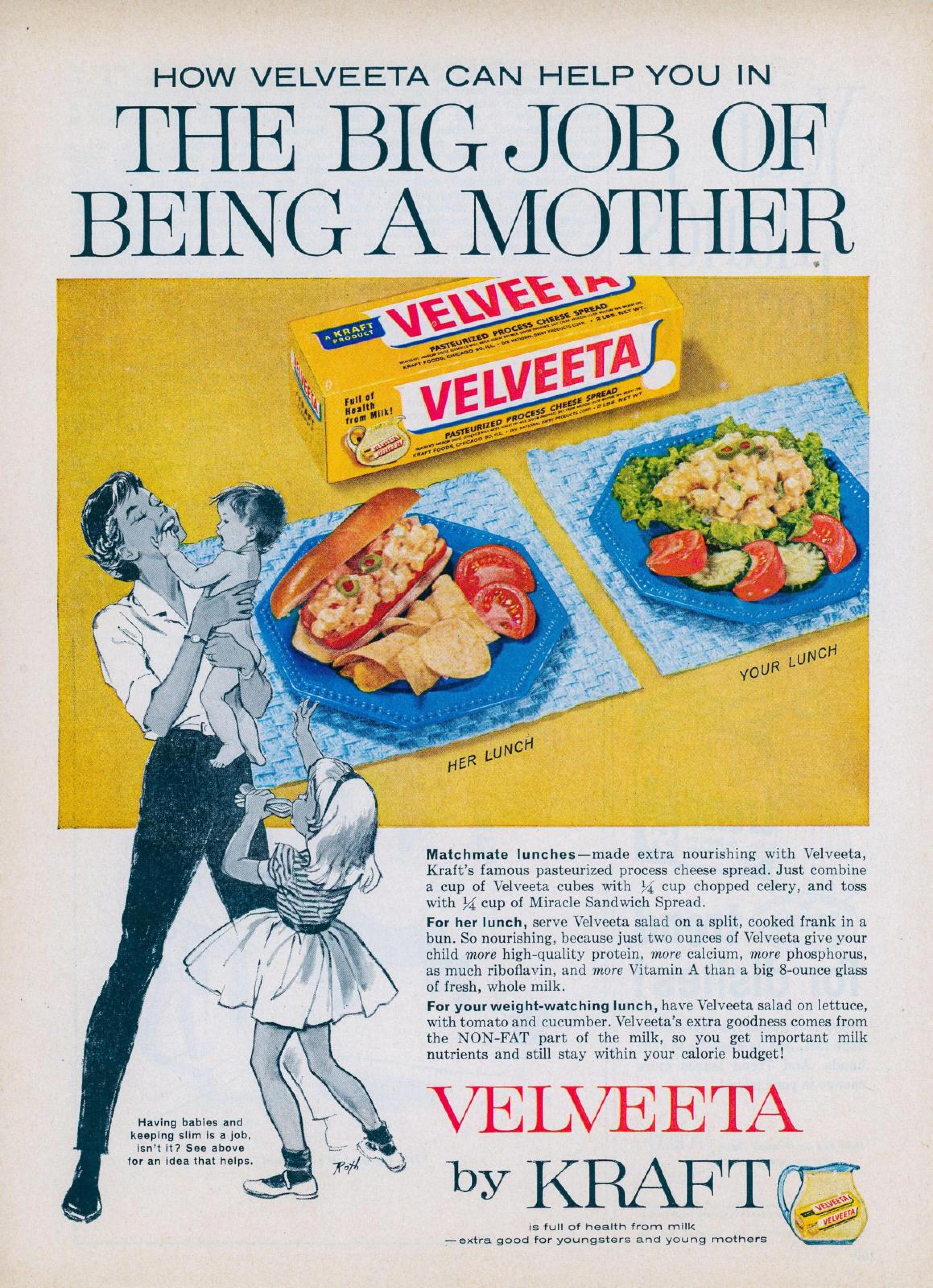
Meanwhile, manufacturers had begun stocking American pantries with crackers and cookies. When television brought the allure of processed food into American households in the 1950s, advertisers met a young audience ripe for persuasion. Popular misinterpretations of Spock and Davis told parents to let kids choose their own food because they would choose the right things spontaneously. Veit quotes a 1947 guide opining that children are “much better nutritionists than the average mother.”
Of course, kids did not end up making spontaneously healthy choices. They did not, because they had been commercially tutored to choose junk. Preservatives and refrigeration meant that processed foods were always at the ready, which prompted the new expectation that moms individualize meals: each member of the family could eat a different thing according to preference and schedule. Parenting developments urged mothers not just to nourish children but to please them, an imperative captured by a famous television commercial for a breakfast cereal: moms knew they could make their kids happy if they bought what even Mikey liked.
Dietary guidelines and industrial agriculture complicated parents’ task yet further by separating healthy foods from the ones kids were thought to want. In the very old days, children’s menus tended to be smaller portions of foods offered to adults. Veit cites one evocative example: “Creamed Calves’ Brains on Toast, Stuffed Prune Salad, Lima Bean Casserole, Red-Hot Bananas, and Liver-Paste Sandwiches.” Near the turn of the twenty-first century, the theory that young taste buds could not handle adult flavors led to the kind of children’s options we’re all familiar with: chicken nuggets, macaroni and cheese, hot dogs, and naked pasta.
It is easy to agree that pickiness is a problem but harder to explain why. If the problem is that picky kids are hard to feed, we might see pickiness as a kind of animal dysfunction, but Depression-era parents who witnessed the initial spike in pickiness thought the problem went beyond bodily health. Unlike moms and dads now who take this behavior for granted, “some 1930s Americans saw pickiness as a moral problem,” Veit observes. This marked a drastic turn from the late nineteenth century, when commentators disapproved of children’s excessive enthusiasm for food as beastly, “indiscriminate,” or “promiscuous.” From one point of view, pickiness can even look a little like self-restraint, which we still consider a virtue. But in fact, in traditional moral terms, pickiness is a species of gluttony. That may seem counterintuitive, since we usually think of gluttony as overconsumption. But the vice, defined as a disordered relationship with food, also covers fastidiousness. Pickiness is less a purely physical revulsion than an act of entitlement. It’s not that a choosy child doesn’t want to eat; it’s that he wants to eat only the things he feels like eating. Any particular child may push peas around their plate without attracting social criticism, but a culture normalizing such behavior deserves plenty of criticism.
In any case, pickiness does entail overconsumption because it presupposes a willingness to waste. As Veit writes, “Modern children’s food was a new kind of cuisine. It was premised on superabundance and psychological freedom, and it was defined by pickiness and waste.” The implications of that pairing, pickiness and waste, deserve further emphasis. In the middle of the last century, mothers told kids to clean their plates because children elsewhere in the world were starving. This mealtime strategy has fallen out of fashion, damned for inflicting psychological harm and using poverty as a rhetorical cudgel. But at least that old admonition kept the hunger of others in the sightline of affluent dinner tables, and reminded children that billions share this small planet.
Veit notes that some American children, due to race or region or immigration status, could never afford to be picky. The 1968 documentary Hunger in America startled viewers because such privation was “so far from most Americans’ personal experiences.” At that time, 95 percent of Americans had enough to eat; the hungry 5 percent were outliers. More Americans are hungry today, Veit observes, and many poorer Americans who are obese are in fact malnourished, subsisting on cheap empty calories.
Though the purpose of Veit’s book is not to teach parents how to feed children better, she does venture some practical suggestions in the epilogue. These include limiting snacks and helping kids try new foods. “Most crucially of all, be confident,” Veit enjoins, because parents who “have confidence in their children’s ability to love the same foods they do” encourage them to be happier and healthier. Confidence is helpful but insufficient. It is both too sanguine a hope and too timid an aspiration. If pickiness is the product of a massive industrial food system, as Veit argues, then parents’ personal faith in their kids’ receptivity will not be enough. Some parents will struggle to push their offspring past kid-menu boundaries because their own habits were defined by them, or because they lack the culinary skills to offer their children a varied and challenging diet. Parents whose kids do eat kimchi, cacio e pepe, pakoras, yuzu, or nigiri may feel smug when they watch other people’s children guzzle soda and gobble nuggets. In twenty-first-century America, food, like nearly everything else, quickly becomes a signifier of status. Kids with adventurous palates can be evidence of a family’s travel experience and household income. But whether their tastes are narrow or broad, American parents and children alike err in assuming that they deserve to eat whatever they want, whenever they want. Don’t yuck their yum, or yum their yuck.
Evaluating pickiness as a lapse of temperance or justice is one admittedly didactic way to read this fine book. But Picky also can be read as parable: what goes sideways with children’s diets mirrors what goes sideways with America otherwise. One key theme of Veit’s narrative is “abundance,” her choice of this resonant word predating its prominence in current political discourse. Veit’s nineteenth-century children saw food the way nineteenth-century writers (and even some later ones) saw America. So much! So big! In this telling of the American story, refugees from scarcity arrived to a land of abundance. Here people could enjoy more than they ever would have in their old countries. Plenty was not zero-sum. There was enough food to go around, and rich and poor harbored similar desires. Of course, enslaved children or those living in poverty did not enjoy all that others took for granted, but they were not excluded from this vision of plenty. Children from economically marginal families even seem to have kept healthy appetites longer: a midcentury Mexican boy in Los Angeles savored goat and chiles, while a West Virginia boy ate vegetables from his garden and recalled, “Maw’s cooking was so good it would make you get down and pound the floor for joy.” Social and geographic mobility preserved culinary variety, but omnivorous appetites crossed socioeconomic lines. In the past, “children’s eagerness to eat was a cross-class phenomenon then, just as pickiness is a cross-class phenomenon now.” At least among children, food cultures were permeable and generous, with recognition that your grandma and mine both cooked something good. Americans were like that lucky person standing first in line at a well-appointed church potluck.
This country of hearty appetites was diverse, egalitarian, accommodating. In the old world, only the few could ever expect to savor those foods, but here, the many could enjoy them. Focus on children’s food habits in particular allows Veit to get at a kind of prelapsarian pleasure that celebrates the good of creation without scruples. Americans once assumed that children’s “cheerful, curious omnivorousness was in the natural order of things.” What happened next was a self-inflicted wound. Reductive science, manipulative advertising, and misused technology spoiled not only healthy appetites but the food that was the source of our health. Profit-seeking turned abundance into excess. What a shame it is to have created a food culture that takes the real pleasures of eating away from children by appearing to offer them more of what they want and less of everything else. Americans feed children badly in obedience to a false set of “best practices” that were always dubious. That conventional wisdom wastes money, misallocates resources, hurts the planet, and sickens children. But Veit cuts clean through the knot. Those ideas are wrong. They can be tossed away like yesterday’s yogurt pouch. Why spend money on what isn’t bread and fails to satisfy?
Picky
How American Children Became the Fussiest Eaters in History
Helen Zoe Veit
St. Martin’s Press
$29 | 304 pp.
We welcome your comments about this article. Please send your response to [email protected].