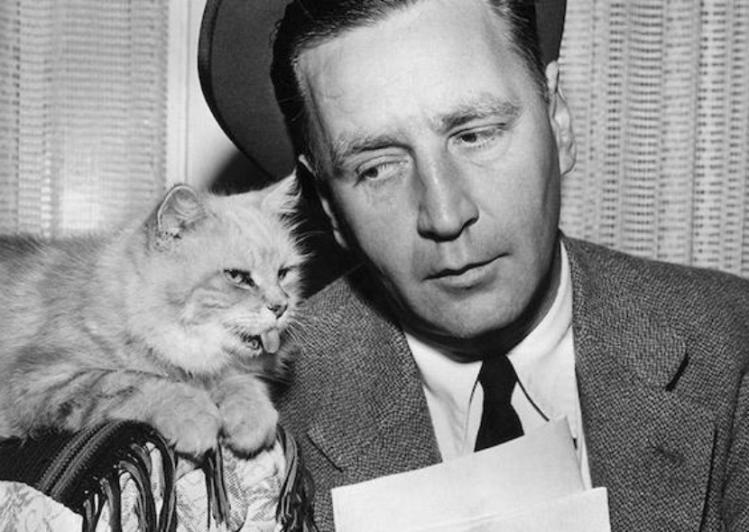
Jim Thompson, the most detectably modernist, entertainingly ludicrous, and titillatingly depraved crime novelist of the twentieth century, hit upon his working method in the early 1930s as he submitted story after story to the serialized pulps and true-crime magazines of the era. He’d comb the local newspapers of the provincial Midwest and repurpose crime reportage as first-person narrative, casting himself as the murderer, the victim, or sometimes both. If a magazine requested images, he’d submit a photograph of himself, his wife, or his mother lying face down in a Nebraska ditch, playing the corpse.
Robert Polito corroborated, contextualized, and deromanticized these and other of Thompson’s writerly idiosyncrasies in a 1995 biography suitably titled Savage Art—a magisterial reconstruction of Thompson’s life and times from his Oklahoma-frontier childhood to his final days in Los Angeles. Polito, himself a writer and poet, used the above bit of information to illustrate the unnerving proximity to his characters that Thompson would establish—narrating their trials and travails in first person from beyond the grave or across the divide of a split personality. Polito also chronicled Thompson’s time in the oil fields, the failed movie house he ran with his father, the failed independent oil rig he ran with his father, the lucrative lunch counter he ran with his mother, his membership in the Industrial Workers of the World, and his leadership of the Oklahoma Federal Writers’ Project. Having established such a degree of proximity to his subject, it’s fitting that Polito is the editor of the newly released compendium of Thompson’s work from the Library of America: Jim Thompson: Five Noir Novels of the 1950s & 60s, an illuminating volume that also includes selected early sketches and writings.
It’s a worthy tribute to Thompson, whose career stalled at the crossroads of critical acclaim and economic stability. His books have fallen in and out of print, boosted by French publishers in the 1950s and ’60s, reissued by Barry Gifford’s Black Lizard imprint in the 1980s and ’90s, and currently available from Mulholland Books, with laughably mismatched covers that present Thompson’s sniveling psychopaths as dapper, fedora-wearing dead shots. Generations of new fans and film adaptations from Bertrand Tavernier, Sam Peckinpah, and Stephen Frears have given Thompson a legitimacy that eluded him during his lifetime. Now, the Library of America acknowledges his place in our country’s literary history.
Some of Thompson’s early short fiction and his 1949 Nothing More Than Murder appeal to aficionados like Polito and me, but 1952’s The Killer Inside Me announced the author’s creative arrival—and the arrival of what would become one of his archetypal psychopathic protagonists. Yet just twelve years later, Thompson’s career would flame out with the publication of Pop. 1280 in 1964. Both of these are included in Library of America collections, but others from this period are not—such as 1953’s The Alcoholics, a sort of proto-Cuckoo’s Nest set at a hard-up sanitorium called El Healtho, and the head-spinning The Nothing Man (1954), which Polito hails as a masterpiece in Savage Art. Although Polito hopes these novels, along with 1953’s Savage Night and The Criminal, get their own reissues, something like The Nothing Man would likely have capsized the already teetering compendium and pulled it into a vortex. Such a work is probably better left out. Also not included, for perhaps obvious reasons, are the paperback-pandering and halfhearted contractual assignments Thompson undertook, which are awash in titillation and depravity to the exclusion of all else.
Even so, the new volume confronts the reader with quite the opening salvo on page one, with the first paragraph of 1954’s A Hell of a Woman.
I’d gotten out of my car and was running for the porch when I saw her. She was peering through the curtains of the door, and a flash of lightning lit up the dark glass for an instant, framing her face like a picture. And it wasn’t a pretty picture, by any means; she was about as far from being a raving beauty as I was. But something about it kind of got me. I tripped over a crack, and almost went sprawling. When I looked up again she was gone, and the curtains were motionless.
Thompson’s prose is at once both clipped and breathless, with a disorienting twist of the gothic that sinks the story deeper into the ugliness that the narrator, Dolly Dillon, speaks of. Dolly is a sorry salesman for the wonderfully dubbed Pay-E-Zee Stores—barely making ends meet, drawing his paltry income by foisting dubious installment plans on unwilling patrons, and then acting as his own strongarm collections agent. So when that face, “like a picture,” opens up the possibility of an “ethical” murder, with plenty of cash in the offing, the fraying salesman jumps at the opportunity. Later, he devolves into pure madness. Thompson conveys this through a remarkable typographical experiment, oscillating wildly between two streams of text that interrupt one another, one in italics, one in standard type.
The best noir is propelled by impulsivity and desire rather than mystery––see James M. Cain or Charles Willeford––and many of Thompson’s protagonists and narrators are all too willing to insert themselves into the wrong place at the wrong time. Consider this from 1955’s After Dark, My Sweet: “I was breathing a little hard, but that was all right. It was good to have done something to breathe hard about.” That’s William Collins, ex-boxer and drifter, who, with alarmingly calm positivity, gets himself involved in a doomed kidnapping scheme. Shootouts and chases abound, but After Dark, My Sweet is as affecting as it is for how long it mires itself in the doldrums of criminality: halfhearted sex, jugs of wine, and household chores around the kidnappers’ hideout in the tall grass of an unnamed Midwestern township. “I picked my way down the lane, taking a sip from the bottle now and then. A couple of times I stumbled and fell down, but it didn’t bother me much. And it didn’t seem dark, but light.” Thompson daubs this monotony with strange surrealist touches, like a verbose, chain-smoking elementary schoolchild, or the culminating death drive that makes it seem as though the novel has shed itself of its own events, carrying on into a netherworld where the rules of reality are suddenly blurred (a thrilling trick Thompson often returned to).
Next come two novels that had high-profile film adaptations: 1959’s The Getaway, later a Steve McQueen vanity project directed by Sam Peckinpah in 1972, and 1963’s The Grifters, the basis for Stephen Frears’s 1990 film of the same name. The novels aren’t ideal as models for adaptation, both too fidgety and reckless to be tamed by star-vehicle treatment. The Getaway moves in fits and starts, and on multiple occasions it threatens to halt the flight of its title in its tracks—as when the fugitives take shelter in a hideout made only of manure. The Grifters details the nightmarish oedipal competition of mother and son in the carrying out of a petty scheme, and how it strains their relationship to the point of the two being bound only by the grift. “Roy reddened. He asked troubledly if every city was like this. Did you have to keep jumping from place to place, using up your capital and having to move on just about the time you got to know your way around?” Neither novel features the first-person-narrated psychosis of the other novels, though Thompson’s omniscience is plenty calculating and cruel in its own way.
The collection ends really the only way it could, with 1964’s Pop. 1280, Thompson’s last noteworthy novel. He was mostly a writer-for-hire after that, toiling away in television scripts and movie tie-in novelizations. But whether he intended it or not, Pop. 1280 proved a fitting capstone, a variation of The Killer Inside Me’s cold, murderous intelligence masquerading as podunk obliviousness, transported back to the early twentieth century. Narrated by first-person protagonist Nick Corey—the lightly regarded sheriff of a tiny Southern town—it can seem like a forerunner to the work of David Lynch, with broad humor and cartoonish set pieces overlaying the evil lurking below. In fact, Thompson returning to the past to capture a flashpoint of pure evil so late in his career is not unlike Lynch momentarily rewinding his Twin Peaks: The Return to the Trinity nuclear test of 1945. Lynch, born in 1946, has images of nuclear annihilation impressed on him from birth; Jim Thompson, born in 1906 over a county jail, came of age in the milieu of frontier law and politicking as embodied by his father, “Big Jim” Thompson.
Big Jim’s ghost frequently worked his way into Thompson’s novels, but Corey is probably his most explicit analogue. Corey’s comical gluttony and adolescent taste for pranks are juxtaposed with his insatiable sexual appetite. He brushes off the petty insults directed at him with an at-hand response: “Well, I ain’t saying you’re wrong, but I ain’t saying you’re right, either.” But an ominous inner voice promises the vengeance that will be brutally meted out: “Well, I’d know what to do about him. I always know.”
As the novel progresses, Corey becomes convinced not only of the necessity of violence, but also of his cosmic responsibility to be its agent. The more Corey indulges his haphazard desire for murder, the more he has to double back and cover his tracks. Ultimately, he grows more conscious of the pessimistic, selfish materialism that drives the world. Thompson always had a remarkable facility for conjuring netherworlds out of familiar American circumstances, but nothing so concisely captures that as when Corey assesses the dwelling of one of his paramours:
I’d maybe been in that house a hundred times, that one and a hundred others like it. But this was the first time I’d seen what they really were. Not homes, not places for people to live in, not nothin’. Just pine-board walls locking in the emptiness.
But these epiphanies don’t amount to much. Soon Corey is back in his office with his feet on his desk. “I scratched my balls, tryin’ to decide at what point a fella stopped scratchin’ and started playin’. Which is an age-old question, I guess, and one that ain’t likely to be solved in the near future.” Thompson always ended up at the furthest edge of rugged American individualism, where the workings of our blood-choked society finally reveal themselves to his protagonists and narrators. Even if they don’t necessarily make much of what they learn, we should be thankful that Thompson at least lets them have the chance.
Jim Thompson: Five Noir Novels of the 1950s & 60s
Ed. by Robert Polito
Library of America
$35 | 814 pp.
We welcome your comments about this article. Please send your response to [email protected].