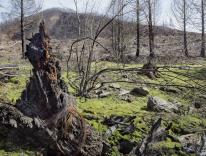
In the fall of 1998, a man who called himself Avalon spent several days camping in the wilderness of northwest Colorado. Each night, after dark, he dragged a couple of forty-pound gasoline canisters up Vail Mountain, setting them on the premises of a ski resort. By that weekend all ten canisters were in place. The resort was closed for the season, but even so Avalon covered the drums with trash bags to conceal them.
This would not be his first act of arson. For roughly a year, Avalon had been working with the Earth Liberation Front (ELF), a band of radical activists based in Oregon. To date, they had burned down two ranger stations of the U.S. Forest Service, two offices of the U.S. Department of Agriculture, and an office of the Bureau of Land Management (BLM). Each action was a protest against some environmental misdeed by the government: the ranger stations, for instance, were known to host timber sales, and the BLM had been corralling wild horses and delivering them to a slaughterhouse.
The ELF had claimed credit for at least a share of these attacks in what it called “communiqués.” The group had drawn national media coverage—while also safeguarding the identities of its members (the “Elves”) and avoiding capture by the police. On a tactical level, its success had been astonishing. But in terms of their larger goals, the Elves had stalled out.
Their aim was nothing less than to launch an eco-revolution across North America. Knowing that the earth was being ravaged by corporate actors on a scale never witnessed in human history—and frustrated by what they saw as the feebleness of mainstream environmental groups like the Sierra Club—the Elves thought their only hope was to inspire an army of like-minded radicals who would join them in attacking the industrial sector. Their long-term goal was to force companies to change their financial calculus, deciding it was no longer profitable to harm the environment. There was a “certain intelligence and logic,” they declared on their website, “to the idea that with one night’s work, a few individuals can accomplish what years of legal battles and millions of dollars most likely did not.”
But so far, no such revolution had taken shape. Avalon believed the ELF needed to go bigger. On his seventh night in the woods, the thirty-three-year-old positioned a gas canister next to each building on the mountaintop. He had chosen the resort because the owners were getting ready to bulldoze 2,200 acres of forest, destroying the habitat of the endangered Canada lynx. He thought torching the place would send a clear message. “He had absorbed the scholarship on press coverage and mass psychology,” the journalist Matthew Wolfe writes in his new book Fires in the Night: The Earth Liberation Front, the FBI, and a Secret History of Eco-Sabotage. Avalon had “concluded that what the ELF needed was a spectacle, an indelible image that no one could ignore, to grab the world’s attention.” He hoped it would be “a catalyst that set off a bold new wave of resistance.”
Around 3 a.m., Avalon dashed to each canister, lighting the matchbooks he had attached to them. Before long, the resort was consumed in a firestorm so massive that it looked like the whole mountain was ablaze.
Once Avalon had escaped to safety, he sank into a deep sleep. When he woke up, eighteen hours later, the arson was already on a newspaper’s front page—and soon it would be in news coverage across the world. It was the most costly act of eco-sabotage in U.S. history.
Wolfe is a masterful storyteller, and it’s worth reading the whole book for the details of what happened next. But it’s hardly a spoiler, nearly thirty years later, to say that the eco-revolution never took hold. Industrial pollution continued apace; the planet kept on getting hotter; and the ELF, which ultimately carried out more than a hundred arsons and bombings, did not have a greater impact than the Sierra Club. On the contrary.
More than any other group, the ELF embodied what came to be known in the late ’90s and early 2000s as “eco-terrorism.” The timing couldn’t be better for a reassessment. The Elves were reviled in their own era, but they’re much easier to sympathize with now. They understood the severity of the environmental crisis long before most other Americans, and their belief that it would never be resolved through normal political channels no longer seems extreme. They broke laws and destroyed property—but drew a hard line against violence toward people—which no longer seem like unforgivable offenses, a point Wolfe presses subtly throughout the book.
Then again, to ask whether their crimes were justified seems beside the point. As California burns, the plains suffer from unprecedented droughts, and islands off the Gulf Coast slowly sink underwater, the more pressing question is why the ELF failed on its own terms. The Elves did succeed in creating a massive spectacle. But why didn’t it change anything?
The ELF originally sprouted in England, in 1992. Wolfe’s story begins four years later, when the organization published a call to arms in the radical Earth First! Journal, urging Americans to organize their own cells. There was no formal structure: no leaders, no paperwork, no dues. All it took to become a member was to declare yourself one and join in eco-sabotage.
For Kevin Tubbs, an assistant editor at Earth First!, the anonymous letter came as a revelation. A native of the Omaha suburbs, Tubbs had been a restless activist since his college years. Earth First!, which was based in Eugene, Oregon, could only pay him poverty wages, so he lived in a trailer furnished by the journal and got his food from dumpsters. Such was his devotion. But by age twenty-seven, he often felt like his work in the movement had been futile. Now, with the ELF, he saw an alternative—a way to take serious action.
In October 1996, Tubbs and two of his close friends, Jacob Ferguson and Josephine Overaker, burned down the Forest Service station in the Willamette National Forest. With this gesture, the ELF’s first American chapter was born. The trio soon brought in more members (including Avalon, a thin, austere man who took his name from a fantasy novel) and began hitting larger targets. “We all wondered, ‘What do you do when you see the whole planet being killed?’” one Eugene activist later recalled to Wolfe. “And the ELF was the answer to the question that everyone was asking.”
Wolfe, a journalist and sociologist at New York University, first excavated the ELF’s history for a 2022 article in The New York Times Magazine. Any narrative journalist who reads the book is bound to be envious, because the story itself is unbelievably rich. If Wolfe hadn’t gotten to it, someone else would have. At the same time, it’s doubtful whether anyone could have done it better. Wolfe’s writing is a marvel. His pacing is perfect, his prose often beautiful. In one episode, he writes that a character “canvassed the chasmal space” with a flashlight beam; in another, he writes that FBI agents found that trying to catch the ELF was “like trying to grab smoke.”
Between 1996 and 2001, the ELF’s Oregon cell carried out at least fifteen acts of property destruction. These included knocking out an electrical tower (disrupting the Los Angeles power grid) and torching a lumber company’s headquarters, a tree farm, a Chevrolet dealership, and a research center at the University of Washington. The Elves eluded capture by taking great pains not to leave evidence. Wolfe has a keen eye for the details of their amateur spycraft. In the lead-up to one ELF mission, for instance, Overaker was arrested for shoplifting flashlights and kerosene. After her release, the others had her take a taxi to the Seattle airport, which was thoroughly covered with security cameras, and stay there for six hours—giving her an unimpeachable alibi while they carried out their work.
As the years went on, however, it became clear that the Elves weren’t getting anywhere. A handful of new cells appeared around the country, but there was no mass uprising. Getting their message out had proven harder than expected. The press loved to report on their exploits, but it never printed their statements, where they explained their mission. And, of course, the Elves couldn’t do interviews, lest they be identified. In a time before social media, this left them without a way to communicate effectively with the public. Avalon decided the only way forward was to keep creating bigger spectacles. But as their frustrations mounted, divisions within the group intensified. In the summer of 2001, the Oregon cell effectively splintered.
But the story doesn’t end there. Nearly half of Wolfe’s book is about what happened after the ELF’s demise—and much of it centers on law enforcement, as investigators piece together clues and then pursue the culprits. Even as I sympathized with the Elves, I also found myself enjoying the thrill of the hunt. The individual detectives come across as smart, decent men. Still, Wolfe’s critique of the broader law-enforcement structure in which they’re operating—and, in particular, of the FBI—is damning.
The concept of “eco-terrorism” originated with a right-wing lobbyist named Ron Arnold, who worked closely with Exxon and other corporations to suppress the environmental movement. Arnold was concerned that acts of eco-sabotage would make the demands of mainstream environmental groups seem reasonable by comparison. Beginning in 1983, he went on the offensive, arguing that companies should refer to attacks on their property as “eco-terrorism.” The FBI soon adopted the term, and lawmakers and the press followed the bureau’s lead. The attacks of September 11 marked a turning point. In the aftermath, Congress flooded the FBI with money, telling it to make counterterrorism its top priority. Corporations saw an opportunity to stamp out eco-sabotage altogether. They lobbied for more aggressive measures against the ELF—and the FBI granted their wish. It announced in 2004 that combating “eco-terrorism” was its highest domestic priority.
By this time, most of the Oregon Elves had already left radical activism behind and were trying to establish normal lives. One became a caregiver for developmentally disabled adults; another worked at a law firm that represented victims of domestic abuse. But even so, the feds weren’t about to leave them alone. Gradually, they compiled enough evidence against one former member to flip him and persuade him to wear a wire. Within a few years, most of the Elves would be in federal prison.
It no longer seems like such a radical position to say that what happened to the Elves was unjust. Yet it wasn’t the FBI’s fault that the group’s work amounted to so little. The question a Eugene activist posed to Wolfe was the right one: “What do you do when you see the whole planet being killed?” And it’s clear, twenty-five years later, that the ELF was not the answer. At least a few of the former Elves eventually recognized this for themselves. Toward the end of Fires in the Night, Wolfe describes one of them coming to terms with his mistakes. He “hadn’t realized how big the world was,” Wolfe writes, and he’d been “naive about the scales of money that industry was operating on, the billions industry had to fight back.”
History could have furnished some valuable lessons—because the Elves were hardly the first radicals who thought they could change the world by creating a spectacle of destruction. The traditional name for what the Elves were doing is “propaganda of the deed,” and one of its early proponents was the Russian anarchist Peter Kropotkin. In an 1880 essay, Kropotkin rhapsodized about the “lonely sentinels who enter the battle long before the masses are sufficiently roused to raise openly the banner of insurrection.” He believed these types could “awaken that spirit of audacity” that would spur revolution.
Taking up this call, between the 1880s and 1910s, anarchists in Europe and North America carried out dozens of political assassinations. Their targets included the U.S. president William McKinley, the French president Sadi Carnot, and the Italian king Umberto I. But in no country did these killings achieve the results the activists had hoped for. As the radical historian Constance Bantman has written, “it resulted in a lasting and highly detrimental equation between anarchism and terrorism, leading to the movement’s criminalisation and depoliticisation, resulting in turn in intense repression.” Kropotkin eventually realized he’d been wrong. A “structure based on centuries of history,” he wrote in 1894, “cannot be destroyed with a few kilos of explosives.” By the end of World War I, most anarchist groups had abandoned propaganda of the deed, and many, including the Industrial Workers of the World, had turned their attention to labor organizing instead.
Half a century later, a group of middle-class American youths, calling themselves the Weathermen, dusted off Kropotkin’s ideas. As college students, most of them had belonged to Students for a Democratic Society (SDS), the premier group of the 1960s youth movement. But as SDS splintered, the Weathermen became more radical, declaring themselves revolutionaries and making it their mission to overthrow the American empire. They started bombing banks and government buildings, hoping this would inspire a broader revolt—specifically, among urban Black communities, which they believed made up an internal colony. They, too, failed in almost every respect. In one famous episode, they accidentally blew up the Greenwich Village townhouse where they were building explosives, killing several of their own members. In other cases, their bombs went off as planned, but none of this helped inspire an uprising. The FBI cracked down hard on the group, but as with the ELF, this was not the main reason the Weathermen failed to achieve their goals.
Repeating a familiar pattern, the leadership realized by the mid-1970s that they needed a different approach. In 1974, the group published a short book titled Prairie Fire, outlining the lessons it had learned and sketching out a new strategy: from there on out, it would operate as a political party and try to organize the masses in a disciplined way. (That didn’t pan out either, but that’s a story for a different essay.)
Now, a quarter century after the ELF’s demise, the same ideas are surfacing once again. The clearest example is Luigi Mangione’s alleged killing of the UnitedHealthcare executive Brian Thompson. It doesn’t seem that Mangione intended to start a revolution; in fact, his writings don’t spell out any overarching theory of social change. But there’s no doubt that he believed violence could serve as a form of propaganda. The purpose of carrying out an assassination, he wrote in one journal entry, was to “spread awareness.” He hoped that by doing it during an investor conference, the “message” would become “self-evident”: that is, it would underscore the way insurance companies make profits by denying claims. He also hoped to strike “a real blow to the company financials.”
It has to be said that on all these counts, Mangione succeeded. In one poll taken shortly after the killing, roughly 70 percent of respondents said denials by health-insurance companies bore significant responsibility for Thompson’s death. By June 2025, UnitedHealthcare’s approval rating had fallen by 14 percent, and its stock price was less than half of what it had been before the killing. But overall, UnitedHealthcare has continued growing; in just one of its recent deals, it has acquired one of the country’s largest home-care and hospice companies, bringing in another nineteen thousand employees across dozens of states. Meanwhile, public policy has only changed for the worse, with insurance premiums rising sharply after Congress slashed health-care subsidies last year. Perhaps one could argue that Mangione helped spur a shift in public consciousness, and that concrete changes will surely follow sometime in the future. But for the moment, it’s hard to point to anything substantial that his actions achieved, apart from inspiring a few copycat crimes.
Why do these ideas keep coming back? Why does almost every generation have to discover their futility for itself? It’s because “propaganda of the deed” presents a fantasy of empowerment in times when left institutions are especially weak, and when political change seems generally hopeless. It’s a tempting response for people of conscience who see the horrors of modern capitalism and feel compelled to do something serious. And their dissatisfaction with the alternatives is understandable. It’s true that voting in national elections is little more than a pressure valve for dissent, and that raising money for the Sierra Club or the American Civil Liberties Union doesn’t lead to transformative change.
For the ELF, shoplifting supplies, dressing in black clothes, and planting their explosives under cover of night—and then seeing their targets burn, and watching the world take notice—certainly generated a frisson. But in Wolfe’s telling, it also gave them a feeling of control, or at least of influence. It allowed them to believe, if only for a moment, that they were catalyzing something larger. In other words, the benefit was psychological. In one case, Wolfe makes this explicit, saying that Jacob Ferguson saw vandalism as “both a necessary tactic of class war and, on a more personal level, a balm—a way of feeling not quite so small and powerless.” The reader gets the sense that this was true for the whole group.
Ultimately, Kropotkin’s anarchists and the Weathermen both learned two lessons that are no less true now than they were fifty or a hundred years ago. One is that full-scale revolution is all but impossible in modern Western countries. Governments are more stable than they used to be, and the masses are rarely inclined to go to the barricades, because they’re happy enough with the status quo. The other lesson is that serious victories for the left, from the New Deal to the Civil Rights Act, have only ever come about through massive organizing campaigns. They don’t happen spontaneously; they require a kind of infrastructure that the ELF never even tried to build.
The story of the ELF’s rise and fall is one of idealistic young people trying desperately to stave off environmental ruin, and effectively being punished by the system they went up against. No doubt some of Wolfe’s characters deserve more praise than others, but the revelations about who each of them were, and what they were made of, are one of the things that make this book such a great read. From one perspective, though, their most fundamental mistake was not learning from the failures of radical groups that came before them. Now that the stakes of the climate crisis are much clearer than they were in the ’90s, there are elements of the Elves’ legacy that are worth taking up again—their moral commitment, their daring. But here’s hoping that anyone who finds inspiration in their example will also avoid their pitfalls.
We welcome your comments about this article. Please send your response to [email protected].