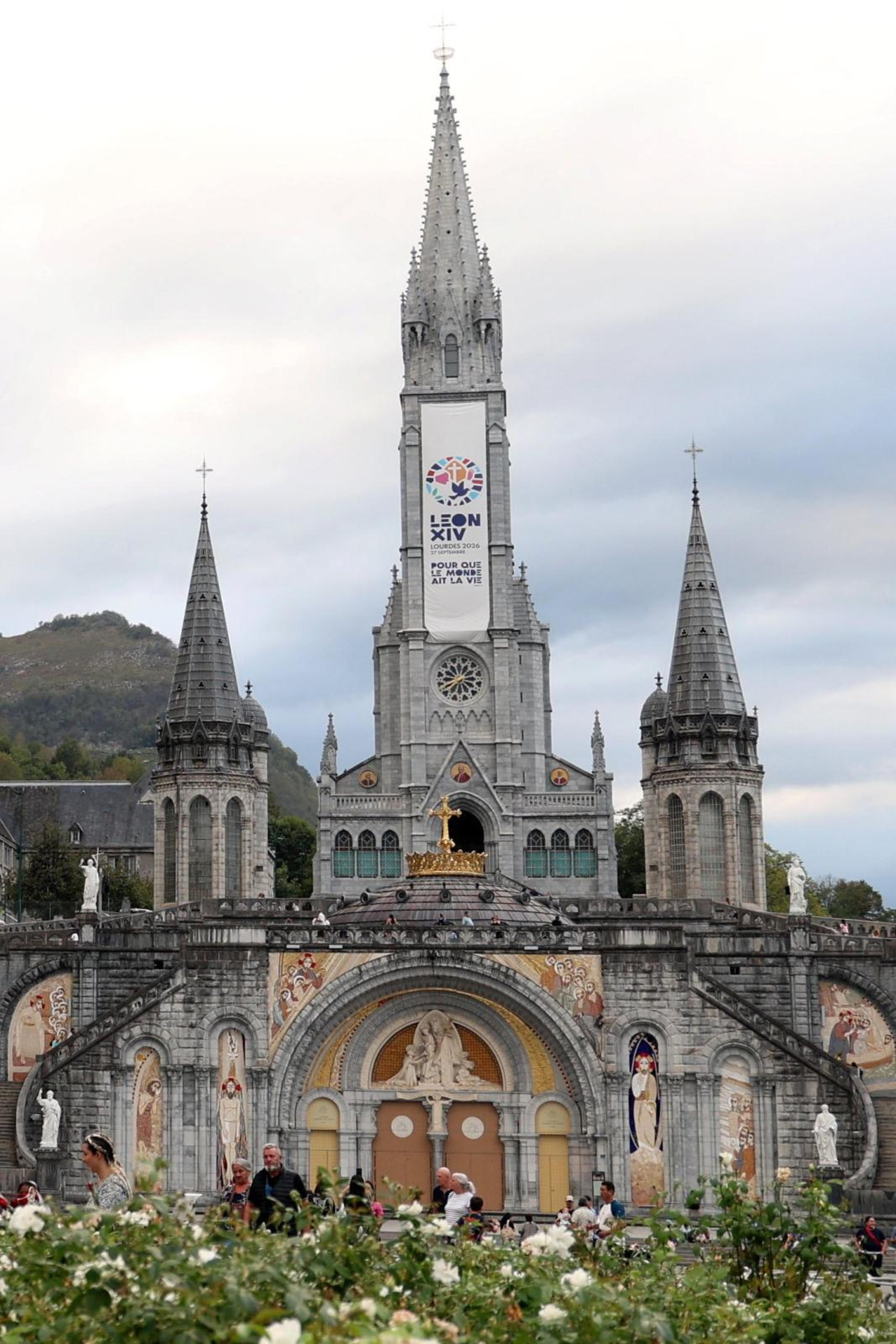
As a professor of the history of Marian devotion, I teach my undergraduate students at Georgetown University how each Marian shrine—Fátima, Lourdes, Guadalupe, and thousands of others—reveals a different component of Marian devotion. At the Sanctuary of Our Lady of Lourdes in southern France, more than five million pilgrims visit the shrine every year, often in search of spiritual or physical healing. On September 26, as part of his apostolic trip to France, Pope Leo XIV will visit Lourdes, the first papal trip there in eighteen years. First known as the place where a young girl reported multiple apparitions of the Virgin Mary, Lourdes is now recognized for its hospitality toward people who are ill, elderly, or disabled. The theme of healing throughout the shrine’s history will make it a thoughtful place for restorative encounters during Pope Leo’s visit.
As in many narratives about Marian apparitions, at Lourdes, a small village in the French Pyrenees, it was a child who saw Mary first. On February 11, 1858, a fourteen-year-old girl named Bernadette Soubirous reported seeing a woman cloaked in white who invited Bernadette to pray the rosary with her near the grotto of Massabielle. In subsequent encounters (a total of eighteen between February and July 1858), the woman, whom Bernadette described as “a lady dressed in white,” asked Bernadette to return to the grotto to pray, as well as to “to drink of the water of the spring.” When Church leaders and French government officials interviewed Bernadette, she offered a physical description that mirrored other renderings of the Virgin Mary:
As I raised my head to look at the grotto, I saw a lady dressed in white, wearing a white dress, a blue girdle and a yellow rose on each foot, the same color as the chain of her rosary; the beads of the rosary were white…. From the niche, or rather the dark alcove behind it, came a dazzling light.
Over the course of these apparitions, other children joined Bernadette to witness “the lady in white,” and the quiet village transformed as a place for pilgrims to visit in hopes of also bearing witness to her. On March 25, 1858, the Solemnity of the Annunciation, the woman revealed, “I am the Immaculate Conception.” Of all the apparitions that Bernadette described, this was one of the most significant in turning Lourdes into a major pilgrimage site.
Just four years earlier in 1854, Pope Pius IX made the Immaculate Conception the third Marian dogma in the apostolic constitution Ineffabilis Deus (“Ineffable God”): “The most Blessed Virgin Mary, in the first instant of her conception, by a singular grace and privilege granted by almighty God, in view of the merits of Jesus Christ, the savior of the human race, was preserved free from all stain of original sin.” Because the woman revealed herself to be the Immaculate Conception on the Solemnity of the Annunciation, the apparition was viewed as confirmation of the Marian dogma.
Following an investigation during which Church officials interviewed Bernadette and others who had witnessed the apparitions, local bishops concluded that the Lourdes apparitions were divine intervention. Pope Pius IX approved the veneration in Lourdes in 1870 and indulgences for pilgrims who visited the shrine, and he issued a canonical coronation to the image of the basilica in 1876. By authenticating the visions that Bernadette Soubirous had at Lourdes, the papacy popularized the site, and an influx of international pilgrims followed.
One of the early instructions that Mary gave Bernadette, who was canonized in 1933, was to drink from the spring waters by the grotto. Because this became a crucial part of the apparition narratives, visitors to the grotto drink from the spring water in hopes of attaining its curative properties. After drinking the water, pilgrims then proceed to the grotto to pray the rosary and to ask for Mary’s intercession. Given that so many have attributed their healing to the water, the Lourdes Commission (1858–62) conducted chemical analysis and found nothing scientifically extraordinary in the water. St. Bernadette attributed its healing properties to faith, noting, “One must have faith and pray; the water will have no virtue without faith.” Nowadays, pilgrims often bring bottles of the spring water back home to their loved ones. More than 7,500 people have reported miraculous cures to the Lourdes Medical Bureau. The Vatican has officially recognized seventy-two different miracles that have happened at Lourdes.
You might like: Vanessa R. Corcoran on Pope Leo's visit to the Sagrada Família
Though Lourdes remains a small village with a population of fifteen thousand people, the Sanctuary of Lourdes has developed extensive infrastructure to welcome pilgrims. For those who are ill, elderly, or disabled, the sanctuary seeks to offer full participation in the rosary recitations, nightly candlelight processions, and visits to the healing baths. There are residences where the sick and pilgrims with disabilities can stay during their trip, staffed by hospitaliers (volunteers) who come from all over the world to aid pilgrims. Programs like Lourdes Hospitality of the Americas help bring those who are severely ill to Lourdes and offer on-site care.
Many Catholic nursing programs even incorporate service trips to Lourdes as part of their education. In assisting local staff, the nursing students learn how spiritual care works in tandem with medical care. According to Christine Mauvais, a nursing student who participated in one such program at Georgetown University, “The language of love and kindness always shines through, even with a communication barrier.”
The grotto at Lourdes is so well-recognized as an important prayer site that the faithful have tried to bring the experience of Lourdes to those unable to travel. Replicas of the grotto exist all over the world; most famous in the United States is the Grotto of Our Lady of Lourdes at the University of Notre Dame in South Bend, Indiana. The Vatican Gardens contain a Lourdes grotto as well.
For the next year, the relics of St. Bernadette Soubirous will tour the United States, beginning on September 18 at the Basilica of the National Shrine of the Immaculate Conception in Washington D.C. A relic tour, a devotional practice dating back to the Middle Ages, allows those unable to travel far distances to encounter the saint in their local community. Held in a 132-pound reliquary, St. Bernadette’s remains will travel to 140 different locations throughout the United States. The relics include rib fragments, pieces of muscles, and some of her hair, all of which were extracted for preservation in 1925. Her incorrupt body remains preserved in France.
Leo will get to see the site for himself, representing all of us in his petitions; his chosen motto for the apostolic journey to Lourdes is “a pilgrim among pilgrims.” According to Bishop Jean-Marc Micas of Lourdes, Pope Leo will “touch the rock, drink the water, light a candle, kneel down and pray in silence, as pilgrims do in Lourdes.” Shrine officials have confirmed that 150,000 people will be in attendance for Pope Leo’s visit. The pope will also meet with a small group of clerical-abuse survivors. Lourdes, synonymous with healing, offers an ideal setting for such a critical encounter to occur.
France is often referred to as the eldest daughter of the Catholic Church. Clovis, King of the Franks, converted to Christianity in 496, the earliest of the Germanic kingdoms to embrace Christianity. Pope Leo’s trip to France, which will begin in Paris with a Mass at the Cathedral of Notre Dame, highlights both the older Catholic religious sites that have shaped devotional culture in France for many centuries as well as the newer sacred spaces of the modern era such as Lourdes. When Pope Leo participates in the rituals of a Lourdes pilgrimage as millions of others have done, he enacts on our behalf the broader search for healing: for individuals seeking comfort, for communities in distress, and for the faithful worldwide.
We welcome your comments about this article. Please send your response to [email protected].