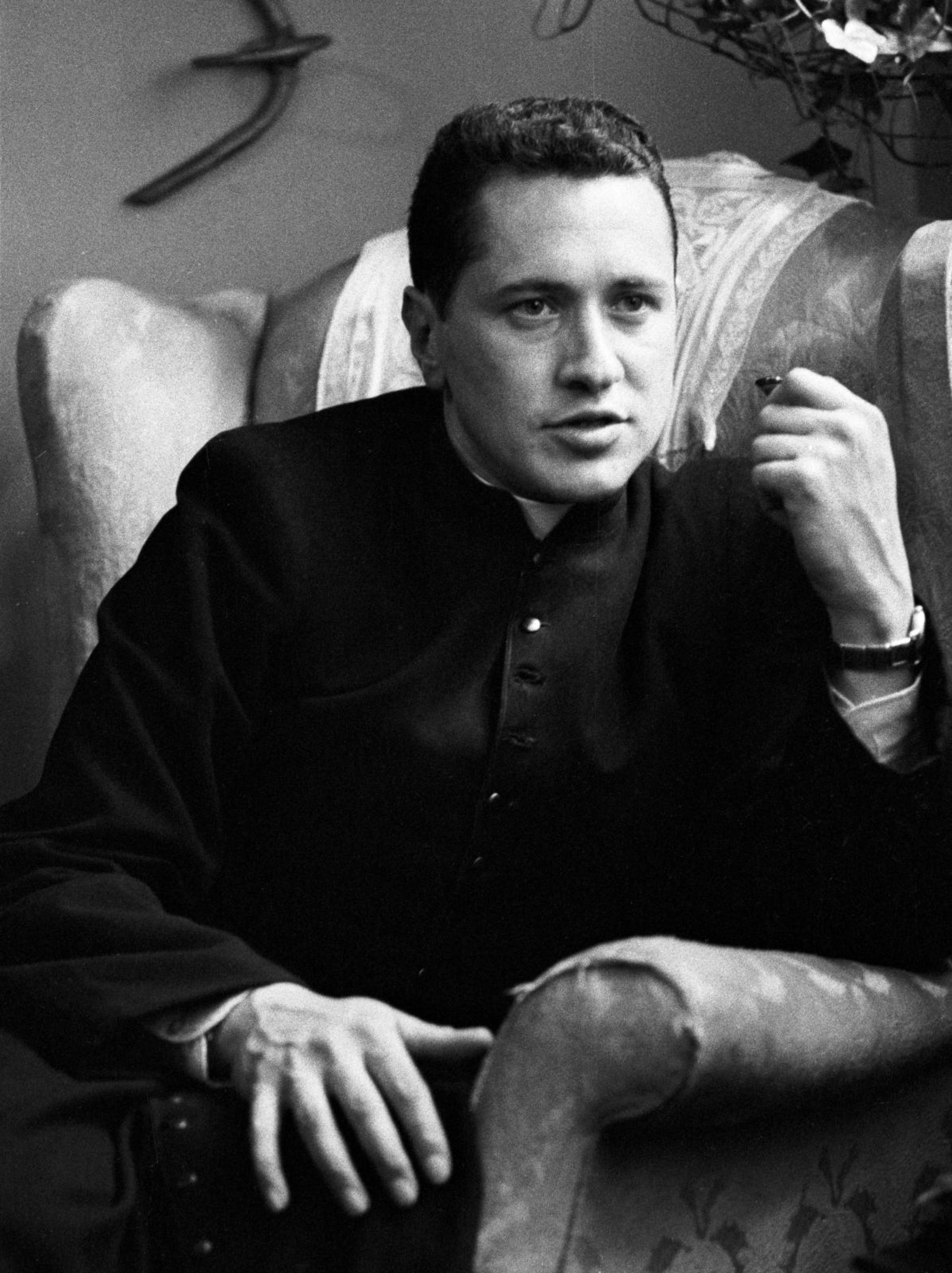
This past February, the Colombian government announced that it had discovered the remains of Fr. Camilo Torres. It could finally lay to rest one of Colombia’s most famous Catholic figures. Beloved in his time not only by his correligionists and fellow academics but also by peasant leaders, Marxist intellectuals, and Communist politicians, Fr. Torres died in 1966 when the guerilla fighters he had joined only a few months before attacked a Colombian military unit. Since then, the location of his grave had been unknown, even as Fr. Torres had become a legend both in the Catholic Church and on the Latin American left.
To get a sense of what kind of legend, imagine Fulton Sheen, Martin Luther King, and Jimmy Hoffa all rolled into one. Camilo Torres was born into bourgeois comfort in Bogotá in 1929, and at a young age surprised his atheist father by announcing that he had a vocation to the priesthood. He also had a vocation as a teacher: he worked as a lecturer in sociology, having received a doctorate from the Pontifical University in Louvain, Belgium. He served as a parish priest, a university chaplain, an advocate for farm workers, a writer, and a politician. In 1965, after years of activism that had resulted in several death threats, Fr. Torres decided that “the Revolution is not only permissible but obligatory for those Christians who see in it the only effective and comprehensive way to put universal love into practice.” So he joined a nascent group of left-wing guerillas called the National Liberation Army (Ejército de Liberación Nacional, or ELN).
I learned about Camilo Torres in high school from an offhand comment my father made about a famous priest-turned-guerrilla. At the time, I could not imagine a more unlikely transformation. For me, the priesthood was about meekness and piety, not guns and revolution. When I pressed my father for details, he told me about a famous song from the 1960s about the guerilla-priest, one his high-school friend would get in trouble for playing in the schoolyard. I searched for this song on Napster, found it, and immediately fell down a rabbit hole of Latin American protest music. I discovered Victor Jara, Mercedes Sosa, Pablo Milanés, Silvio Rodriguez, and other names associated with the midcentury Nueva Canción movement. When I told my father about this, he frowned. “Now we will be added to some list,” he said.
You might like: Saint Oscar Romero on the political dimension of Christian love
“We discuss whether the soul is mortal or immortal,” Fr. Torres famously wrote, “and neglect another point about which we are all in agreement, and that is that extreme poverty is fatal.” But it’s hard not to think about the soul and immortality when contemplating Fr. Torres’s life. A central tenet of the Christian faith is that only God can save us from death. Certainly, the songs written about Camilo Torres are all preoccupied with life after death. The most famous of these, Daniel Viglietti’s 1968 “Cruz de luz” (“Cross of Light”) likens Fr. Torres to Christ:
Donde cayó Camilo
Nació una cruz
Pero no de madera
Sino de luz…
[Where Camilo fell
a cross was born
Not one made of wood
but of light…]
Cuentan que tras la bala
Se oyó una voz
Era dios que gritaba:
¡Revolución!
[They say that behind the bullet
one could hear a voice.
It was God who cried out:
“Revolution!”]
Viglietti ends the song in a prophetic register: Fr. Torres has somehow overcome death.
Y cuando ellos bajaron
Por su fusil
Descubrieron que el pueblo
Tiene cien mil
Cien mil Camilos prontos
A combatir
Camilo Torres muere
Para vivir
[When they went down
for their rifles
They discovered that the people
are a hundred thousand—
A hundred thousand Camilos
ready to fight.
Camilo Torres dies
to live.]
Fr. Torres died a martyr, and his death will inspire others to continue the fight. Another song, written by the Cuban singer Carlos Puebla, expresses the same idea more explicitly:
Camilo Torres será
arma nueva y nuevo fino,
igual que nuestro camino,
porque jamás morirá.
[Camelo Torres will be
A new weapon and new spirit,
Just like our struggle
Because he will never die.]
Resurrection, real or metaphorical, was an abiding theme for many songwriters of the Nueva Canción movement, as well as their precursors, like the great Argentine guitarist Atahualpa Yupanqui. Yupanqui was a better poet than Puebla, and his ode to Che Guevara, “Nada más” (“Nothing More”) is even more explicit about defying death:
Alguna gente se muere
para volver a nacer.
El que tenga alguna duda
Que se lo pregunte al Che.
[Some people die
To be born again
And whoever doubts this
Should ask Che.]
Finally, there’s “Por quien merece amor” (“For He Who Deserves Love”) by Silvio Rodriguez, perhaps the most popular of all these songwriters, who sings:
Mi amor abre pecho a la muerte
Y despeña su suerte
Por un tiempo mejor
[My love stands up to death
And risks its luck
For a better time]
Torres is famous for his idea of “efficacious love.” “The main principle of Catholicism is the love of one’s neighbor,” he wrote. But that love “must look to become effective.” It therefore has a political dimension. It isn’t enough to clothe the naked and feed the hungry; “it is necessary to take the power from the privileged minority and give it to the poor majority.” Gustavo Gutiérrez’s landmark book A Theology of Liberation wasn’t published until 1971, five years after Torres’s death. Yet the arc of Torres’s life anticipated its argument.
Many have treated Camilo Torres as a heretic who subordinated his Christian faith to Marxism or as a madman seduced by the romance of revolution who confused love with violence. But one should remember that he worked and wrote at a time when a tiny minority owned most of the farms in Colombia, a nation—like many others in Latin America—which claimed to be Catholic yet allowed millions to live in misery. Even when the Vatican was most critical of liberation theology, it has never denied the deep injustices that gave rise to the movement or disputed the imperative to fight deep inequality.
Public statements from famous priests and bishops reflect the ambiguity of Fr. Torres’s legacy. “Camilo Torres is judged for the last months of his life,” said the Jesuit Javier Giraldo, who for years had lobbied the Colombian government to search for the priest’s remains. “But…those are three months that contrast with his many years of work as a priest, university professor, and in dialogue with various social and political groups.” (Fr. Giraldo died this summer.) For his part, Cardinal Luis José Rueda Aparicio, bishop of Bogotá and Primate of Colombia, wrote in a public letter: “The Church prays for the eternal rest of Father Camilo and beseeches the Lord for the definitive end to all forms of violence in Colombia.” The second part of that prayer is as urgent as ever. The ELN is still part of a conflict that dates back to Fr. Torres’s time, one responsible for thousands of deaths. Today, the guerilla organization he joined routinely engages in kidnapping and, more recently, drug trafficking to advance its cause. This past year, the ELN was responsible for more than sixty civilian deaths.
Álvaro Valencia Tovar, the general in charge of the military unit that Fr. Torres attacked, had been Torres’s childhood friend. After the battle, Valencia Tovar recognized his dead friend, and at the request of Torres’s brother, buried him anonymously in the jungle. Nineteen years later, he quietly had Fr. Torres’s remains moved to an unmarked ossuary in the municipal cemetery of the northern town of Bucaramanga. That’s where investigators discovered them in 2024. Today, they have been returned to Fr. Torres’s family, and there are plans to bury them in the National University where he once taught.
Camilo Torres was surely right that a fully “efficacious love” must struggle for social justice. But before that struggle is complete, before the lion lies down with the lamb at the end of time, this love will also bury the dead and reconcile men whom fate had driven to mutual enmity. And after all the struggles of history are over, we hope it will save us from death itself.
We welcome your comments about this article. Please send your response to [email protected].