To the extent that Providence has a national profile, it is as a shabbily quaint small town with an Ivy League university and an outsized mafia presence. In the six years I’ve lived there, though, it’s been ruled not by mafiosos but, like most other gentrifying post-industrial cities, by an uneasy alliance of townie landlords, mansion owners, luxury-apartment developers, and cops.
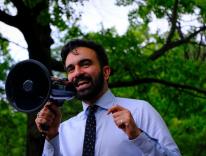
Next year, it will likely be run, in no small part, by democratic socialists. On Thursday night, David Morales, a Gen-Z state representative, toppled centrist incumbent Brett Smiley to earn the Democratic nomination for mayor of Providence. Like New York City mayor Zohran Mamdani, Morales is a young (just twenty-seven), smiling, suit-clad socialist. He is now the overwhelming favorite to triumph in the general election in November. This was the first time an incumbent Providence mayor has lost a primary—the culmination of what Boston Globe columnist Dan McGowan called “arguably the best campaign in the history of the city.”
Morales’s campaign was remarkable because his opponent was far from weak—unlike the diminished Andrew Cuomo, who ran against Mamdani, or Haley Stevens, who lost her senate primary to Abdul El-Sayed in Michigan. Though he thrills no one, the owlish, bespectacled Smiley is a capable politician with no major scandals to his name—a genuine feat in Providence. After last year’s mass shooting at Brown University, he was the state’s only public official capable of conveying both sorrow and calm. He is immensely well-resourced, the political champion of the wealthy homeowners on Providence’s East Side. His husband is the top real-estate agent in the city, and the couple recently finished construction on their third residence, a stylish multimillion-dollar home on a four-acre estate. And Smiley put his cash to work during the campaign, flooding mailboxes and airwaves with jarringly negative ads characterizing Morales as a threat to law and order. (Morales’s campaign alleged that one ad darkened his skin tone.)
You might like: Dominic Preziosi on Zohran Mamdani's run for mayor of New York
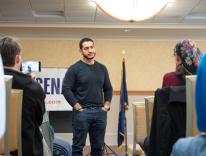
For his part, Morales is an amiable fixture of the Rhode Island left, a permanent presence at protests and on picket lines who also happens to moonlight as a professional wrestler. When I saw him speak at the offices of Brown’s graduate-student union, I was struck by his encyclopedic recall of the numbers attached to local union chapters. I imagine he could recount the history of every labor action in the state over the past decade. Although endearing and sharp (he was awarded a master’s degree at Brown at the age of twenty), he can also come off as rehearsed, chanting lines about affordability in a steady singsong cadence. He certainly falls short of Mamdani’s preternatural political talent.
So how did he win? In short, frustration. Rhode Islanders are, by and large, sick of living in a state where nothing seems to work. Local residents are threatened by a dilapidated built environment: the state’s roads are the worst in the nation, the Providence mall’s parking garage seems to be teetering like a Jenga tower, and part of the city’s Washington Bridge was closed on the verge of collapse. Thursday’s election was a sweep of the Rhode Island political establishment. Dan McKee, the bumbling and corrupt incumbent governor, was routed by his primary challenger, former CVS executive Helena Buonano-Foulkes. Pawtucket’s longtime mayor was primaried, too. Morales rode a wave that was, on one level, less left-wing than antisystem.
Then, there is the word of the hour: affordability. Morales connected nearly all his public statements to his commitment to bring down rents. Providence has become staggeringly more expensive over the past five years. A wave of remote workers migrating south from Boston raised demand; corporate landlords began buying up rental properties; and the aging housing supply has remained mostly stagnant. This year, Smiley vetoed a bill to cap rent increases after it was passed by Morales’s allies on the Providence city council. This was, ultimately, the only contrast Morales needed.
Morales perfectly bridges divides within the coalition that brought him to power. He was not born in the state, and he has a degree from Brown. In this, he shares a great deal with his campaign’s core supporters: under-forty renters with tattoos and fancy degrees who earn less than our parents did at our age. But unlike most of us, Morales grew up living in public housing and was raised by a working-class single mother. The three voting locations where Morales performed the best—winning more than 75 percent of the vote—are apartment complexes providing low-cost housing for elderly and disabled people.
The primary election was an astonishing triumph for the organized Providence left, especially the housing activist group Reclaim RI, which backed Morales. The Providence chapter of the Democratic Socialists of America refrains from endorsing any candidate who runs as a Democrat and is, thus, a marginal factor in Providence electoral politics.
Reclaim RI won an arguably even more impressive victory in a smaller-scale race. Councilmember John Goncalves currently represents the city’s first ward, which contains the Fox Point neighborhood, directly abutting Brown’s campus. An industrious young politician, Goncalves is notoriously eager to please but found himself in a no-win position, representing the pivotal vote capable of overriding the mayor’s rent stabilization veto. Side with the mayor and he’d face a primary from the left. But draw the ire of the landlords and developers and his political career might be dead. He did what he believed to be the smart thing: he sided against rent stabilization.
The left made good on its promise: Reclaim RI endorsed a late primary challenger who, in just a few months, managed to narrowly best Goncalves’s much better-funded operation. When it becomes savvier for ambitious politicians to side with renters and socialist activists than landlords and the sitting mayor, a seismic political shift is underway.
The closest thing the Morales campaign had to a scandal came in a leaked video from a fundraising event in New York City. The clip shows socialist podcaster and Reclaim RI cofounder Dan Denvir declaring, with Morales applauding in the background, that “David is going to turn Providence into a laboratory for municipal socialism.” Denvir’s words were admittedly ill-advised: few, after all, want to live in any sort of laboratory. The Smiley campaign eagerly commissioned ads featuring the clip.
But behind the statement lies something important about the new “sewer socialism” championed by people like Morales, Mamdani, and Washington D.C. mayoral nominee Janeese Lewis George. Namely, that it is animated by an experimental spirit, a desire to examine stubborn problems with new eyes, to summon the creative intelligence of working people. If political experimentation frightens us, we can blame our atrophied democratic imaginations. Experimental problem-solving among equals just is the practice of democracy. If that’s what becoming a laboratory for municipal socialism means, this Providence resident is not opposed.
We welcome your comments about this article. Please send your response to [email protected].